
High Court judges are to hear a legal challenge to controversial green belt development proposals for Wigan land

A legal challenge at the Royal Courts of Justice this coming week could have major repercussions for development plans in Wigan.
The claim is being brought by campaign group Save Greater Manchester’s Green Belt (SGMGB) against the Housing Secretary and local authorities across Greater Manchester, and opposes the adoption of the Places for Everyone (PfE) plan.
SGMGB says the net loss of green belt land as a result of PfE is not necessary to grow the region, and that Greater Manchester Combined Authority (GMCA) should prioritise brownfield land for development instead.
PfE puts forward long-term plans for the development of housing and industry in nine of the GM boroughs (Stockport opted out five years ago).
It sets out what land within the nine boroughs should be earmarked for development until 2039, and identifies which areas will be developed for housing, offices, industry and warehouses.
The draft PfE was submitted for examination in February 2022 and included the release of almost 2,500 hectares of what SGMGB describe as environmentally and ecologically rich land from the green belt, and initially proposed the addition of 675 hectares of land to the green belt at 49 sites to partially offset this loss.
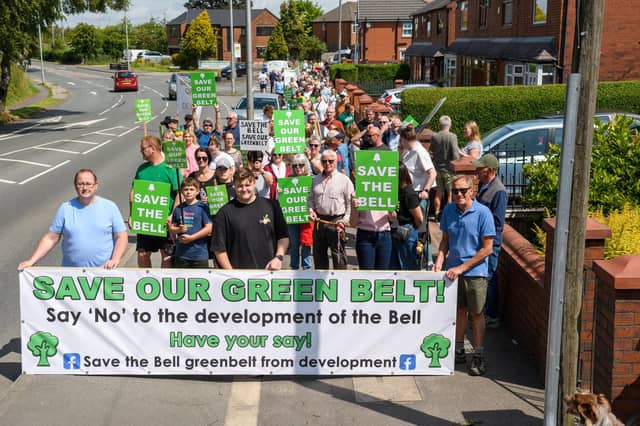
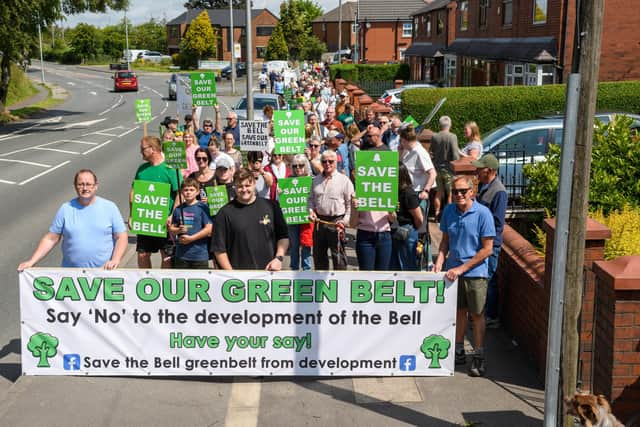
Among are proposals to develop Pemberton’s last remaining green belt, known locally as The Bell and which is mainly farmland where Blackpool’s famous donkeys spend the winter.
There have been protests, as there have been in Astley where residents fear up to 300 houses could be built between the site of Lancashire Mining Museum to Boothstown.
In March 2023 during the examination period for PfE, the land for green belt additions was reduced to 17 sites. The reduction was justified by what the GMCA suggested was a new legal test, which it said changed the criteria for what sites can be used as green belt space.
GMCA’s announcement was made without warning at a hearing session in March 2023 which had initially been scheduled to consider all 49 proposed green belt additions.
As a result, campaigners, including SGMGB, had no chance to seek legal advice to oppose the change.
In March 2024, PfE was approved by GM councils, including Wigan.
GMGB launched its legal claim against the decision, which will be heard at the High Court on October 8 and 9.
SGMGB says PfE should adopt a “brownfield first” policy when allocating land for development. The group argues that green belt land should be preserved to conserve irreplaceable habitats, ensure future food security, reduce the effects of climate change, and support physical and mental health and recreation.
The claim is being heard on the grounds that it was an error in law for GMCA to take a revised approach and adopt the stricter legal test it used to determine which sites were eligible for being added to the green belt.
It is being brought against the Secretary of State for Housing, Communities and Local Government and GMCA, as well as the nine GM councils including Wigan.
Zoe Sherlock, chair of SGMGB, said: “During the examination the GMCA introduced significant policy changes that materially weakened the plan.
"Most of those amendments were introduced with very little notice to participants, but the huge change to green belt additions was actually presented on the morning of the hearing, effectively as a fait accompli. Unlike councils and developers, communities did not have legal representation at the examination, so this tactic was extremely prejudicial.
“Over 27,000 residents objected to the release of green belt, and these additions were a key element of the compensatory measures.
"We remain baffled as to why this change was proposed at such a late stage.
“Communities deserve better from the planning system.”