
Kitt Green Roll of Honour
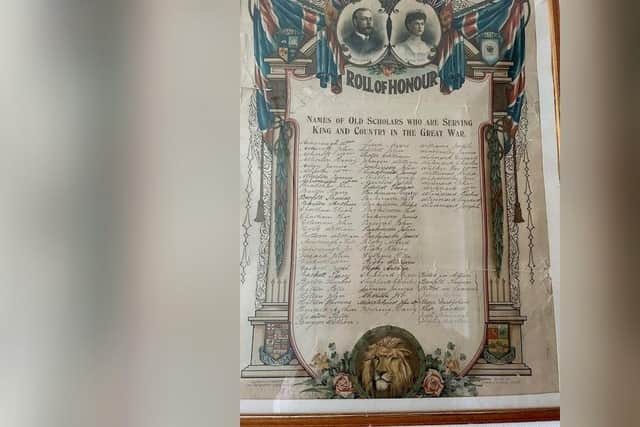
St Francis’s church in Kitt Green has a Roll of Honour which lists the men who served in the First World War.
There are 71 handwritten names on the list. The names of those killed are listed at the bottom right-hand side, a later addition. The names include men with the surnames of Ainscough, Barton, Gaskell, Parkinson and Winnard. These must have been men from the same family. And neighbours with their families living near to each other.
MOSES DERBYSHIRE OR DARBYSHIRE
Moses was born in 1891 in Orrell, baptised at St. John’s in Pemberton in November of that year.

1901 census shows that he lived at 47 City Road, with his mum Mary a widow and four siblings.
There are Parkinsons, Winnards and Winstanleys on the same page of the census.
By 1911 the family had moved along City Road to number 70. He and his two brothers were coal hewers.
Moses joined 13th Battalion of the Manchester Regiment and died in Greece, age 25. He is buried in Greece at the Salonika Anglo-French Military Cemetery, just outside Thessaloniki. There are now 1,648 Commonwealth servicemen of the First World War buried or commemorated in this cemetery.
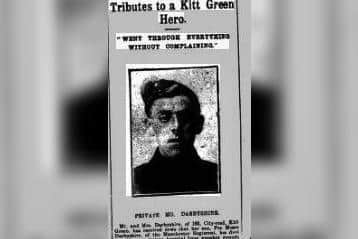
Mo’s death is recorded in the Wigan observer “Tributes to a Kitt Green hero” on 21 October 1916. On the same page there are 18 other men listed as killed from other areas in Wigan - Haigh, Poolstock, Hindley, Standish and Platt Bridge.
There are some details available from his records:
· As part of the joining up process he had a physical examination on 28 September 1914 in Wigan, He was five feet and six inches tall and weighed 128 lbs, less than ten stone.
· He was absent from parade whilst stationed at Seaford in November 1914 and then the following year went missing in Aldershot for eight days. He paid a forfeit for both these absences.
· He died of wounds in General Salonika hospital, he had been awarded two medals British Expeditionary Force and Mediterranean Expeditionary Force.
His name is on Wigan Cenotaph outside the Parish Church.
Wigan Observer article
“Tributes to a Kitt Green hero”, 21 November 2016
Mr and Mrs Darbyshire of 168 City Road, Kitt Green has received news that her son Private Moses Darbyshire, of the Manchester Regiment has died in a clearing station hospital from gunshot wounds in the head received in action. Private Darbyshire was 25 years old. The Captain of the deceased’s company writing to Mrs Darbyshire says “ A company took part in a raid on the enemy’s trenches. Your son was in one of the bombing parties bombing the enemy back along their trenches when he was hit in the head by a piece of enemy bomb. We brought him back with us straight to the doctor who did what he could for him. He was sent down to hospital but died a week later. It will be some satisfaction for you to know that he was hit when in the post of honour, and when doing his duty to his country. I have been in charge of this company for over 18 months, and well know the hardship and difficulty that every man has had to endure. Private Darbyshire was one of those who went through everything without complaining but keeping cheerful. He did his duty always and could be relied on and was the sort of man that could least be spared. Please accept my sincerest sympathy and those of the officers of the company in your loss. A comrade also writes describing how Private Darbyshire met his death and adding – “I must say our comrade was well like with us all in our platoon and we feel we must express our sympathy to you. Tom Parkins, Mo’s bosom pal, is taking it rather hard here and all credit must be given to Tom for the way he acted towards his pal. When he heard of Mo being wounded he went back to the enemy and carried Mo back to our lines along with our Captain both risking their lives, but I am glad to say neither Tom nor our Captain got touched, but they got our comrade Mo, back again. Mrs Darbyshire, the boys here wish you to accept their deepest sympathy, and they also wish you to know that Mo died a hero.”
THOMAS BENFOLD
Thomas was baptised at St John’s Pemberton on 21 April 1892, born in Orrell.
In 1901 he lived with his family in Spring Road, Orrell.
In 1911 census he lived with his mum, Hannah and his dad, Thomas and four sisters and five brothers, at 326 Woodhouse Lane.
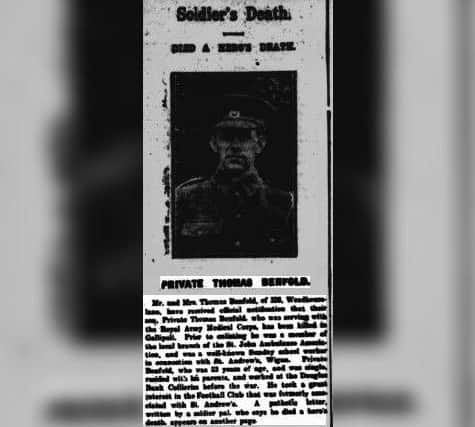
We have an account of Thomas’s death, told with great affection by his friend, Richard Banks, published in the Wigan Observer on 13 Nov 1915.
DIED A HERO'S DEATH
“GAVE HIS LIFE TO SAVE A COMRADE”
Private Richard Banks, whose home is at 78 Clayton Street Wallgate, is serving in the Field Ambulance of the Mediterranean Expeditionary Force writing to Mr. and Mrs. Benfold, of Woodhouse lane Wigan in regard to the death of their son Private Thomas Benfold whose portrait appears on another page.
“Your son Thomas, died in the execution of his duty, and he died hero's death. He gave his life to save a comrade. He left camp 7.30am on Wednesday morning, quite cheerful and happy and was going up to our Advance dressing Station called “Pink Farm.” The stretcher bearers convey the wounded from the regimental aid post to the dressing station. They had just got into the reserve trenches, and put their overcoats and haversacks down, when Tom and a chap named Tom Yeomans were called to take a man down to the station, he having been wounded in the head. They had the stretcher on a litter, Tom at the front end and his mate at the back. There were some troops going across the open in massed formation, and the Turks seeing this, started sending the deadly shrapnel. His mate tells me they were going at pretty good pace to get the wounded man to the dressing stations to be attended by the surgeon.
Then all at once Tom stopped, turned round and looked at him, and got quietly down and stretched himself out. His mate tells me he did not think it was anything serious and the only words he muttered were “Oh, dear”. As he got down he crossed his hands on breast and fell asleep. It was over in less than a couple of minutes. His mate ran for the surgeon who had just finished fastening a tourniquet on a man’s leg which had been badly damaged by the shrapnel and said to him “Surgeon Calthrop, Benfold’s got done”. He picked up his haversack and ran off, Tom’s mate following him, only to find that Tom had passed away. This was about 8.45am last Wednesday morning. He was taken to the dressing station and sent down to the hospital at the bottom of camp. A fellow came and told me that my pal had got injured, so I ran down to the hospital to meet the motor ambulance wagon, and after waiting about ten minutes, the wagon came, but when I saw him it brought tears to my eyes, to think that I had lost my best pal.
He was laid to rest at five o'clock in the R. N. D. Cemetery, Orchard Gully. The Sergeant Major sent for me and told me that I had charge of the funeral arrangements, with being his particular pal, and he sent a digging party to dig his grave. He was borne to the cemetery by the lads of Wigan and Hindley, St. John Ambulance Brigade. The members from Wigan Brigade, were J Lowe, W. Woosey, and myself, from Hindley Brigade H. Anderton, H. Crosswell, T Brooks and W Ashcroft. He was buried by the Army Chaplain, the Rev. C. W. G Moore, Church of England Chaplain 2nd brigade RND. There were about forty of his comrades stood round the grave beside the Staff-Sargeant of his section and the Officer Commanding the First Field Ambulance to witness the memorial service. You can rest assured that he had a good military funeral, and he is now at rest on Gallipoli peninsula, the battlefield where thousands of heroes have fallen.
I was with the Sergeant Major when his pockets were searched and all his personal effects were collected to be sent home. They were packed in a tin box to be sent to the AGC Alexandria to be examined and forward on to you.
The contents were as follows: Wristlet watch (glass was cracked), fountain pen and pencil, a prayer book and wallet, pay book with 6s drawn from July 1st, his identification disc, two knives, his pipe (he had sent from Liverpool by his brother), cigarette case and tender lighter, four RND shoulder badges and cap badges, a pair of scissors, and his purse which contained half a crown in English money, French money, 1 franc and 30 centimes. I packed the envelopes with the letters he had received from home. The two packets contained letters he had received from his young lady, Miss E Danson. In the other envelope were the letters he had got from home, so I expect you will not be offended at me putting the letters together. He used to read me all his letters and I was the same with him. We could not have been more affectionate if we had been brothers and I know he will rest when he knows that I, his true and best pal, have had dealings with them.
We were old chums in the Brigade, as W. Taylor will tell you and we stuck to each other like glue from the very morning we left Wigan to go to Manchester to be sworn in and we have never been parted until now. I know quite well what your feelings at home will be, from what I have gone through since I lost him. I might tell you, if you have a service at St Andrew’s there were two of his favourite hymns we used to sing nearly every evening at Blandford??? and coming across on the ship they were “The day Thou Gavest Lord is Ended and “Nearer My God to Thee”. He used to delight in singing them.
I must now close as I don’t want to cause you any more pain after what you have endured, I hope you will bear up as best you can: all his ???? sent you their deepest sympathy. My deepest sympathy goes to his loving father, mother, sisters and brothers: also his friends and??? Tom’s true and best pal, Dick
Orchard Gully is now part of Skew Bridge cemetery in Turkey and there are now 607 First World War servicemen buried or commemorated.
Thomas’s name is listed on Wigan Cenotaph and St. Andrew’s war memorial. In the newspaper article it describes him as a Sunday School worker at St. Andrew’s.
It looks like his friend, Richard Banks, survived the war and married Ellen Critchley at the Parish Church in 1922. He died in Standish in 1978.
No luck tracing poor Miss E Danson.