
Maxwell Ayres: beloved Wigan borough painter capturing history with heart and humour
Maxwell Ayres, a local painter from Leigh, has long captured the emotional and historical layers of the town's heritage through his paintings. Since the age of eight, Ayres has been painting, and over the past few decades, he has depicted old collieries such as The Parsonage and Bickershaw. His use of colour, expressive brushstrokes, and skillful play of light and shadow have brought Leigh's long-gone but not forgotten places back to life.
Ayres' father, who served in the Armed Forces during the Second World War, documented the changing industrial landscape of Europe through his drawings. Stored at Spinners Mill, a drawing by his late father captures the Kaiser Wilhelm Memorial Church in Berlin. It is clear from his father's work, characterised by its heavy and light strokes and intricate shading, how Ayres developed his love for painting. Like his father, Ayres preserves the cultural landscape, ensuring future generations can appreciate Leigh's heritage. In a 1992 interview with the Manchester Evening News, Ayres stated he wanted to paint these buildings as “a matter of principle” and “wanted the children growing up now to know their heritage.”
With buildings such as The Parsonage Colliery and Bickershaw Colliery no longer standing, Ayres' paintings act as a medium through which we reconnect and reengage with our heritage. Ayres puts it best when he stated in the same interview, “I could paint stately homes, palaces, and churches but what use are they? They have no working parts." As described by Ayres, these buildings were " beautiful " and “wonderful” because they hold many residents' memories of family, friends, and those who worked there. Mining was not just a means of earning a living for many in the borough; it was a way of life.
However, Ayres's journey as an artist has not been without challenges as a catastrophic fire that broke out at his flat late last year destroyed many pieces of his work. Before the fire, Ayres planned to exhibit his work at Spinners Mill. Since the fire in December, the people of Leigh have rallied together and created a GoFundMe campaign to raise £1,000 to help restore Max’s work. This act alone highlights Leigh’s strong community spirit, supporting people in times of need, a tradition that spans many decades. To date, the campaign has raised an amazing £750, which is a testament to the community’s dedication to preserving its cultural heritage and supporting local artists like Ayres.
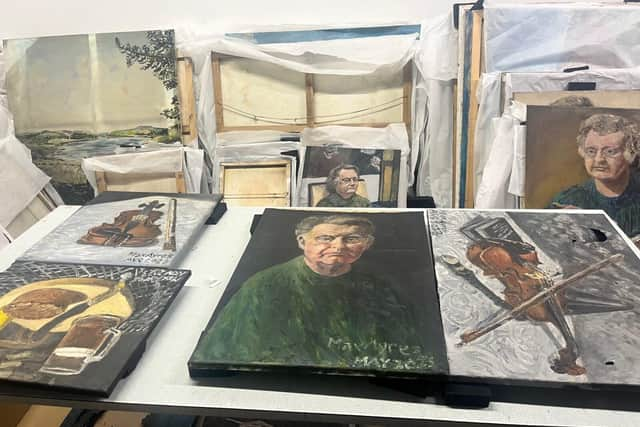

Recently, I had the honour of viewing some of Ayres' work currently stored at Leigh Spinners Mill. Angie Ryan, the project coordinator at Horrocks Gallery, kindly showed me Ayres' pieces and discussed his life and work. From spending time with Angie, I was able to see firsthand the impact the fire had on some of his pieces. Some survived with minimal damage, while others were affected by smoke during the fire. Though some pieces may be impossible to restore, they remain part of Ayres' story. Angie discussed using these works in Ayres’s upcoming exhibition to highlight his journey as an artist and the challenges he has faced. Ayres estimates that there were around 1,000 pieces of his work stored in his flat. Angie detailed how she and a few other volunteers made several trips to salvage as many paintings as possible. This story further exemplifies how the community of Leigh rallies around those in times of need.
Speaking to those who know Ayres, it becomes clear that he is a beloved character within the Leigh community. Reading interviews with Max, I can see this quality firsthand. His account of getting thrown out of Leigh Library during a Beethoven recital made me laugh. A paint-covered and sodden anorak is not the most fitting outfit for such an event. In Ayres’s words, as he said to the chap, “It's a great honour to be thrown out of Leigh Library than to be thrown into it.” Little did they know that his attire was fitting, as hours before he was painting Leigh Spinners Mill in pouring rain.
Angie informed me about Ayres’s approach to his work, noting that he never worked from photographs and always used a physical subject. For instance, when painting landscapes, Max painted them by viewing his surroundings firsthand. He often got lifts from friends if they went for a walk or fishing and sat and painted as and when he could. When painting a local Manchester scene, the weather changed, and clouds covered the sky. This small detail Ayres observed in his painting highlights how painting from a physical subject means you can never predict what will happen.
Max Ayres is an artist who has dedicated his life to capturing the moments of Leigh’s culture and heritage. From the famous faces of local collieries to well-known landscapes, Ayres creates through his paintings a chance to recapture and immortalise the history of Leigh for future generations. I can’t think of a better way to leave you than with this gem of an answer from Max when he was asked how long it takes to finish a painting. He replied, “As long as it takes to spend time in a pub, but with something to show at the end of it.”