
Campaigners against overheated hospitals descend on Wigan Infirmary
Campaigners from all over the country descended on Wigan Infirmary to urge action to be taken over its allegedly overheated premises.
Three years ago it was revealed that Wigan’s hospitals had more risk assessments made on the back of complaints they were “too hot” – over 1,000 – than anywhere else in the country.
And last year’s figures also topped 500.
Wrightington Wigan and Leigh NHS Foundation Trust (WWL) has previously described itself as an “outlier” as far as these figures are concerned because they record their figures differently from other trusts.
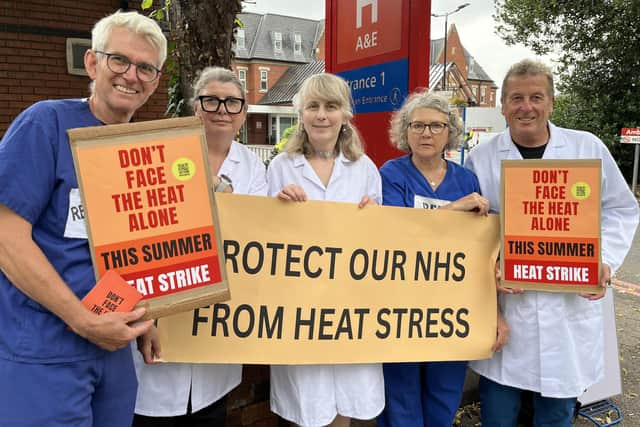

But at present the Wigan hospitals still stick out on league tables when it comes to supposed overheating, which can badly affect already ill patients and the vulnerable, and also make work tougher for already hard-pressed staff.
And so group of doctors, scientists and members of the public gathered outside Wigan Infirmary today (July 17) to raise concerns about the risks of extreme heat on health, healthcare infrastructure and health workers.
They handed out leaflets and spoke to staff, visitors and patients about the ways in which extreme heat worsens numerous health conditions, impacts health infrastructure and places an additional burden on staff forced to deal with increased work demands due to the peak in admissions, in often poorly ventilated departments.
Heatwaves are becoming more intense and more severe as a result of global heating. As a result, over recent years, the frequency of overheating episodes has almost doubled (from 2,980 recorded incidents in 2016-7 to 5,554 in 2021-22).
By 2050, it is estimated that over a third of health and social care facilities will be in areas of high or acute levels of heat “disadvantage."
Already many NHS premises record temperatures above the recommended maximum ward limit of 28°C.
This year's heatwaves alone is expected to cause an extra 600 deaths, with the young, the elderly, or those with long-term illnesses most vulnerable1.
Furthermore, heat and air pollution worsen each other’s impacts on health and together affect every part of the body, from pre-conception, through pregnancy complications, childhood developmental and breathing problems, chronic kidney disease, heart attacks and strokes, to dementia and mental illness.
Meanwhile the recently published NHS 10 year plan mentions NHS resilience to extreme weather caused by climate change, reaffirming a commitment to upgrading NHS premises and to NHS net zero.
It is however unclear whether there has been joined up thinking regarding the carbon and water footprint of the proposals to put Artificial Intelligence at the heart of NHS care, or the need for low carbon cooling as well as heating.
The outreach action at Wigan is part of the national heatstrike.uk campaign which includes a coalition of trade unions and climate groups who are calling for greater awareness of, and action on, the impacts of heatwaves. Its demands include:
-
A national maximum working temperature (a measure already in place in many countries)
-
The introduction of a Heat Furlough scheme to protect workers, and
Government commitment to a credible climate plan to limit future temperature rises (the government’s climate road map has twice been found inadequate in the high court).
Retired GP Dr David McKelvey said: “Global and indeed UK temperatures are rising and the number and severity of heatwaves is increasing.
"I’m worried about how this will put more workers and patients at risk.
"The government says that it is taking this seriously, but its climate change mitigation plans have been found, for the second time, to be inadequate in the High Court.
"I hope this action today will help to get more resources to help hospitals, especially Wigan Infirmary, cope with heatwaves”.
A WWL spokesperson said: “Patients are our number one priority, and we do everything we can to ensure they are comfortable during their stay with us, making sure that conditions within our hospitals are conducive to providing the best possible care.
“While the data on overheating in our hospitals appears to be excessive, incidents are recorded by area, so two wards in one hospital on the same day that exceed 26 ºc counts as two incidents.
“Given the large multi-site nature of our estate, this will inevitably increase the number of incidents recorded when outside temperatures exceed seasonal norms.
“As with all hospitals, the Trust is working hard to address the impact of adverse weather conditions, supporting patients and staff in our hospitals and remaining focussed on ensuring that all new build and refurbishment takes account of climate change adaptation as part of our Green Plan.”