
Wigan's hospitals play their part in reducing the number of patients waiting for operations and tests
Wigan’s hospital staff are celebrating after helping to cut the number of patients waiting for vital tests and operations.
New national figures show the NHS delivered its highest ever number of elective surgeries, tests and appointments during a single financial year.


The national waiting list for elective procedures fell by more than 312,000 people – the biggest annual drop in 16 years – with 65.3 per cent of patients now seen within 18 weeks.
And Wrightington, Wigan and Leigh Teaching Hospitals NHS Foundation Trust (WWL) played its part, with the number of patients on its list falling from 50,122 at the end of March 2025 to 44,346 in March 2026.
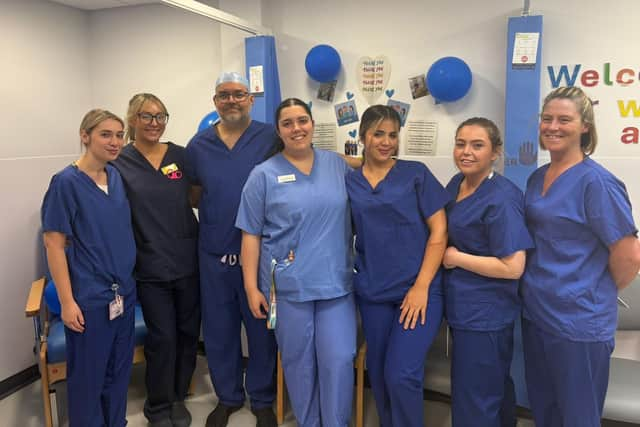
Its accredited surgical hubs – Wrightington Hospital and Leigh Infirmary – have a key role in this progress, treating around 400 patients every week from Wigan, Greater Manchester and across the North West.
Prof Sanjay Arya, the trust’s chief medical officer, said: “I am incredibly proud of our teams, whose commitment and expertise continue to drive improvements across the region, and I would like to thank them all for their hard work and dedication.
"By scrutinising our patient pathways, embracing innovation and expanding our surgical hubs, we are delivering faster treatment, shorter recovery times and a better overall experience for the communities we serve.”
At Wrightington Hospital – which is a national centre of excellence for orthopaedic surgery – the length of stay for hip and knee replacement patients has halved, meaning people return home sooner and recover more comfortably.
The hospital has expanded its use of robotic assisted surgery, adding a second robot to support precision joint replacement.
A new one-stop hernia pathway has been introduced at Leigh Infirmary which is already helping more than 120 patients, with a further 100 scheduled for surgery.
Work is also under way to expand a streamlined cataract pathway, allowing opticians to book patients directly into one-stop clinics to speed up treatment.
The trust recently ran a hub optimisation week, which tested new processes and surgical techniques to increase capacity by a further 15 per cent.
It allowed teams to test new processes to help maximise the number of patients being seen, as well as showcase new surgical approaches and techniques.
The NHS figures show that of the 44,346 patients on the waiting list at the end of March, 886 people had been waiting for more than 52 weeks, which was down from 1,055 the month before.
Separate NHS England figures show the number of people waiting for one of 14 standard tests – such as an MRI scan, non-obstetric ultrasound or gastroscopy – fell from 11,821 at the end of February to 9,682 at the end of March.
A total of 1,799 patients had been waiting for more than six weeks (18.6 per cent) and 493 for more than 13 weeks.
The most in-demand test was non-obstetric ultrasound, with 2,845 people on the waiting list – down from 3,937 a month before – followed by MRI scan (2,396) and echocardiogram (1,462).
There were 11,490 waiting list tests carried out during March, up from 10,168 the month before, as well as 1,353 planned tests and 3,837 unplanned tests.