
Wigan's incredible history, when it was bigger and more important than Manchester
There’s much more to Wigan than its notoriety as the birthplace of George Formby, George Orwell’s book The Road to Wigan Pier or Wigan Warriors.
Members of Wigan Local History and Heritage Society reveal its proud past, as the museum with 35,000 artefacts undergoes a revamp.
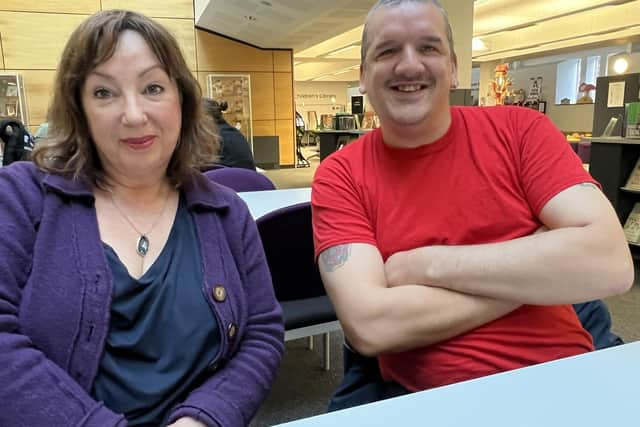
Marie-Clare Kenyon – known as Clare – and Andy Lomax are passionate about Wigan’s rich heritage.
Its history spans way before the Roman occupation circa 2,000 years ago, onward as an Anglo-Saxon settlement and its evolution into a medieval borough, with a royal charter giving permission to hold a market granted in 1246.

During the industrial revolutions in the 18th and 19th centuries, it became a major centre for coal mining and cotton spinning, a fact alluded to by George Orwell in his work, which he wrote while staying in Wigan during the 1930s.
But according to Clare, not everyone in Wigan was happy with the image he painted in his book. She claims he had an “agenda, which was about finding poverty and seeing how the ‘poor people’ were living.”
She continued: “He came to Wigan with a story in mind and was determined to find it, and he did. He stayed somewhere in Darlington Street and in Beech Hill.
“In the first place he stayed, he couldn’t find what he wanted. He then moved and he found somewhere that was worse. A lot of Wiganers do resent The Road to Wigan Pier because they feel it didn’t reflect the town as it should have done.”
Andy said: “It focused on the negative social deprivation side. The flip-side is – like my grandma used to say, God rest her soul – 1940s Wigan was booming. You never knew there was a war on.
“My grandma described the nightlife – the ballrooms, the dancing, the cinema, the theatre. Orwell didn’t talk about any of that. It was purely all about the down and outs eating tripe and all that.”
In reality, Wigan has a lot more to brag about, said Andy. “I think one thing that slips through the net quite a lot is that it’s in the top 10 – maybe the top five – oldest boroughs in the country.
“It’s older than Liverpool and apparently there’s some ancient argument with Preston that goes way back along the lines of, ‘we’re older than you’ and vice-versa.
“The old town motto was ‘ancient and loyal’. So they carried that through and it came through the English Civil War when it remained loyal to the Crown.”
According to Andy and his research, in the run-up to the first Industrial Revolution in the 18th century, there were lots of people and wealth coming into Wigan, but that prosperity never found its way to the working classes.
He said: “Before that, Wigan would’ve been hardly populated – quite sparse. It was full of nailmakers, goldsmiths, silversmiths, clockmakers and people who made clothing. It was rich. There was a lot of money knocking about the place. It’s believed people were paying more in business rates than in Manchester and Liverpool.
“For everything we know about Wigan, I do think it’s punched above its weight for an awful long time – possibly for hundreds and hundreds of years.
“Of course, its location couldn’t be more ideal when it comes to the economy and manufacturing base, with Liverpool 20 miles in one direction and Manchester the other way.
“That’s why we have our railway system the way we do – with two adjacent train stations across the road from each other going in different directions.”
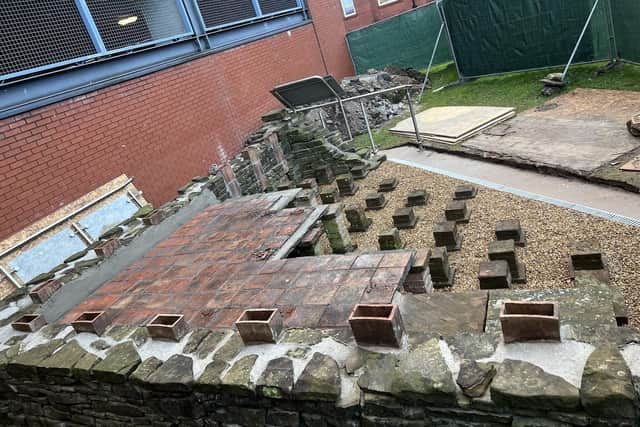
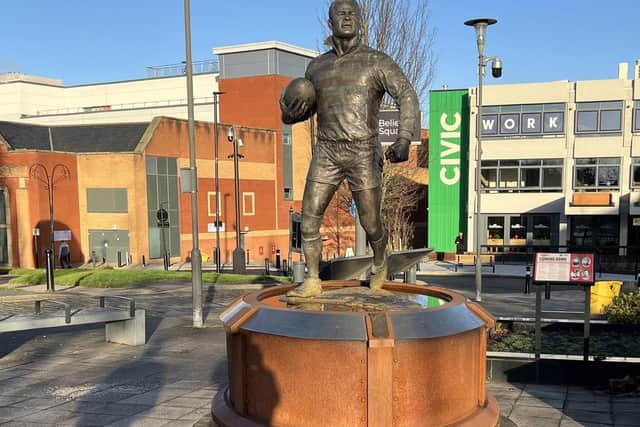
The pair were talking in Wigan’s Life Centre, a stone’s throw from the highest point of the town and where the remains of a Roman fort were discovered.
Close by, there are visible remains of a Roman bath house, which underlines its importance to that once-great empire.
It is believed it was named Coccium by the Romans and formed a key part of the journey between Manchester and Ribchester in Lancashire.
Andy described the point – at Believe Square – as a “perfect spot if you were a Roman general”.
Clare said: “Before they rerouted the river to build the central railway station, Wigan was surrounded on three sides by the Douglas. So it was like a natural moat and thus it offered protection. So there was only one side they would have to keep watch over and defend.
“And the river was a good source of food because it had lots of salmon. That was right up until the Industrial Revolution, before it became polluted. They’re trying to clean it up now, but there’s trouble with sewage pollution.”
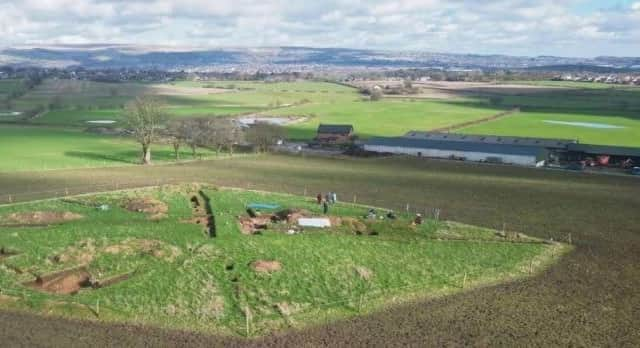
Going back in time even further, there is the “Ringditch” in Aspull – a Bronze Age cremation site, currently being excavated by archaeologists.
Andy said: “To put it into context, that predates the Egyptians. Even their burials aren’t that old. The beauty of archaeology is that not all of it’s been found.
“So when you come across something like that – which is nationally significant – they’re [Wigan Archaeological Society] trying to keep hold of it, because it’s on private land.”
One thing that irks Andy, however, is the townsfolk’s reputation as “pie-eaters”.
He said: “The reason for it was the coal miners’ strike in 1926 during the renowned General Strike. The miners from the next town in Leigh kept saying, ‘don’t go back [to work] too early, we’ll get a good deal’.
“But the Wigan miners went back too early. So they were made to eat humble pie. And, literally, that’s where it comes from.”
Such is the interest in Wigan’s history, the society has almost sold out of its book, which is a deep dive into the history of King Street, the town centre home to the offices of the local industrialists of yesteryear and where there are 10 grade II-listed buildings.
King Street: Wigan’s King of Streets is available from the society’s website.