
Concerns have been raised about staffing and climate change as it is revealed firefighters went to more blazes
Firefighters attended significantly more fires in Greater Manchester last year, new figures show.
Meanwhile the number of fires attended by services across England rose by over a quarter, driven by sharp increases in outdoor primary fires and secondary fires.
The Fire Brigades Union warned services across the country "are under more pressure than ever", especially due to increasing numbers of wildfires caused by climate change, and called on the Government for "serious investment".
Statistics released by the Ministry of Housing, Communities and Local Government show Greater Manchester Fire and Rescue Service attended 10,972 fires in the year to June, up 35 per cent from 8,102 the previous year.
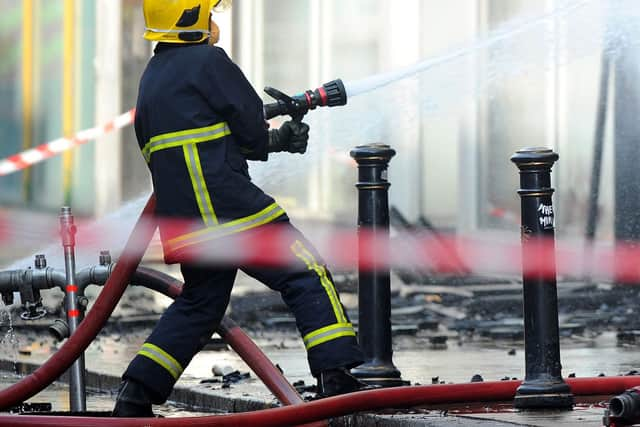

Services across England attended 165,697 fires in the 12 months to June, marking a 28 per cent jump.
The year-on-year increase was mainly driven by a 52 per cent rise in outdoor primary fires and 48 per cent rise in secondary fires.
Primary fires are those in buildings, vehicles or outdoors, involving a fatality or casualty, or where five or more crews were called. Secondary fires usually refer to small outdoor fires, not involving people or property.
Overall fire and rescue services attended 6,157 outdoor primary fires and 98,687 secondary fires last year.
The data also shows the number of fire-related fatalities nationally has fluctuated between 200 and 350 per year since 2015, with an exception in 2017 when the Grenfell Tower tragedy took place.
There were 279 fire-related fatalities across England in the year to June, up 21 per cent on 231 the previous year, which included 20 fatalities in Greater Manchester.
Steve Wright, FBU general secretary, said: "Fire and rescue services are under more pressure than ever, responding to more incidents with fewer resources.
"Austerity has left fire services across the UK stretched dangerously thin, without the resilience to cope with increasing risks."
He added firefighters are being deployed to increasing numbers of wildfires, driven by rising temperatures caused by climate change.
"Instead of providing the investment urgently needed, the Government inflicted deeper cuts this year," he said.
"Cuts cost lives. Fewer firefighters mean that it takes longer for crews to arrive at emergencies, when every second counts.
"The Labour Government must provide serious investment to rebuild the fire and rescue service and equip firefighters to face these increasing risks."
Fire and rescue services across England attended 628,764 incidents in the 12 months to June, a six per cent increase on the previous year and 25 per cent increase compared with 10 years ago.
This included 35,581 in Greater Manchester – up 14 per cent from 31,324 the year before.
Dr Thomas Smith, associate professor in environmental geography at the London School of Economics and Political Science, said: "The climate of the UK has changed in recent decades.
"The length of dry spells and the length, frequency, and severity of heatwaves have all increased in both spring and summer.
"This, in turn, increases the probability of extreme fire weather conditions that favour both the sustained ignition and the spread of fires."
He added the abandonment of "more traditional methods" to keep vegetation loads down, such as grazing and muirburn, the deliberate burning of moorland vegetation, are resulting in "an increasing abundance of flammable vegetation in many places".
The MHCLG was contacted for comment.