
Graham Workman: the puffin - our little brother of the north
Going through some photos and cataloguing them into files on my iMac Another this weekend and I found a species that I have just too many shots of – literally hundreds! But Puffins are camera magnets - and to be honest I have no idea what makes them so visually appealing.
We have much more colourful birds, more impressive sized birds and birds that interact with man on a regular basis - our garden Robin and Blackbird have got very approachable over the years and put up with us wandering into their territories.Their stripy bright coloured beak is so distinctive and is probably the main feature that makes them so appealing. But their time of coloured beak is only during the breeding season. For around 8 months of the year they are far out in the Atlantic Ocean only returning to land when breeding time arrives. Puffins moult their feathers during their time at sea and shed all the colourful sheath that covers their beaks as well as the black markings around their eyes. The Atlantic Puffin is a bird of the colder waters as its scientific name suggests, Fratercula arctica means “little brother of the north” in Latin.
Now if you ever come across a puffin during the winter you would think, mmmm that looks familiar – but I’m not sure what it is as they are nothing like their colourful breeding attire, in fact there would be a good chance that you would not recognise it as a puffin, thanks to its drab grey beak.
Young puffins are similarly coloured when they first face the big wide world. Their faces, beaks and feet are all grey!
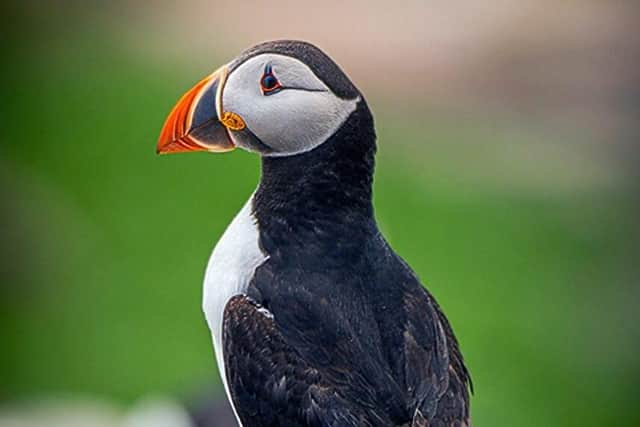

It must be over 40 years ago that we had a famous Puffin that crash landed during a storm that caused chaos across the the UK. A knock at the cottage door and I was presented with a Puffin that had ended up thinking in the dark that our we road was water - it wasn't! Anyway we fed the little chap its of pilchards and strips of Mackerel which he gulped down. Anyway to cut a long story short the BBC came and did a quick segment for the news and we called him Pilchard the Puffin and after a few days he was released over at Formby and off he flew heading out to sea no worse for his brief adventure in Haigh!
FactoidsAround 90% of the Atlantic puffin population are found in Europe; with 80% in Iceland and Norway, and the remaining 10% breed around Britain and Ireland. There are over 1 million puffins in the UK.
Puffins dive into the water to catch their prey, usually within 30 metres of the water's surface but they can dive down to 60 metres.
They have serrated bills so they can hold their fish in place. One puffin was recorded holding 83 small sandeels in its bill at once!
Puffins often live for 20 years.