
Graham Workman: Woodies and Doves
Menu Favourites!
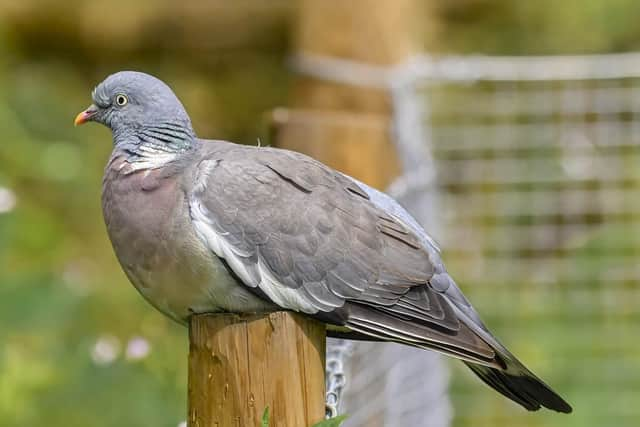
Looking out of my office window the other morning I saw an unusual sight! A woodpigeon and a collared dove sharing the same branch in a Sycamore tree – odd I thought and it was! Twenty minutes later they were still there so I thought this need further investigation! They were about a metre apart and just ignoring each other. Another 30 mins and checking again they were still there – I gave up and left the to it.
Both birds are not known for their skills in nest building. The nests they build, if you could call them nests are usually incredibly flimsy – just a few twigs placed over each other to lay the white eggs on. As you can imagine the nests don’t do well in strong winds and it’s very common to find the eggs at the bottom of trees after a gale.
Poor woodpigeons don't have an easy life. Favourite menu item for Sparrowhawks and if they stray into towns and cities the formidable Peregrine Falcon steps in.

Young pigeons and Doves are called Squabs, and they are fed 'milk' by the parent birds!! This substance rich in fats and not that dissimilar to mammalian milk. Special cells in the crop (a pouch situated in the throat) produce the milk and provide food for the newly-hatched young.
The collective noun for a group of pigeons or Doves is a flock.
The Collared Dove is quite a bit smaller than the Woodpigeon and more delicate in shape and body. Collared Doves are a creamy grey-buff in colour. When seen at close range a black half collar on the back of the neck is clearly visible (in adults). The typical call is a clear and persistent three note 'coo COO cuk'.
To any birders under forty it’s difficult to believe that Collared’s once were some thing of a rarity and had twitchers racing around the country when one was found!!! The spread of the collared dove through Europe is very well documented. Originally found in western Asia, in 1932 they had spread only as far west as Hungary. Then quite a fast explosion in the population had them zooming across Europe halting only briefly at the Channel, they crossed into England in 1955, and have now become a very common and widespread resident. In 1977 less than fifteen years after colonizing, there were already possibly 25 000 breeding pairs in the British Isles. There are now reckoned to be 200,000 pairs in Britain and another 30,000 in Ireland.
Collared Doves have very dusty feathers. This 'dust' can produce fantastically detailed prints on a window, if they should fly into one. Years ago we woke to a splendid feather pattern on the lounge window where one had collided into it!!! We thought it was probably trying to escape a sparrowhawk along our hedge when it saw what it thought was a dark opening into deeper hedge – big mistake it was our lounge window!!!!