
Nature Notes with Graham Workman: A bird with a sixth sense!
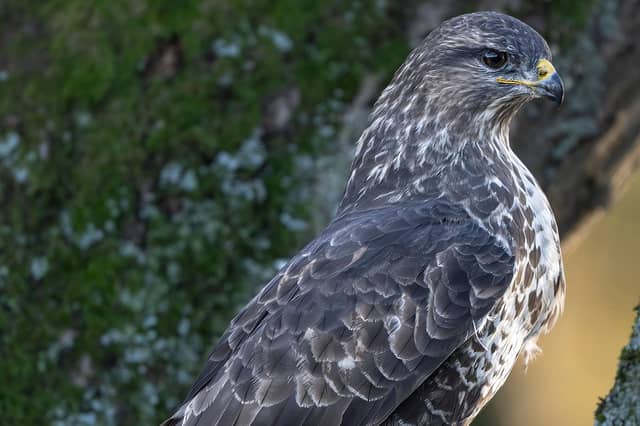

Now one of our most common birds of prey, the buzzard is a bird with a sixth sense regarding photographers!
One will be sitting on a fence post looking absolutely fantastic with the sun in the right place, lighting perfect and not a breath of wind.
So you drive slowly up, thinking this will be a superb composition, stop the car, fine, turn the engine off and WHOOSH of the buzzard goes.
Even more frustrating is the malicious buzzard.
This one will wait patiently, your camera has the right lens on, you’ve sorted aperture, ISO and shutter speed and touch the switch to lower your window……..and whoosh, off it goes, more than likely chuckling to itself as it flies away.
The buzzard was once hunted virtually to extinction from lowland Britain, but now it is back with a vengeance, soaring aloft in greater numbers than it has done for over 200 years and fast becoming Britain's most common bird of prey.
Once persecuted by gamekeepers as vermin, the tide has changed for the buzzard and its population is booming.
A study, published in the journal British Birds, estimated the population at between 44,000 and 61,000 pairs in 2009.
That was a sixfold increase on the bird's population since 1972 and meant that the buzzard had overtaken the kestrel and the sparrowhawk to become Britain's most common bird of prey.
Now the buzzard population has again increased and there may now be over 75,000 breeding pairs across the country.
From just a few pairs in lowland areas in 1910, buzzards began a slow recovery when many gamekeepers were called up during the Second World War. Keepers had hunted the bird, believing it to be a threat to pheasants and partridges.
In Britain, the buzzard does not migrate and rarely wanders more than 30 miles.
It hunts mainly from a perch camouflaged against a tree and sits for hours waiting for food to pass – a good example of this technique is in the photos in my post.
He sat silent and unmoving watching what I was up to before deciding "naw, nothing of interest here," and moved off.
Buzzards soar in the air to prey on rabbits, rats, squirrels and weasels. When such prey is scant, the buzzard eats carrion, but it only needs a frugal 140g (5oz) of food daily to survive.
Buzzards are easy birds to identify – unless you’re in Scotland where they are called the "tourists' eagle" and I bet you can guess why.
They have dark brown upperparts with much paler underparts and brown and reddish streaks on their bellies.
There is a pale band across the breast. The primaries are almost black with a darker trailing edge. The short, broad tail is grey-brown with narrow bars and a dark terminal band. The head it brown overall with some white on the throat.
Their eyes are dark, the bill is black and the legs and feet are also yellow.
This one was much more happy than many buzzards when you have a camera ready for the shot.
He stayed still for a couple of minutes before off again on his travels – but I did manage a few shots before he left.