
Nature Notes with Graham Workman: Ducks in disguise
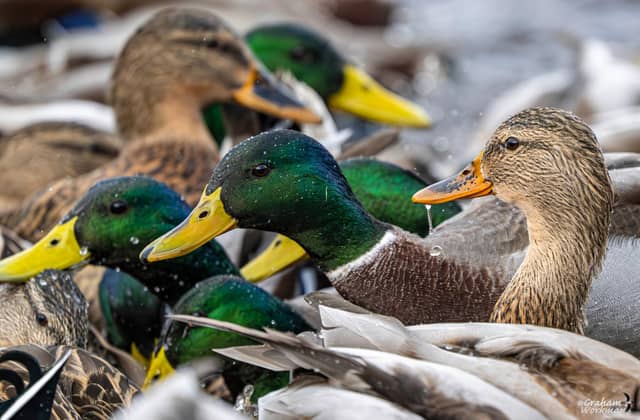

Well, it won’t be long now before our ducks don their breeding "disguises."
Most ducks shed their body feathers twice each year and nearly all drakes lose their bright plumage immediately after mating, and for a few weeks look just like the females.
This rather drab appearance is called the eclipse plumage.
The return to breeding colouration varies in species and individuals of each species.
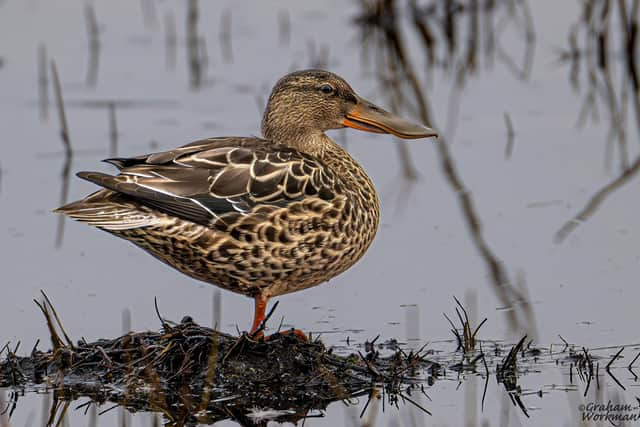
Some teal and shovelers may retain the eclipse plumage until well into the winter.
On the other hand, wing feathers are shed only once a year and the small "patch" of wing colours (speculums) are always the same.
The best known of all our ducks is probably the mallard.
The drake (male) has an iridescent bottle-green head and neck, separated from its chestnut breast by a narrow white neck ring.
The underbody and wing coverts are predominantly grey with the characteristic white-edged, blue-purple speculum being a striking feature.
Tail coverts are black with the four central feathers upturned giving it a curly perm look.
A greenish-yellow bill and orange legs complete the familiar picture.
Mrs Mallard is a much less colourful bird of mottled brown and paler underparts.
Her bill is orange and the legs are somewhat weaker in colour than those of the drake but the iridescent speculum is common to both sexes.
Juveniles and the male in eclipse plumage are similar in general appearance to the female.
The mallard has a strong, fairly fast, level flight with rapid wing beats. It is one of our largest ducks.
The drake is normally silent in flight while the female emits the familiar low "quack".
A very distinctive duck, the shoveler displays the ultimate in "beaks" - a very broad spatulate bill which gives an immediate clue to the species's feeding habits.
The drake in his breeding finery has a bottle-green head, white neck and chest, dark chestnut flanks and underparts and dark brownish-grey wing coverts.
The colouring of the Mrs Shoveler is similar to our other dabbling ducks but the giveaway is of course its shovel bill.
Both ducks and drakes have a green speculum and display a blue-grey patch on the forewing.
The shoveler has a rapid flight with a rattling sound from the wings.
It is medium size and the light blue shoulders are prominent in flight.
The large bill can often appear much longer than its head and shoveler are pretty quiet in flight.
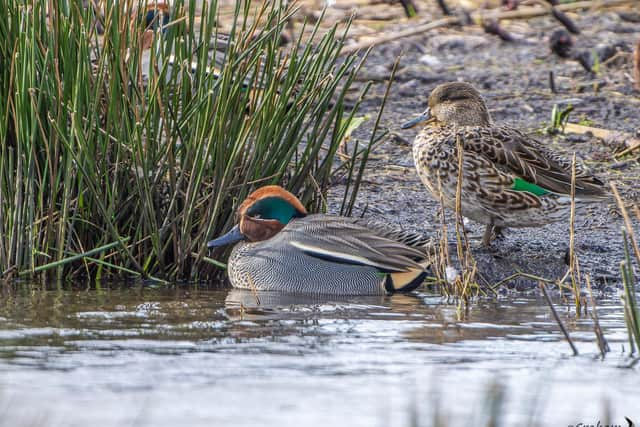
The teal is one of our smallest ducks but the male in full breeding plumage makes up for his small size by his striking good looks.
His glossy chestnut head shows an iridescent curving green stripe, with narrow cream edging, running from the eye to the back of the neck. The high-definition body plumage is well known to fly anglers who make their own flies.
The highly visible green speculum is present in both duck and drake and in eclipse their plumage is very similar with their mottled browns and paler belly.
The legs and bill of both sexes are dark grey, tinged with brown.
The teal has a very fast flight with small flocks regularly flying in unison.