
Graham Workman: King of the Ice
There's no disputing who is King of the Arctic
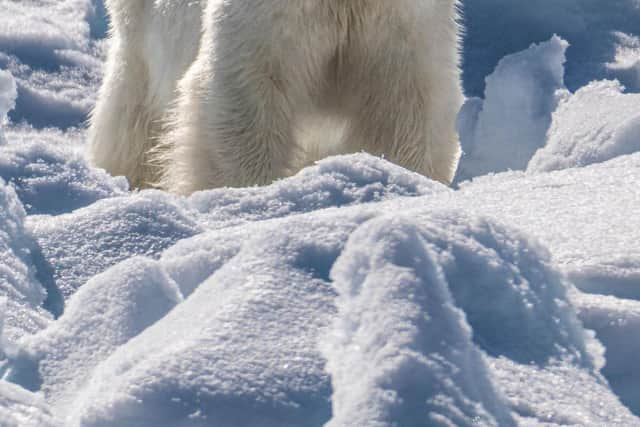
This guy was huge and brought some real drama to the Arctic expedition for several hours. It began with a small ‘shape’ far out on the ice which one of the expedition staff recognised immediately as a bear. The Polar Bear was moving at a pretty fast pace and it wasn’t long before the reason became very apparent. Every 100m or so he would stop and with head and neck raised carefully scent the air in all directions – at one point he was also using his tongue to ‘scent’ the air. Polar bears have an incredible sense of smell and can smell their prey up to 32km away and can likely smell seals underneath compacted snow or ice from 1km away.
This one had picked up the scent of a female bear around 2km away – unfortunately she had two cubs with her of about 18months old. The male would immediately kill the cubs to make the female ready for mating. Polar bear cubs are pretty large when they finally emerge from their den in which they were born during the winter. At birth though they are tiny – around 700g Polar bear milk has a high fat content which allows the cubs to increase their weight 15-fold from birth to when they emerge from the den in spring. The mother soon picked up the males scent and immediately started heading away from the direction of the male quickly with the cubs obviously aware that something was up followed her very closely. At full speed Polar bears are scarily fast averaging up to 25 miles per hour for sprints but a more usual pace of around 4 to 5 mph. A female with cubs is much slower just around 2mph. This female had set a pretty fast pace and had to keep stopping and encouraging the cubs to up their pace. These three were definitely losing ground to the large male who was moving at quite some speed. Male Polar bears can be up to twice the size of females weighing in around 800kgs (the same as around 10 average men!!!) 800kg, and can also grow up to 3 metres long, making them the largest bear species and the largest land carnivore in the world.
So for the next few hours we watched transfixed the ‘race’ between the four bears. At one point the female led the cubs over a large boulder field deposited by the glacier which did slow the male down. Eventually the female led the cubs away from the pack ice and swam out into the open ocean looking for a large piece of ice to climb onto and hopefully drift off with her two offspring to safety.

We had been so lucky to watch the bears in this dash for safety and more than a few of us were filled with anxiety hoping the cubs eventually escaped.
Life in the Arctic is full of perils – especially if you’re a young Polar Bear cub!!