
Graham Workman: The King of the Eiders
A true duck of the far north
The top of my birds to see on my Arctic Expedition was the King Eider – a truly stunning looking bird and being honest a quite a bizarre looking Eider.
Among the waterfowl of the world, I cant think of another that is more ornately adorned than the male King Eider, its black-and-white plumage accented by a red-and-orange bill, pearl-blue crown, and spring-green cheek. Females are a rich marbling of rusty brown and black. I suppose the Mandarin Duck gives it a close run for colour and plumage patterns.
As sea ducks go the King Eider is among the largest and breeds along Northern Hemisphere Arctic coasts of northeast Europe, North America and Asia. The birds spend most of the year in coastal marine ecosystems at high latitudes and migrate to the Arctic tundra to breed in June and July – which luckily was exactly the time I was there, and it meant that I saw them in all their breeding finery!
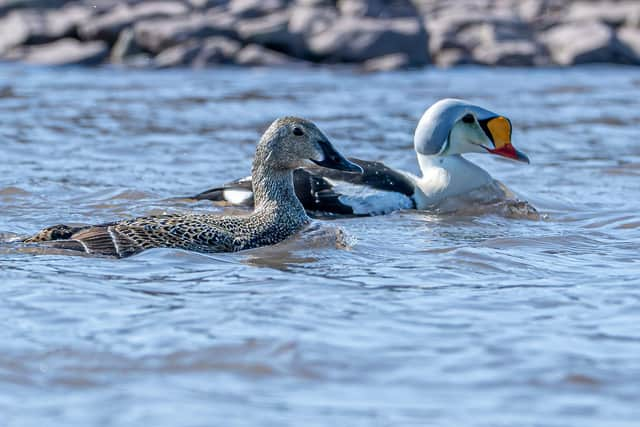

The female King Eider is a very good mother (it should really be Queen Eider if the male is King) she does not feed very often during the three-week incubation period. One female was not observed to leave her nest for seven days, until being flushed by an Arctic Fox. They breed near freshwater lakes, pools, bogs, marshes, streams and small rivers the coast or up to 50 km inland and away from the coast. We found one female sat on her nest and she was only a few hundred meters away from the ocean.
Some interesting facts I found while researching the species –
- Recent studies have revealed that some King Eiders when migrating over land, such as the Alaska Peninsula or the Kamchatka Peninsula of Russia, regularly fly through high mountain passes. They fly pretty quicky too and can maintain speeds of up to 40 miles per hour, and even faster with tailwinds.
- The female King Eider looks after the nest on her own without any input from the male. When an intruder is present, the female sits low on the nest with her head flattened on the ground. She sits tightly on the eggs and sometimes can be touched or picked up off the nest.
- King Eiders are deep sea specialists too – they regularly forage on seabeds up to 80 feet deep looking for shellfish and crabs. Their favourite food is mussels and In winter, many King Eiders gather together in huge groups on the coast. Some of these groups can have more than 100,000 birds!
There are four species of eider, Common Eider, Stella’s Eider, King Eider and Spectacled Eider. I’ve seen three of the four but need to see the Spectacled Eider to complete the list! Only one problem and it’s a pretty big problem To see a Spectacled Eider means me traveling to Alaska or Russia – not something I was considering! They have turned up in the UK but that’s incredibly rare – there was one male turn up in the Netherlands this spring.