
A key link road between Wigan and Hindley has been planned for 77 years – is it finally about to be built?

A closer look at the proposals for the Wigan to Hindley link road as the consultation is about to close.
An initial consultation on the long-planned Wigan to Hindley link road ends this week with hopes that building it will begin in 2029.
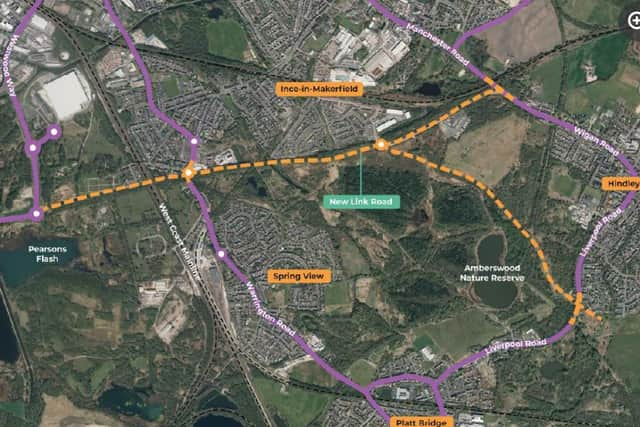

The project, previously known as the East-West link road or A5225, has been an aspiration since 1949.
The single carriageway 2.5km road would take traffic from A49 Westwood Way to A5777 Manchester Road and include links with Warrington Road, Phoenix Way, Seaman Way and south to Liverpool Road.
Over the decades, efforts have been made to secure funding to progress the scheme.
In October 2023, the Department for Transport published Network North, a £36 billion plan to improve transport in the North, then in March, the Government committed £153m to the scheme.
The investment provided by Network North meant that, subject to business case approval, the majority of the scheme could be funded by the DfT, along with local contributions.
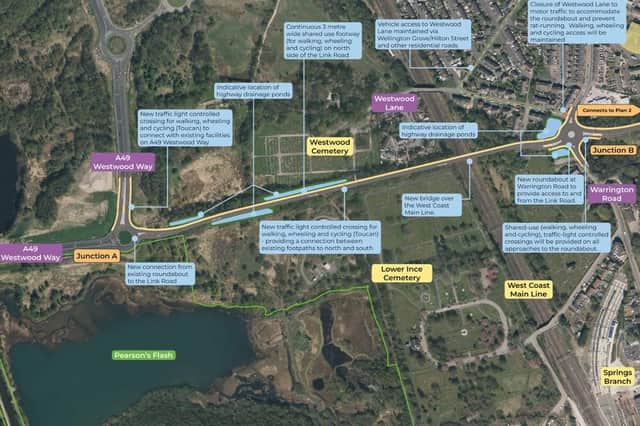
A major barrier to the road is the west coast mainline so a bridge would be built above the railway for traffic.
Drop-in sessions were held this month and following the current consultation, which ends on Friday, Wigan Council hopes to submit the outline business case to the DfT in spring .
Here are key questions on the planned new road, with answers from material included within the council’s consultation:
What are benefits of the new road?
Wigan Council’s consultation report said: “The WHLR would help reduce congestion in Wigan town centre, Scholes and Ince, and help make journeys quicker, and more reliable for travelling in or through the area.
“Reducing the volume of traffic, particularly heavy goods vehicles, within residential areas alongside the existing A577 and A58 would also contribute to improving road safety for all road users.
“The link road would contribute to improved air quality in existing built-up areas by reducing transport-related emissions associated with congestion across key east-west routes via Wigan town centre, Scholes and Ince-in-Makerfield.
“We are aware that not all residents drive, therefore, the WHLR would also improve connections and help reduce journey times on buses. It will also provide new walking, wheeling and cycling routes, helping to make sustainable travel a more practical and attractive option for everyday journeys.
“It would help enable local regeneration and growth by improving access to new housing and employment investment for the community.”
What is being proposed?
An approximately 2.5-mile, 30mph, single carriageway road which would connect the A49 link road with the A49 Westwood Way, A573 Warrington Road, Phoenix Way, Seaman Way, A577 Manchester Road and A58 Liverpool Road.
Proposals include:
- Shared-use path for walking, wheeling and cycling
- Six new or upgraded junctions
- Shared-use crossings to provide walking, wheeling and cycling users access to existing paths affected by the proposals
- Path to connect equestrians to existing routes within the area
- Construction of a bridge over the West Coast Main Line
- Street lighting
What are the junction proposals?
Junction A: A49 Westwood Way/Ince link
A shared-use traffic-light controlled crossing on the northern side of the existing roundabout between A49 Westwood Way and the new link road, which will be connected to existing shared-use paths.
There will be a shared-use path along the northern side of the new link road, connecting to A573 Warrington Road.
Junction B: A573 Warrington Road/Ince link
A new roundabout at A573 Warrington Road to provide access to and from the link road, with shared-use, traffic light-controlled crossings on all approaches.
Closure of Westwood Lane to motor traffic at its junction with A573 Warrington Road will be required, with walking, wheeling and cycling access maintained.
Junction C: Phoenix Way
A new junction connecting to Phoenix Way, with a shared-use crossing.
This junction would be a priority-controlled arrangement without the provision of traffic lights.
The shared-use path will tie into a new walking, wheeling and cycling route connection on Phoenix Way.
Junction D: Amberswood/Seaman Way
A new roundabout at the Amberswood/Seaman Way link junction, with traffic light-controlled shared-use crossings (toucan) on the western, southern and eastern approaches, and a parallel shared-use crossing (zebra) on the northern approach.
Junction E: Seaman Way/A577 Manchester Road
Improvements to the existing A577 Manchester Road/Seaman Way junction, with the introduction of traffic lights and shared-use crossings, and a connection of the existing shared-use path into Walmsley Park at the north of the junction.
Junction F: Amberswood Link/A58 Liverpool Road Junction
A new four-arm junction with traffic lights, which will include shared-use crossings on all sides and an equestrian crossing on the northern side.
The junction will connect into a shared-use path proposed along the new Amberswood link road.
The equestrian crossing will connect into an existing bridleway and National Cycle Network (NCN Route 55) on the north-eastern side of the link road.
How will the scheme affect the environment?
Wigan Council said “assessing and minimising the impact on the scheme on people, wildlife, plants and landscaping is a key part of developing the WHLR design”.
Environmental surveys are currently under way and, where feasible, the WHLR will be designed to avoid or mitigate environmental impacts.
Where this is not possible, the landscaping design will be developed to ensure the WHLR is sympathetic to the environment and replacement habitats will be provided.
The council will consider the noise and air quality impact of the WHLR on communities.
It said that through reduced congestion, the scheme is expected to result in an overall improvement in air quality.
The scheme design will be developed to minimise the impact of traffic noise through, for example, the introduction of noise fencing and earthworks embankments.
The council said that as the WHLR is at an early stage, work is ongoing to assess its environmental impacts to inform design development and determine mitigation measures.
This information will be provided as part of the second stage of consultation in 2027, subject to the outline business case being approved.
A comprehensive report on the expected environmental impacts of the WHLR will be included in the planning application.