Wigan D-Day veteran's son creates spectacular 30ft long model of Mulberry Harbour
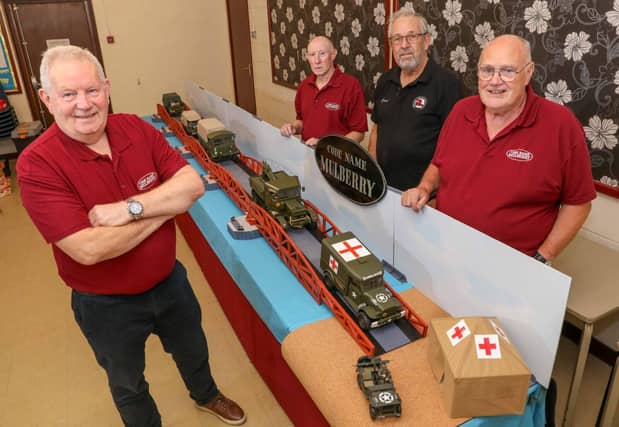

The son of a Wigan soldier who stormed ashore in Normandy has made a 30ft model of the floating harbour that was key to the success of the Allied invasion that started on D-Day.
The spectacular scale model of the Mulberry Harbour will be a star attraction at an exhibition staged in Llandudno in North Wales to mark the 80th anniversary of the operation that marked a major turning point in World War Two.
It’s been created by former Greater Manchester Fire Service head of engineering John Collier, from Orrell, and his friend, David Collier, from Bolton, who believe they may be distantly related.
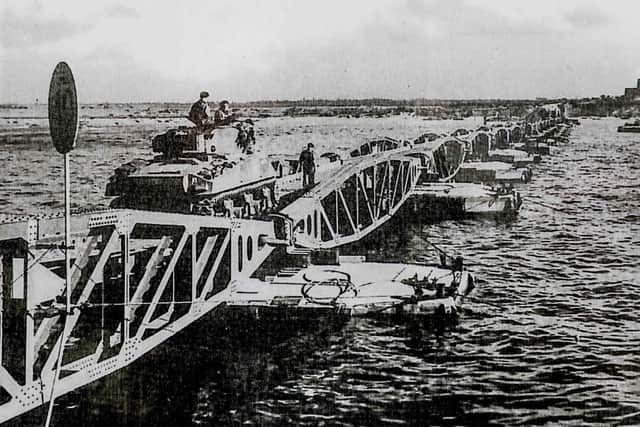
The giant concrete pontoon set up on Gold Beach, where British troops landed on June 6 1944, provided the bridge over which two million men, four million tons of supplies and half a million vehicles made their way into occupied France.

Among them was John’s dad Bill, a Royal Army Service Corps mechanic whose job was to keep the tanks of the Guards Armoured Division rolling down Hell’s Highway, the road to Arnhem, to support the paratroopers who had seized the Pegasus Bridge.
The model will form part of the exhibition at Llandudno’s Holy Trinity Church from October 2 to 27.
The exhibition, called the Longest Yarn which tells the story of D-Day, is being organised by the local community action group in the seaside resort, the Friends of Mostyn Street.
It will include a series of 80 metre-long 3D panels recreating the historic scenes in wool, all knitted and crocheted by an army of 2,000 volunteers from across the world.
Alongside it at the town’s Holy Trinity Church for the first time will be an accompanying panel featuring the famous Mulberry Harbours built on Conwy Morfa.
The display, that’s even longer than the Bayeux Tapestry, will be the centrepiece of a series of events taking place in Llandudno to commemorate D-Day and the 80 panels signify the 80 days it took the Allies to fight their way across France to Paris.
The new panel, knitted and crocheted by Creadigol Criccieth Creative, a team of up to 25 women from Criccieth, will include a depiction of the launching of the prototype concrete Mulberry Harbour developed in secret at Conwy Morfa where almost 1,000 men worked on the project from 1942 to 1944.
John said his father rarely spoke about his part in the invasion but did open up after seeing the film A Bridge Too Far about how soon after they landed across the bridges from the Mulberry Harbour to the beach at Arromanches they reached the city of Caen.
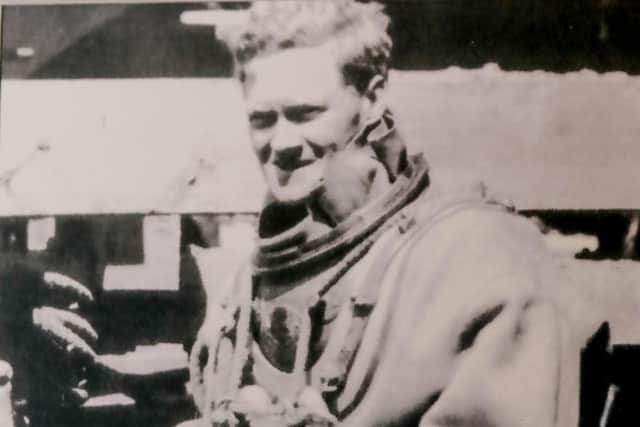
There he found a young French woman clutching a naked baby, so the resourceful Bill broke into an abandoned church and took a priest’s surplice to clothe the child, as well as a Frecnh prayer book as a memento.
John says his dad nearly didn’t make it that far. He and his RASC colleagues were waiting at Tilbury Docks for the order to move when his commanding officer decided they’d waited long enough and gave the order to move out.
Despite a poor weather forecast they embarked for Normandy. The next day, June 18, the Guards Chapel was destroyed by a German bomb and the engineering workshops were also hit: “But for that I probably wouldn’t be here,” John said.
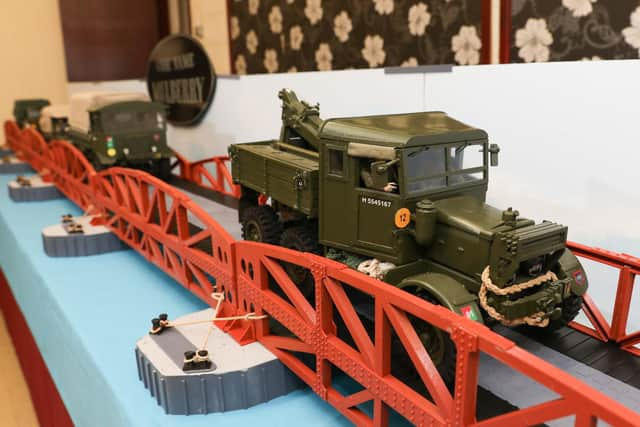
The model created by John and David, members of a Leyland modelling club, shows the harbour, developed at Conwy, in action off Arromanches with a series of pontoons crammed with armoured vehicles, trucks and troops heading for the beachhead.
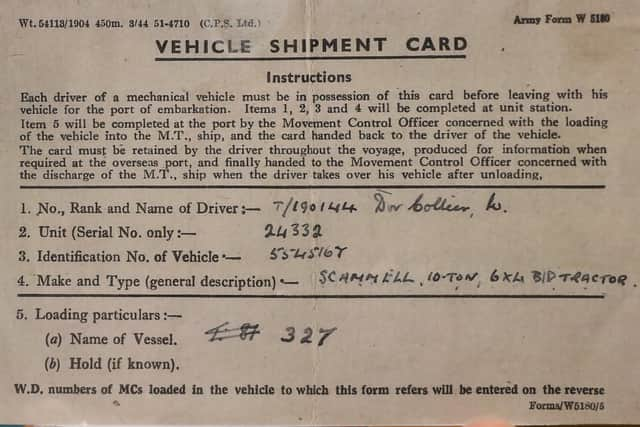
It’s been a labour of love for John who found a photograph of his father’s showing an old Scammell army truck. He said: “I decided to make a model from scratch and I’ve been doing it ever since.
“Everything apart from the axles has been hand-made based on the old photo of my dad’s and I won a prize at Blackpool Model Show with it in 2019 so I decided I needed a way of displaying the models I’d made.
“In my dad’s belongings I found his service number and the landing craft he went ashore in and that it must have been from the Mulberry Harbour and so I made the model of it.
“There are others, but they’re 1/400th scale while this is closer to the 1/14 scale of the truck so I invested in a 3D printer and learned how to use it and made the pontoon bridges. Each pontoon took over 100 hours and there are seven of them.
“David thought I was crazy at first but realised the logic of what I was trying to do with these models of World War Two tanks and trucks and so we built it with the harbour at one end of the bridges and a landing craft at the other and even a tugboat alongside.
“It was an incredible piece of engineering because the pontoons the bridge rested on were even designed to lift as the tide came in but they also had to stay aligned and are crowded with vehicles.