
Wigan Warriors’ identity built on youth as Matt Peet doubles down on pathway belief
Matt Peet has hailed Wigan Warriors’ thriving production line of homegrown talent, but warned that structural challenges within the sport could make such success stories increasingly difficult to sustain.
The Warriors coach was speaking after naming a squad heavily populated by academy graduates in recent weeks, displaying the strength of the club’s development system. Ten academy products have featured in the 17-man squad across the last two matches, while a fully homegrown spine was on show in last week’s win over Bradford Bulls in the shape of Noah Hodkinson, Jack Farrimond, Harry Smith and Brad O’Neill.


For Peet, that is both a point of pride and a reflection of years of work across multiple levels of the game: from junior rugby at community clubs, to the scholarship, academy, reserves and first-team squads with the Warriors.
“Absolutely,” he said when asked if it was credited to the club’s pathways. “You are probably going to see less and less of that now that they’ve increased the overseas quota.
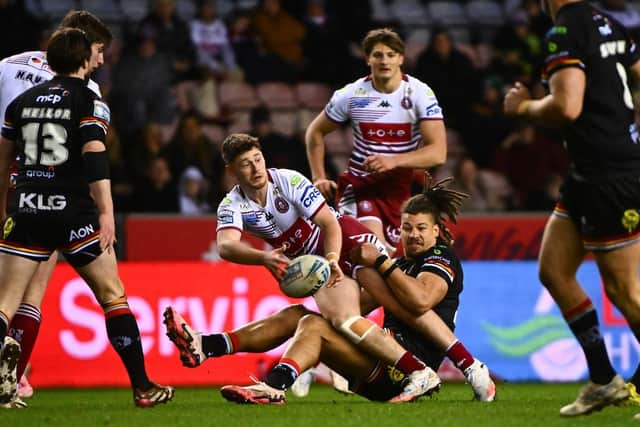
“It’s just the way it is. Sometimes, it is easier to recruit players in those positions because you want experience and maturity, but it’s great for us that those players have come through our pathway, intelligent lads, well-rounded in terms of their skill set, and they understand how we want to play the game.
“So I think it’s a good sign for the club, it reflects well on the work of our pathway and the local community game as well.”
Peet was keen to emphasise that Wigan’s success is not achieved in isolation, instead pointing to the role of the community game and schools across the region.
“You look at those lads – Noah with Hindley, Harry with Halton Farnworth Hornets, Brad with Leigh East and Halton, and Jack with Leigh Miners – so not only have they come through our pathway, but they’ve also come through the North West Counties,” he said.

“So a lot of people can take pride in it, whether it’s people who have worked with them at Under-10s or through our pathway here at Wigan, or the schools.
“It’s really pleasing to see, and it’s what the game should be about, really.”
Wigan’s reputation for producing elite-level players stretches back decades, and Peet rejected the idea that there is any hidden formula behind that sustained success.
“It’s certainly not a secret,” he said. “It’s just hard work.
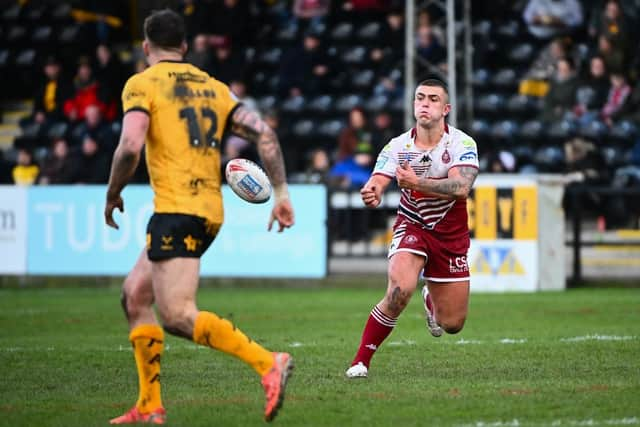
“We’re privileged at Wigan that we sit on a hotbed of rugby, which is not just the Wigan town, but the North West Counties, and it’s kind of our approach that we feel we’ve got to have a large contingent of homegrown players coming through your squad.
“Not just to support in times of injuries and add depth, but to eventually become your first-team established players – Harry Smith and Brad O’Neill are great examples of that.”
Peet again highlighted the contributions that go into developing an established first-team player, from early identification at junior level through to first-grade exposure.
“It’s about using what’s at your disposal and where we are, there are great rugby players around here and a lot of good rugby people who work with these lads on their way through,” he said.
“Whether it’s at these community clubs like Hindley in Noah’s case, through our scholarship, the scouts that identify them, all the coaches through the system, right up to first-grade, I could name them all.
“And ultimately the players themselves, having that self-belief, and then I get the easy part, which is to put them in and I watch them flourish.”
Despite the clear emphasis on youth development, Peet stressed that Wigan are not solely reliant on producing their own players and will continue to recruit high-quality talent from elsewhere.
“It’s exactly right,” he said when asked about balancing homegrown development with external recruitment. “I think it takes confidence and a belief that these players can become world-class.
“I don’t need to name the names who have come through our system over the years, long before I was here, and have gone on to play at the highest level.
“So I think when you have that confidence and belief in the lads, I think it transfers over to them when they take the field.”
However, that belief in youth is complemented by a pragmatic approach to recruitment.
“We will always look for exceptional talent from anywhere in the world, we’re not purely Wigan-centric and purely our own system, but I do think it’s a good approach to have,” Peet added.
“You’ve built primarily on homegrown players who understand the ethos of the club and the ethos of the town, and then they can help keep your hometown feel about it.
“There is a temptation for clubs to stray from that, but I think we’re fortunate that our supporters believe in it as well, and they understand it.
“And I think they take as much satisfaction backing these young lads and watching them develop, as when we sign lads from overseas or from other Super League clubs as well.
“The supporters certainly buy into it, and it is probably a big part of us being Wigan.”
Peet’s own background within Wigan’s youth system has seen him work across multiple levels before stepping into the head coach role, and he believes that continuity helps ensure players are supported effectively.
“I don’t know, I can’t compare,” he said when asked if his pathway experience makes it easier to promote young players.
“I just know that I’ve been involved all through the pathway, so I know the different levels. I know where players are in terms of their development and how to support them and challenge them.”
He also pointed to the collaborative nature of the club’s coaching structure.
“We’ve also got a lot of staff who are well-equipped, and the main thing is the belief in it,” Peet said.
“The work the coaches do and the strength and conditioning, the education the players get from the coaching staff.
“I’ve got a lot of personal relationships with the staff throughout the pathway, we’re very close, we talk a helluva lot, we watch one another’s training sessions, and we get involved with one another’s training sessions.
“It’s a very joined-up approach here, so I don’t think much gets missed in terms of trying to support these lads through their development, the best we can.”
And while Wigan’s production line shows no signs of slowing, Peet was quick to acknowledge that other Super League clubs are also producing strong emerging talent.
“There is plenty more waiting in the wings,” he said. “I watched our Reserves at the weekend, I’m seeing our academy train at the moment, they’re looking in good shape.
“But it’s not just Wigan that – I think Warrington, Leeds, St Helens have got some great kids, so there are plenty of players who come through similar pathways, so it’s not just Wigan.”
Peet addressed the growing trend of Super League players moving to the NRL, with Leeds Rhinos prop Mikolaj Oledzki the latest England international to make the switch for 2027 and beyond.
“It has to be, doesn’t it?” Peet said when asked if the situation is concerning for the competition, with the NRL’s salary cap roughly three times higher than Super League.
“I feel like we’ve been saying this for a long time, and if nothing changes, then nothing will change – it’s only going to get worse.
“If we leave the cap where it is, if we don’t alter dispensation for homegrown talent, then it doesn’t matter how many young players we get through, Warrington get through, Saints get through – we’ll be watching them on Saturday mornings rather than Friday nights.
"I feel like we’re repeating ourselves, but we can’t blame these lads for wanting to go. I understand the NRL is a strong competition at the moment, but it comes down to money. Mikolaj, Owen Trout, these lads looking after their families and playing in a competition… there’s plenty of attractions, isn’t there, for a young man.”
But he warned that the current system risks discouraging clubs from investing in youth development.
“I’m just stating the obvious, you can see why clubs would choose a different path rather than promoting from their academies,” Peet added. “Because no sooner are they in and breaking through, that we’ve got a battle on our hands to keep them.
“So does it make more sense then to go and sign a 24/25-year-old out of the Q Cup? But until the powers that be decide what our competition end goal is – is it to help England win? Is it to keep talent over here? Or is it just to provide a stepping stone to a bigger salary cap? There’s not much I can do."