
Talking Sport with Gavin Browne: Italia ‘90 inside story remains a real page turner
With the 2026 World Cup about to kick off, a book from 36 years ago remains the standard bearer...
Here we go, the World Cup’s upon us with an expanded 48 teams and played across three countries for the first time.

While it remains to be seen if bigger equals better, I can’t recall feeling as underwhelmed regarding any of the previous 10 tournaments I’ve watched as I do at the moment.
I don’t remember the 1978 and 1982 competitions, having been a toddler and four years old respectively.
Mexico’s later kick-off times in 1986 meant I only saw a handful of non-school night games, so 1990 is the first World Cup where I remember being able to watch most of the action.
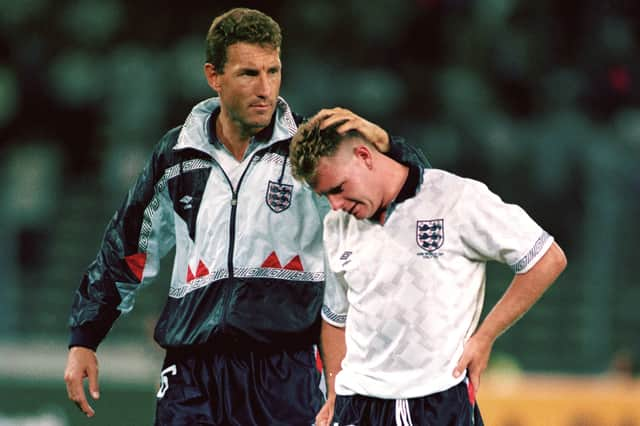
Of course, if you’re English, that tends to trigger memories of Paul Gascoigne’s tears, Nessun Dorma, World in Motion and the urban myth that Dave Beasant could have replaced Peter Shilton in the semi-final shootout.
He couldn’t. Teams could only name five substitutes and England’s replacement keeper on the night was Chris Woods, so let’s park that one shall we?
With English teams banned from European football at the time and, as a result, barely any continental football shown on British TV, Italia ‘90 seemed like a window into another world.
British grounds weren’t the most attractive to visit, so the San Siro and its distinctive concrete pillars seemed almost space age in comparison.
A myriad of books have been written about 1990 but, in my view, the best remains ‘All Played Out’ by Pete Davies.
Younger readers may know it better as ‘One Night In Turin’, as it was renamed in order to tie in with the release of a film based on the book in 2010.
The book is a much more comprehensive account, both of the football and Davies’ experiences before and during that summer.
He lays out his experiences, warts and all, not just with the England team but travelling around the tournament as a whole: officialdom, fans, Italian folk and the British media.
Now, as someone who’s covered the best part of 1,000 football matches in 20-odd years amid the rise of the all-powerful media officer, the access Davies is given is astonishing.
He gets on first-name terms with the players throughout, visiting them at the various team hotels, providing behind-the-scenes snippets of how footballers occupy themselves on their days off, as well as sitting on the bench for one of England’s pre-tournament friendlies.
By far the biggest eye opener, however, comes a few months before the World Cup altogether.
A midweek game saw Charlton Athletic host Arsenal in February 1990, when Davies was given a lift to the game and then back to where he was staying in Tooting. His chauffeur? Sir Bobby Robson.
That’s right, he travelled to and from the game with the England manager in the driver’s seat. Somehow, I can’t picture that happening these days.
Not only that, they’d previously spoken about the lack of games on offer just in case Robson needed an alternative front pair should either Peter Beardsley or Gary Lineker have to be left out.
Yep, the idea of dropping Lineker had crossed the manager’s mind. In Davies’ words: “Robson had a paranoia attack. ‘This is confidential isn’t it? This is for the book? This isn’t for any paper? The Sun’d pay £50,000 for this.’”
Speaking of Fleet Street’s finest, some of them don’t exactly come out of it brilliantly.
The tabloid war was still in full swing, reflected in some of the era’s frankly nonsensical coverage.
OK, the draw against Poland which sealed qualification was nervy but one writer’s observation that ‘There are so many donkeys in his side that Robson should open an animal sanctuary and dispense carrot juice’ should have been laughable at the time, never mind after a run to the semi-finals.
It gets worse. Robson’s decision to take the PSV Eindhoven job after the World Cup saw him labelled as someone who ‘has taken his thirty pieces of silver before a ball is even kicked’.
As Davies put it: Robson had been offered a job, his employers provided no assurance they would keep him in his present role and gave him permission to pursue the offer abroad.
Franz Beckenbauer had also announced he would be leaving the West Germany job and it seemingly wasn’t an issue, so why the outrage in this case?
David Rocastle was described as having stormed out of the England team base when he was left out of the final squad.
What he’d reportedly done instead was packed and quietly left. No wonder Lineker labelled the story as ‘scandalous’.
Once the tournament started and England had a few injury concerns, attention turned to David Platt and Steve Bull.
“An Aston Villa humper and a second division battering ram,” mocked one writer. “Italy in crisis. Germany in trauma. Brazil all a-tremble.”
That would have been Platt who had gone into the World Cup as the PFA player of the year, while Bull - yes, admittedly, playing outside the top flight - had scored four in his seven England games.
The aspect which dates the book the most comes at the end, when Davies says we can look forward to the 1994 World Cup with the highest of hopes – and we all know what happened there.
There are plenty more eyebrow-raising anecdotes so, if you can find a copy of it, it’s well worth your money.