
Electoral reform campaigners say ‘Wake up Westminster’ ahead of pivotal Makerfield by-election
On the eve of the crucial Makerfield by-election electoral reformers have been calling for the ditching of the first past the post system because of its “distorted results” and demanding its replacement with proportional representation
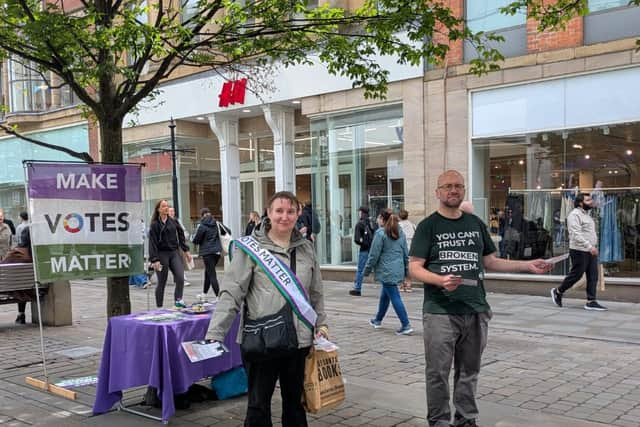
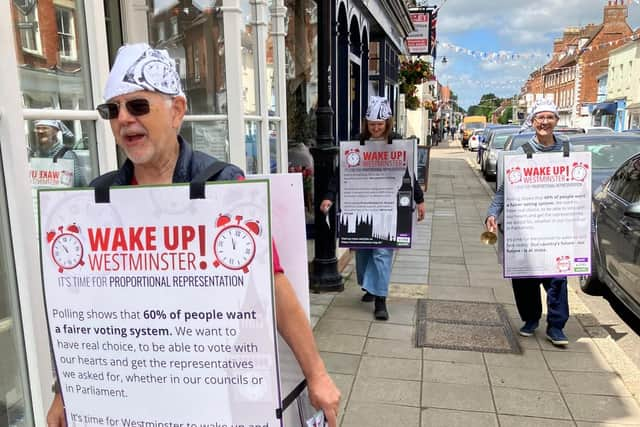
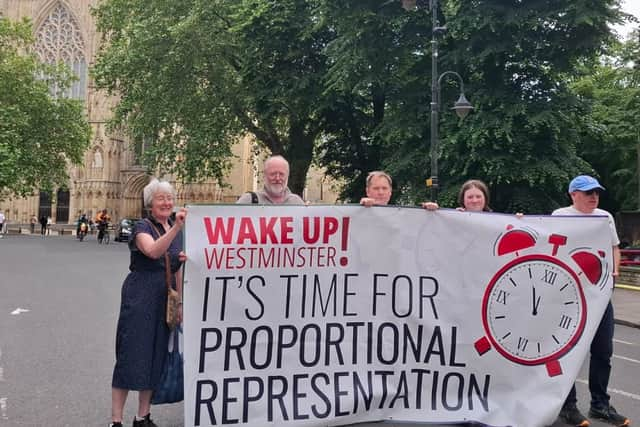
Members of the Proportional Representation (PR) advocacy group Make Votes Matter have held an Action Day in Manchester city centre – comprising a banner drop in St Peter’s Square and a street stall in Market Street – ahead of the Makerfield by-election on Thursday June 18.
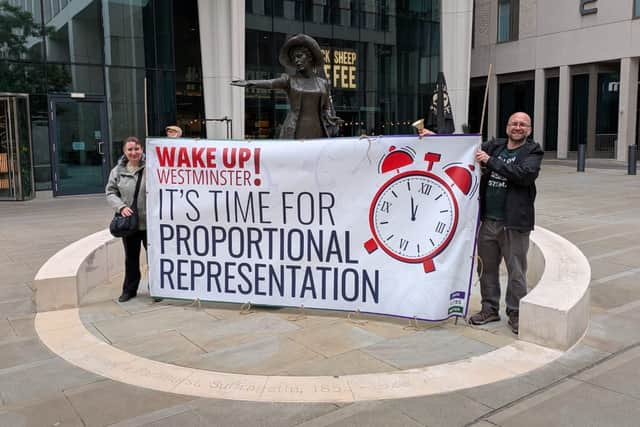

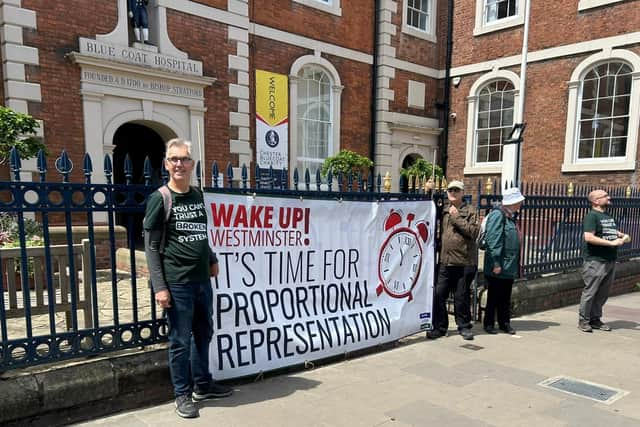
Held as part of the group’s Wake Up Westminster campaign, the day also sought to garner support for an amendment to the Representation of the People Bill endorsing a National Commission on Electoral Reform.
Other Wake Up Westminster events held that day included a themed march through London past Parliament and Downing Street featuring pyjama-clad participants, and banner displays around York.
Similar events held this week included a demonstration outside the constituency office of Samantha Dixon (Chester North and Neston, Labour) – the junior minister responsible for elections policy – and various banner drops, street stalls and “roving stalls.”
MVM argues that results in last May’s local elections demonstrated the distortive nature of the majoritarian First Past the Post (FPTP) and Plurality Block Voting (PBV) systems and the replacement of the longstanding two-party system under Labour and the Conservatives with a multiparty one.
The potential for random results under FPTP have led to some commentators claiming that we now live in a “slot machine democracy.”
With elections for thirds of councillors held for all 10 Greater Manchester metropolitan districts, examples of disproportionate results included:
Reform winning 96.0 per cent of seats in Wigan with 43.6 per cent of votes, and 94.7 per cent of seats in Tameside with 41.9 per cent of votes.
The Lib Dems winning 61.9 per cent of seats (and a narrow majority) in Southport with 32.1 per cent of votes.
The Greens winning 56.3 per cent of seats in Manchester with 37.3 per cent of votes.
MVM Manchester organiser Michael Jones said:
"I live in a safe seat and election after election my vote makes no difference at all - no matter how I vote.
“The current voting system lets down so many voters at every election which is so frustrating when there are clearly better systems out there.
“Proportional representation means that every vote counts and we can have the choice at the polls that we all deserve whilst knowing that our vote is never wasted."
With Labour’s losses of 1,498 councillors in May’s elections further undermining confidence in Keir Starmer’s premiership, Makerfield incumbent MP Josh Simons resigned from his Wigan seat to allow Greater Manchester Mayor Andy Burnham the chance to re-enter Parliament in the hope of mounting a leadership challenge.
With serving Prime Ministers required by modern convention to be sitting MPs, Burnham is currently at a serious disadvantage in potentially succeeding Starmer in contrast to other speculated rivals including Wes Streeting (Ilford North) and Angela Rayner (Ashton-under-Lyne).
Makerfield marks Burnham’s second attempt to re-enter Parliament following the Labour National Executive Committee’s decision to block his nomination as candidate for the Gorton and Denton by-election in February, ostensibly to prevent a mayoral by-election.
With Green candidate Hannah Spencer having won and Labour candidate Angeliki Stogia coming in third behind Reform challenger Matt Goodwin, commentators believed that this outcome demonstrated increasing fragmentation in British politics.
The NEC’s decision drew criticism given polling suggesting that Burnham’s nomination would have retained the seat for Labour.
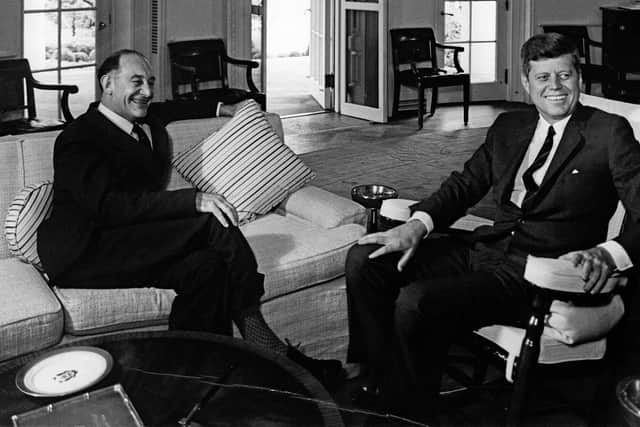
This is the first by-election triggered specifically to provide a seat for a political figure not currently in Parliament since the 1965 Leyton by-election.
Engineered to return extra-parliamentary Foreign Secretary Patrick Gordon Walker following his shock defeat in Smethwick in 1964 amid a racially charged campaign, he narrowly lost and was forced to resign from the Cabinet.
On June 18, by-elections are also being held in Aberdeen South and Arbroath and Broughty Ferry, triggered following the election of incumbent Scottish Nationalist MPs Stephen Flynn and Stephen Gethins to the Scottish Parliament in last May’s devolved elections.
As a cross-party organisation, supported by individuals and groups across the political spectrum, MVM does not endorse any one candidate.
Instead, it seeks to highlight which candidates support PR and pledges to cooperate with whichever candidate wins to secure electoral reform.
Such by-election candidates include:
Andy Burnham (Labour), who reiterated in an interview with the Observer his commitment to PR.
Jake Austin (Liberal Democrat), whose party supports Single Transferable Voting for general elections and English local elections.
Sarah Wakefield (Green), whose party supports Additional Member System for general elections.
Robert Kenyon (Reform UK), whose party has a general commitment to PR.
Peter Ward (Rejoin EU), whose official description cites ‘Bring In PR’ as a secondary goal.
Ed Gemmell (Climate), who commented that PR is needed for ‘new ideas, wildly more ambition and universal collaboration in parliament’ and cited the successes of Teals (environmental, conservative independents) in Australia.
Dan Clarke (Libertarian), who commented that his party is ‘massively in favour of PR and its introduction’.
Engaging with members of the public at their Market Street stall, MVM also encouraged them to contact their MPs in support of an effort to progress the campaign for electoral reform.
The Government’s Representation of the People Bill – currently at the committee stage – proposes to:
Lower the voting age to 16.
Introduce automatic voter registration.
Expand the range of acceptable voter identification.
Introduce limits on company donations and close loopholes for unincorporated associations.
Enhance the powers of the Electoral Commission.
With the bill due to receive its third reading, the Chair of the All-Party Parliamentary Group (APPG) for Electoral Reform Alex Sobel (Leeds Central and Headingley, Labour) proposed an amendment in support of a National Commission on Electoral Reform.
The National Commission proposed would be tasked with reviewing the current FPTP voting system and “[making] any recommendations for reform to ensure that the voting system is fair, representative, and capable of sustaining public confidence in democratic outcomes.”
If adopted, the amendment would require the Bill’s sponsor Housing, Communities and Local Government Secretary Steve Reed (Streatham and Croydon North, Labour) to publish a feasibility report within three months of the Bill’s passage. If considered feasible, the Commission would need to be independent and publish its final recommendations within twelve months of its launch.
At time of writing, more than 120 MPs across several parties have endorsed the amendment. Among them are Greater Manchester MPs Hannah Spencer, APPG Vice Chair Lisa Smart (Hazel Grove, Lib Dem), Jo Platt (Leigh and Atherton, Labour), Debbie Abrahams (Oldham East and Saddleworth, Labour) and Tom Morrison (Cheadle, Lib Dem).