
Nature Notes: Graham Workman explores the role of the hare in folklore and history
In this week’s Nature Notes column, Graham Workman discusses hares.
I love the folklore associated with our native wildlife and find our closeness to some species absolutely fascinating.
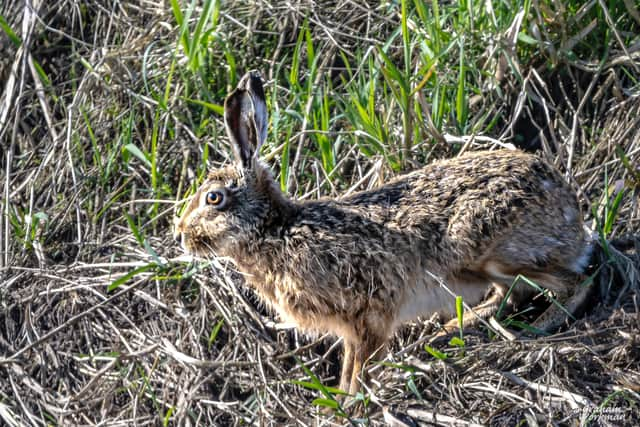

Some with origins as far back as the neolithic times when there would be much to fear/revere for certain species.
Our folklore is deeply tied to the shifting landscape—from the dense impenetrable "wildwoods" of prehistoric Britain to the managed agricultural fields of the Middle Ages.
As we transitioned from hunter-gatherers to farmers, relationships with native animals shifted from sacred reverence to fear, utility and superstition.
One of my favourite associations is the hare.
Because hares live above ground in "forms" (shallow depressions in the earth) rather than burrowing like rabbits yet regularly vanish into undergrowth and run with incredible speed, prehistoric peoples likely viewed them as intermediaries between the earthly realm and the underworld.
Recent archaeological excavations have uncovered completely intact, un-butchered Iron Age hare skeletons buried with immense care, confirming they were treated as gods or sacred companions to an unknown female deity.
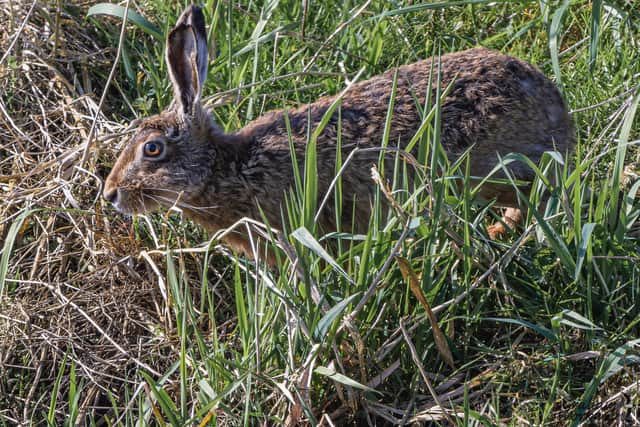
Later in our history there was a definite taboo against eating hares and actually written evidence was provided in De Bello Gallico, Julius Caesar famously observed that the Britons considered it “against divine law to eat the hare”, rearing them purely for pleasure and spiritual reverence.
In AD 61, before leading the Iceni rebellion against the Romans, Queen Boudicca reportedly released a live hare from beneath her cloak.
The direction of its frantic flight was used as a method of divination to predict victory.
So folklore of the British hare is deeply rooted in mystery, magic and transformation, shifting dramatically from revered prehistoric deity to a feared symbol of witchcraft.
While the native mountain hare (Lepus timidus) has lived in Britain for millennia, the familiar brown hare (Lepus europaeus) was introduced during the Iron Age.
Over thousands of years, these animals have held a uniquely sacred and liminal space in the British imagination.
In hare mythology, the hare is a creature with pagan, sacred and mystic associations, by turns benign, cunning, romantic or, most famously, in its March courtship rituals, mad.
It is largely silent, preferring to feed at night or, in summer, as the last light fades from the day, a shadowy existence which adds to its mysteriousness in hare mythology.
There is a lovely old Suffolk saying – how can you tell a hare in a field from a stone? If it moves, it’s a stone!!!!
I’ve been lucky of late as it’s only a couple of weeks since I saw my last hare – well I saw his black-tipped ears disappearing into the distance.
Hares are easily distinguished from their relatives the rabbits by their larger size, longer ears and longer hind legs. Normally the two animals do not mix.
Hare tracks, especially in snow, can be distinguished by the longer stride and the absence of toe and pad marks due to the hairy soles of their feet.
Hares live in well-defined territories spending the day lying in shallow depressions under cover known as "forms".