
Nature Notes with Graham Workman: hornet's appearance was not all it seemed
Graham Workman looks at hornets in this week’s Nature Notes.
I didn’t realise the sinister reasons that this hornet was, or so I thought, just photobombing my shot of the red admiral on the Ivy on our garden wall!
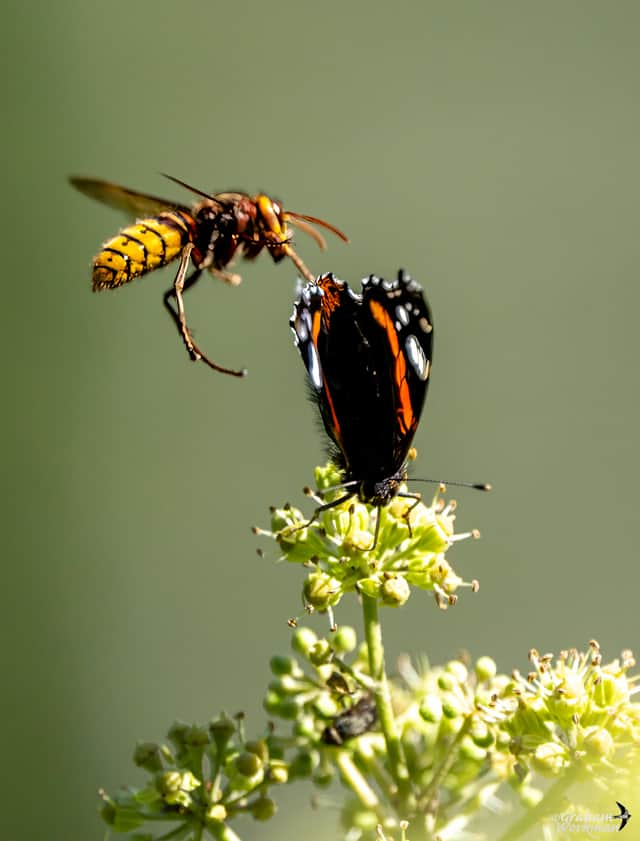

Nope, it was actually attacking the butterfly! It appears that red admirals feature high up on the “take away” menu of hornets.
This is a European hornet (Vespa Carbo). They are allegedly the king of our native wasps and our only native hornet.
They have a scary reputation of massive painful stings and so aggressive if you get on the wrong side of them a “gang” of warrior hornets will chase you down and fill you full of stings!
In reality they are much less aggressive than their smaller cousin the common wasp and don’t deserve their fearsome reputation.
Like all wasps and bees, if they think their nest/hive is threatened they will come out fighting and there will be pain involved!
Not that long ago it was only “down south” that the hornets were living, now they are slowly spreading north and are a more regular sight here in North -West England.
They are out and about from May to November and are easy to tell the difference between our wasps.
The first give away is their “buzzing” which is very deep, noisy and LOUD!
Next, they are quite a bit larger than our common wasps with yellow and brownish-red striped bodies, reddish wings and a yellow head.
Queens are larger than the males and workers.
One bit of interesting info -the males don’t sting!!!
Just the same as our common wasps’ hornets are social wasps, which means their lives are completely focused around the nest.
Their nests are large and built by the workers out of chewed wood and organic materials turned into paper mâché.
The nests are usually situated in dark and sheltered places, hollow trees being a real favourite location.
Only the queens of healthy colonies produce fertile eggs which are cared for by female workers.
During the year, the workers look after all the maintenance the hive structure needs and they let the queen get on with her egg laying duties.
Then as autumn approaches, the queen lays eggs which as well as males (drones) she produces fertile queens too.
These new queens leave the nest to mate and start new colonies.
Sadly, once the new queens have mated, the old queen, all her colony and the males die.
The new queens then hibernate over the winter and then the cycle starts again and she will establish new nests in which to lay her eggs and the hatched workers take over maintenance, repeating the cycle.
Hornets are proficient hunters and hunt a variety of insects to feed to the growing larvae.
They have a very diverse diet, hunting large insects like dragonflies, beetles and butterflies and moths.
The hornet in the photo is going to kill the red admiral, snip off its wings with its sharp and powerful jaws, then back to the nest to feed the larvae!
Come autumn they will get a taste for tree sap, nectar and fruit.