
Nature Notes with Graham Workman: owls and woodpeckers in the vast forests of Norway
This week’s Nature Notes column finds Graham Workman in Norway looking for the great grey owl.
We had a “dad and lad adventure” last week photographing owls and woodpeckers in the vast forests of Norway!
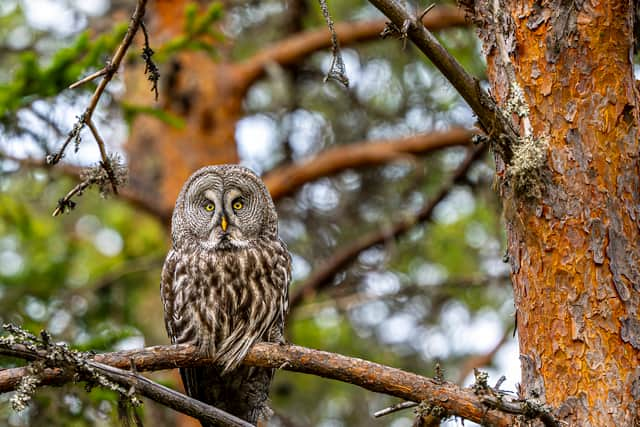

The great grey owl (Strix nebulosa) has been on our target list for years and to finally spend time watching one was fantastic – a dream come true (thanks to Simon Rix, our guide, who we went out with every day).
Despite its large size the great grey owl is an elusive bird and is not easy to find.
Even in perfect habitat it can be invisible, depending on where it’s decided to roost.
Luckily Simon had put in the legwork and knew of a nest box he’d been able to watch and eventually had a pair of GGOs occupy the nest box (see the female peeping at us from just over the edge of the nest box).
As we approached, the female who was off the nest box had obviously seen/heard us and let us know she had by clicking her beak and letting out a couple of loud “whooooos” and a grunt!
We stayed a good way off from where Simon spotted her on a branch, as they will attack humans if they get too close to their nest, plus we didn’t want to disturb her in any way.
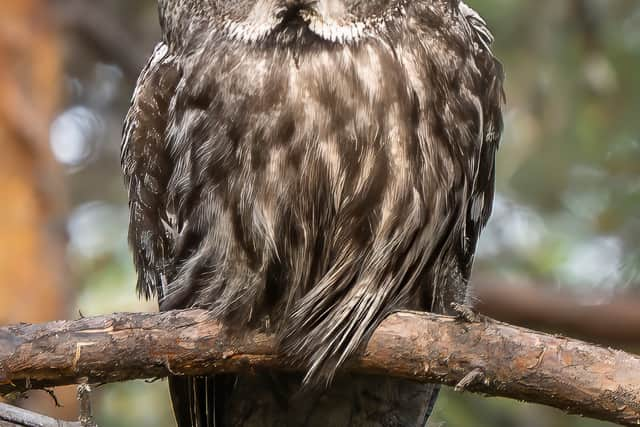
Here’s some info on the owl:
Adults, which this one was, an adult female, have large, rounded heads with grey faces and striking yellow eyes with darker circles around them which emphasise the eyes.
They don’t have ear tufts, but its first claim to fame is it has the largest facial disc of any raptor.
A what? A facial disc is a concave, circular arrangement of stiff, densely packed feathers on the faces of certain birds, most notably owls.
The great grey’s is, according to scientists, perfect in its shape and it also has the ability to “move” these feathers - it’s a natural satellite dish which they use to track sound while hunting!
The other two owls I’ll share have a very similar “facial disc”.
One of my favourite things with their plumage is the white gentleman’s moustache – I had a master at school who had a “tash” just the same!
Some say it’s a white collar or "bow-tie" just below the beak, but in my humble opinion it’s def a “tash”.
You can see from the photos they have quite long tails which taper to a rounded end.
Both its common and scientific names are well suited for this large grey owl.
The Latin name for great grey owl is Strix nebulosa. Strix means to utter shrill sounds and nebulosa means misty or cloudy, referring to its grey colour.
Another “claim to fame” is that great grey owls are the world's largest species of owl by length.
Its massive size is very deceptive, basically it’s a medium-sized owl covered in very, very fluffy feathers, large head and as I mentioned before a long tail – in fact the longest tail of any owl. Their length ranges from 61 to 84 cm.
Great grey owls live between 10 and 20 years in the wild and have reached over 40 years in captivity!