
Nature Notes with Graham Workman: gulls, the coastal birds that have moved inland
Graham Workman looks at gulls in this week’s Nature Notes.
I’ve never seen as many gulls – literally thousands - in fact, it was like a snowstorm with the biggest ever snowflakes!

The tractor was doing a very neat job keeping his furrows straight and as soon as the turf was turned, the gulls descended like a plague of white locusts!
The majority of the gulls were black-headed gulls – or spot-headed gulls as they had all lost their rich chocolate colouring and had assumed their little spot for the winter.
Black-headed gulls are more inland gulls these days than “sea gulls”. In fact, some never ever see the sea!
This is the gull most frequently seen in urban and suburban areas and is seldom given a second thought when seen in city centres during winter, it has become like a white pigeon.
In fact this is a fascinating and quite recent development – the first black-headed gulls wintered in central London only 100 years ago.
Inland breeding colonies range from less than 10 pairs up to a staggering 20,000 pairs and tend to be associated with old gravel pits and sewage works.
We are now in a situation where inland breeding colonies actually outnumber coastal ones.
Black-headed gulls are sociable, quarrelsome, noisy birds, usually seen in small groups or flocks, often gathering into larger parties where there is plenty of food or when they are roosting.
Another common gull that is now seen inland is the wrongly named common gull!
Despite its name, the common gull is one of our scarcer gulls, much less common than black-headed gull or herring gull.
Known to frequent sports fields and parks, it has a habit of “paddling” - stamping its feet to imitate rain and encourage its invertebrate prey to the surface.
The common gull can be found on farmland, wetland and coastal habitats throughout the UK.
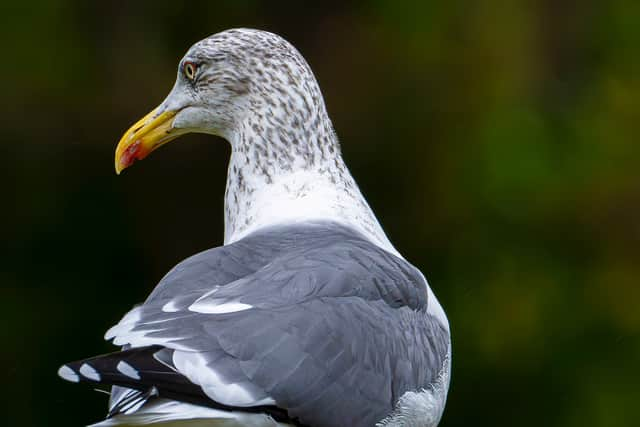
A medium-sized gull, it is similar in appearance to the larger herring gull, but lacks the famous red spot on its bill.
It breeds on coastal marshes, sand dunes, rocky ledges and shingle beaches, and even on buildings. It can be spotted at landfill sites eating rubbish, but is not as common inland as its name suggests.
Another gull to look out for is the herring gull – wonder how it got its name?
The herring gull breeds mainly in north and west Europe.
It is widely distributed around the coasts of the British Isles and prefers to nest on rocky coastline, with cliffs, islets and offshore islands, though a range of other habitats are used including sand dunes, shingle banks and, increasingly, rooftops of buildings in urban areas.
A small proportion of the population nests inland, mainly on lake islands and moorland.
The herring gull is an opportunist feeder, being both predator and scavenger.
While primarily a coastal feeder, it readily takes advantage of the often abundant food supplies available indirectly from man, especially waste from the fishing industry and landfill sites.
Outside of the breeding season, herring gulls are common along coastlines and inshore waters but also occur inland.