
Nature Notes with Graham Workman: honey bees and bumblebees buzzing around the garden
Graham Workman looks at bumblebees and honeybees in this week’s Nature Notes column.
The sun had brought out literally hundreds of bees and butterflies on our bed of pink geraniums at the side of the cottage.
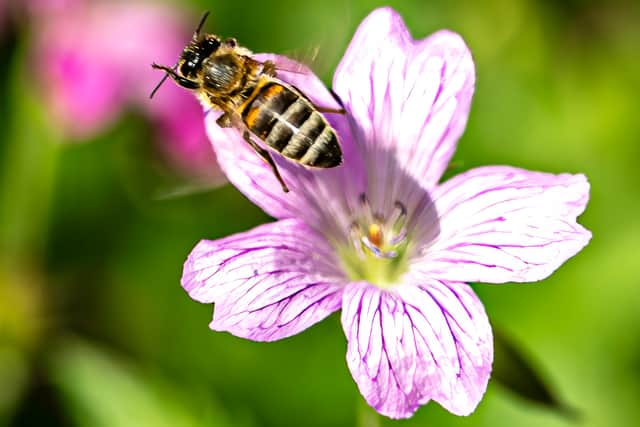

I thought, “I’ll get the camera and get some quick photos”, as I’ve been desk bound for three weeks or so.
Evening bat surveys are brilliant and I get a chance to spend quality time with detectors and thermal imaging equipment to watch and listen to bats!
I have a team of four surveyors who are out with me most nights.
The only downside is the report that then gets generated by the data recorded during the sunset till well after dark, so the next day quite a few hours are taken up writing and using photos taken during the survey.
So it was a nice change to get one of my cameras out during daylight hours!
It wasn’t long before something became very obvious – while there were literally hundreds of honey bee workers all among the flower bed, there wasn’t one bumblebee!
Twenty years ago it would have been quite a find to record a honey bee in the garden - at that time it would have been all bumblebees, hoverflies butterflies etc.
There has been quite a debate about the real negative impact that the enormous uptake of people introducing hives for honey into their gardens is having on our bumblebees.
This is primarily through competition for resources and the spread of diseases.
Because honey bee colonies are massive - housing tens of thousands of bees - they can strip floral areas of pollen and nectar, leaving less food for wild bumblebees.
The main negative impacts of honey bees on bumble bees include:
- Resource depletion: honey bees are highly efficient foragers. In environments with limited floral resources, they can outcompete bumblebees, sometimes suppressing bumblebee populations and reducing their reproductive success.
- Disease transmission: honey bees and bumble bees often visit the same flowers, making it easy to spread pathogens. Honey bees can shed infectious particles onto shared flowers, transmitting viruses (such as deformed wing virus) and parasites to wild bumblebee populations.
- The "hive density" risk: negative impacts are highly localised and are most severe when large numbers of managed honey bee hives are placed in areas with poor or limited forage, or near sensitive reserves important for rare bumble bee species.
But there are many and more are joining the debate in that the species generally coexist peacefully, often foraging on the same flowers without conflict.
- Forage: they frequently gather pollen and nectar side-by-side. Because honey bees practice floral fidelity (focusing on one type of flower per trip) while bumblebees mix flower types, they naturally share food resources.
- Nest competition: there is no competition for nesting sites. Honey bees live in large, constructed hives, whereas bumblebees nest underground or in rotting logs.
Def a big plus for bumblebees is that they are generally much less aggressive than honey bees.
They are highly docile and usually only sting when directly pinned, squeezed, or if their nest is heavily disturbed.
While both will fiercely defend their colonies, honey bee hives hold up to 60,000 bees, creating a more intense defensive response. In contrast, bumble bee colonies max out around 50 to 400 bees, resulting in far fewer potential defenders.