
Nature Notes with Graham Workman: The Sky Dance
Acrobatic buzzards have just begun their flying displays
The mewing call overhead had me look up and see my first displaying buzzard of the year over the cottage this morning – hopefully the first of many.
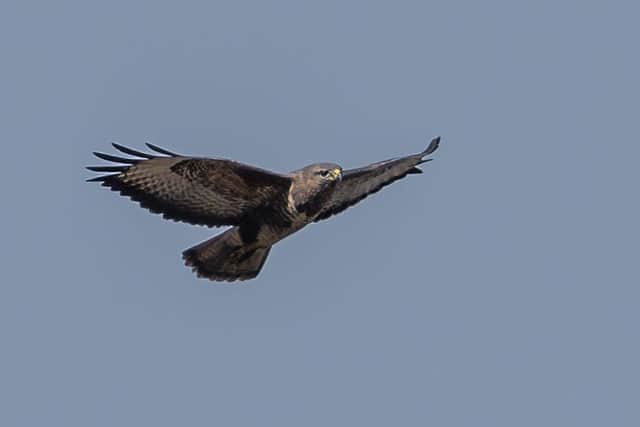

Buzzards regularly mate for life an as the weeks pass they’ll soon be doing their spectacular flying displays.
Males will perform their acrobatics plunging, rising, and diving again, or flying upside down to touch talons with the female.
It’s not that long ago that buzzards returned here in the north west of England.
I remember seeing the first one in the sky over the cottage – this early sighting wasn’t of one displaying but one on its way somewhere else.
Soon they started to be a more regular sight and eventually, 15 years ago, I found the first nest in out woodland.
Two chicks were successfully reared and were a welcome addition to the local population.
The buzzard was once hunted virtually to extinction from lowland Britain, but now it is back with a vengeance, soaring aloft in greater numbers than it has done for over two hundred years and fast becoming Britain's most common bird of prey.
Once persecuted by gamekeepers as vermin, the tide has changed for the buzzard and its population is booming.
A study, published in the journal British Birds, estimated the population at between 44,000 and 61,000 pairs in 2009.
That was a sixfold increase on the bird's population since 1972 and meant that the buzzard had overtaken the kestrel and the sparrowhawk to become Britain's most common bird of prey.
Now the buzzard population has again increased and there may now be over 75,000 breeding pairs across the country!
From just a few pairs in lowland areas in 1910, buzzards began a slow recovery when many gamekeepers were called up during the Second World War.
Keepers had hunted the bird, believing it to be a threat to pheasants and partridges.
In Britain, the buzzard does not migrate and rarely wanders more than 30 miles.
It hunts mainly from a perch camouflaged against a tree and sits for hours waiting for food to pass.
Yet it also soars into the air to prey on rabbits, rats, squirrels and weasels.
When such prey is scant, the buzzard eats carrion, but it only needs a frugal 140g (5oz) of food daily to survive.
Buzzards are fairly easy birds to identify.
They have dark brown upperparts with much paler underparts and brown and reddish streaks on their bellies.
There is a pale band across the breast. The primaries are almost black with a darker trailing edge. The short, broad tail is grey-brown with narrow bars and a dark terminal band. The head it brown overall with some white on the throat. Their eyes are yellow, the bill is black, and the legs and feet are also yellow – or that is how they are supposed to look.
But buzzards appear in so may colour variations sometimes it’s not that easy if you’re not familiar with them.
In Scotland they are called the "Tourists' Eagle" and I bet you can guess why!