
Nature Notes with Graham Workman: what is a ‘hooked nose sea pig’?
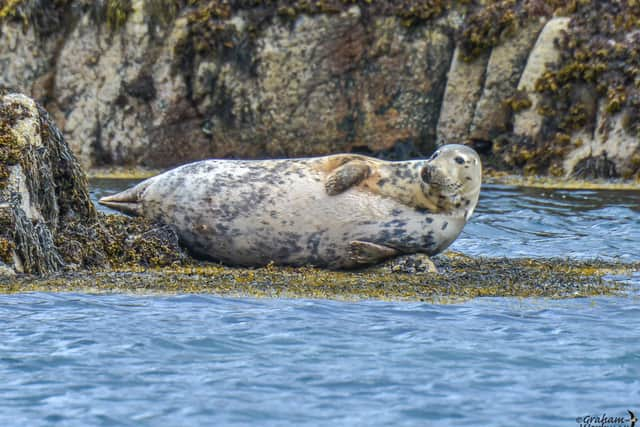
Graham Workman looks at grey seals in this week’s Nature Notes.
And now for something completely different... how about the hooked nose sea pig’?

“The what?” I hear you mutter!
That's an accurate translation of its scientific name Halichoerus grypus – but you’d probably recognise it by its more common name of grey seal.
It is also known as Atlantic grey seal and the horsehead seal.
It is distinguished from the common seal by its straight head profile with nostrils that are well apart, and fewer spots on its body.
Bull greys have larger noses and a more convex profile than common seal bulls.
Males are generally darker than females, with lighter patches and often scarring around the neck.
Females are silver grey to brown with dark patches.
Grey seals are the largest breeding seals found in the UK and bulls can reach over 11 feet in length!
They don’t appear anywhere near that size until you get close – then grief, they’re massive!
Half of the world's population of grey seals is found around British coasts, and for a pleasant change, numbers here have doubled since 1960, which is good news for the species but not for some fishermen.
This is due to their main food being cod, flatfish, sand eels and one of their favourites (and def one of mine!!) – lobster!
In the autumn, the “girls” get together at traditional pupping sites called rookeries.
Female seals produce a single pup each year and the newborn pup has a white or yellowish-white coat.
This is quickly moulted after about three weeks, to reveal a short, velvety coat similar to that of the adults.
The pup feeds from mum for 14 to 21 days and during this time trebles its weight from 30 pounds (14kg) at birth to about 100 pounds (45kg).
Forget gold top or Jersey milk, seal milk is incredibly rich and contains over 50 per cent fat!
Just what the pup needs to build up much-needed reserve blubber to insulate it from the cold sea and provide nourishment until it learns how to hunt and feed itself.
Following the weaning of her pup, mum seal will immediately seek out a mate again.
Females mate at five to six years of age. Males need a bit more time to mature and are usually around nine to 10 years old when they are ready.
Seals are incredibly vocal during pupping season and when they moult.
Young pups can often be heard calling to their mothers.
In 1946, the pioneer sound recordist Ludwig Koch made the first recording of young seals in breeding caves on Skomer.
When feeding, these “hooked nose sea pigs” can dive to an incredible depth of 70 metres.
The world population of the grey seal is thought to be around 125,000 animals.
In the British Isles there are small numbers in south-west England, but much larger numbers in the north-west of Scotland, including lonely North Rona, a small island, but home to some 8,250 grey seals.
Grey seals also occur in the Faroes and Iceland, Norway, in the Baltic and in Canada, but without question the stronghold of this our largest mammal are the British Isles.