
Nature Notes with Graham Workman: one swallow does not a summer make!
Well, the first swallows have begun to arrive so summer must be on the way!
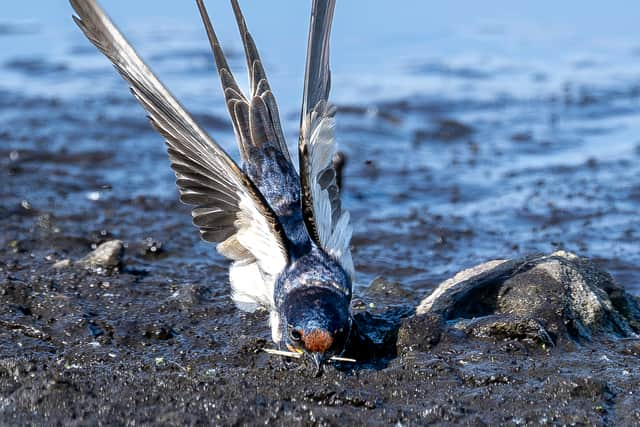
This shot is from 2025 with an adult collecting fresh mud to build the nest

So where have they journeyed from?
European swallows spend the winter in Africa south of the Sahara, in Arabia and in the Indian sub-continent.
Our British swallows go further south and spend their winter in South Africa: they travel through western France, fly over the Pyrenees, then down eastern Spain into Morocco, and across the vast waterless Sahara.
Some birds follow the west coast of Africa avoiding the Sahara, (sounds like a good idea) and other European swallows travel further east and down the Nile Valley.
Unlike other birds swallows don’t try to “fatten up” before they leave – they fly during the day and feed on the wing at every opportunity.
They will try to feed up before crossing areas such as the Sahara Desert as they could well starve to death on the crossing.
Many swallows don’t make the crossing due to starvation; exhaustion and storms take a heavy toll.
Migrating swallows cover 200 miles a day, mainly during daylight, at speeds of 17-22 miles per hour. The maximum flight speed is 35 mph.
So as you can imagine it takes a while to fly the several thousands of miles to their destinations in South Africa.
I could never understand why they fly all that way backwards and forwards (up to eight times in a swallow’s lifetime) when there are more than enough insects to go around in summer and winter in South Africa – why come to Britain?
Most of the explanation revolves around food.
In temperate and Arctic regions of the northern hemisphere, insects are abundant during a short season.
Migration evolved as a way for birds to exploit resources that are seasonally abundant and, equally important, to go elsewhere when the resources become scarce or harsh weather arrives.
However, many species can tolerate cold temperatures if food is plentiful; when food is not available they must migrate.
While this simple explanation for why birds migrate is essentially true, intriguing questions remain.
One puzzling fact is that many birds journey much further than would be necessary to find food and good weather.
Presumably, British swallows could survive equally well if they spent the winter in equatorial Africa instead of flying, as they do, several thousands of extra miles to their preferred winter home in South Africa’s Cape Province.
So why do they do it?
To be truthful I have no idea I’m just so glad they do – what would an English summer be without a swallow?!