
Oooooh look a Kite
A much more common bird now, regularly being seen in the skies around Wigan
Their scientific name is Milvus milvus. ‘Milvus’ in Latin means ‘kite’ and of course its obvious where the red comes from!
The Red Kite was persecuted to the point of near extinction in Britain, In the early 1930s, only two breeding pairs of red kites were known to survive in the British Isles, both in central Wales. But a late 20th century reintroduction programme has transformed the fortunes of this species. With centres of high population in the Chilterns, Wales, Yorkshire and eastern Scotland, Red Kites can be seen circling and drifting above major roads, farmland and woodland, even adjacent to major cities such as Gateshead.
Strikingly coloured, the rich reddish-brown tones of the bird’s plumage shine in good light, contrasting with white and dark brown in the wings, and the long forked tail is very evident. In some areas, such as mid-Wales, farms put out food for this carrion-eating raptor and large concentrations have become a wildlife tourist attraction. One of their favourite foods are earthworms, especially in spring following heavy rain they will slowly glide over fields looking for worms.
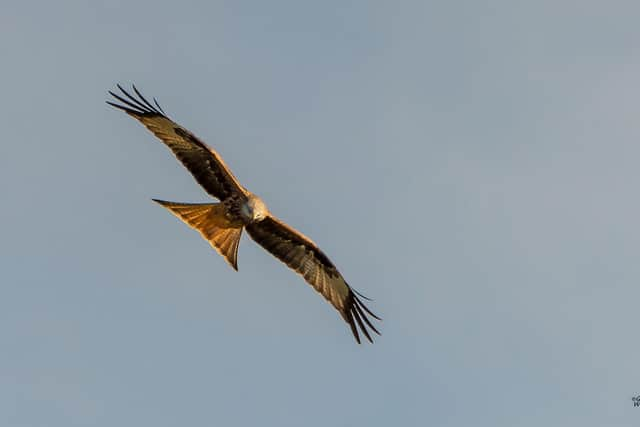

Red kites are a large bird of prey, with a wingspan of nearly 2m, and the females can be up to 5% bigger than the males. You can tell them apart from their fellow birds of prey by their glorious reddish-brown body and grey head.
They are sometimes mistaken for buzzards, but the main giveaway is their forked tail – their tail feathers fan out with a deep ‘v’ in the middle, creating a distinctive silhouette against the sky when they’re in flight. They also tend to soar more (like a kite, hence their name!), compared to buzzards which tend to flap their wings more often.
Red kites are now on the Green List, meaning their numbers are not considered to be under threat, but they have seen some ups and downs through the centuries. In the Middle Ages they were widespread and even protected by royal decree because they were so valued as scavengers and keeping streets clean that killing them was a capital punishment.
By the 16th century, however, they were reclassified as ‘vermin’ and persecuted by gamekeepers and by those who collected their eggs. By 1871 they were extinct in England, by 1879 in Scotland, and by the time efforts were made to protect red kites in 1903 only a few pairs were left in remote parts of Wales.
As well as the Red Kite there’s another Kite that’s much rarer but does turn up most years – the Black Kite. Getting into a regular visitor to Britain from mainland Europe, usually during April and May, Black Kite is more uniformly dark and with a less strongly forked-tailed than Red Kite.
Unlike others of the family black kites are more opportunistic hunters much more likely to scavenge. They spend much time soaring and gliding in thermals in search of food. Their angled wing and distinctive forked tail make them easy to identify. They are also pretty noisy blighters with their shrill whinnying call.
So look to the skies!!!!