
Wildlife expert Graham Workman picks out three different swans and shows how you can tell them apart
An object lesson from wildlife expert Graham Workman on how to differentiate between three swan species that we see in our rivers, canals and lakes
We headed to Martin Mere on Thurday to see the whooper swans that had recently arrived.
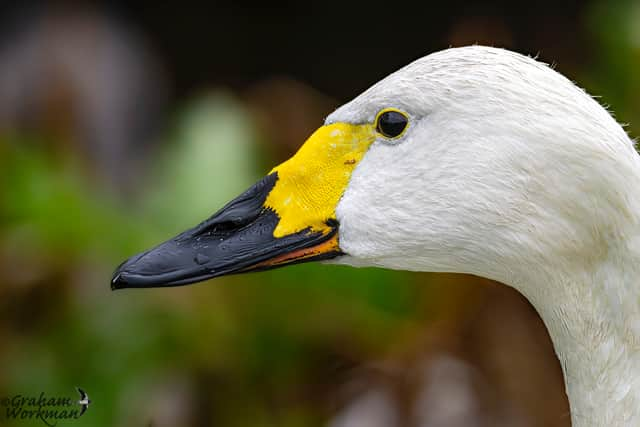

The whooper swan (or whopper swan due to its size which is a good way to remember it) is larger than our other “winter swan” the Bewick’s although they are still smaller than our mute swan.
To see hundreds of these large white birds flying into a wetland habitat is a fantastic sight as they come into land (well water actually) like a squadron of B52 bombers.
Whooper swans are an incredibly rare breeding bird in the UK, with just a handful of pairs in remote areas of northern Scotland.
The Icelandic swans that breed in Iceland are usually here from autumn to spring – October to March being the normal period.
Come spring the whooper swans will make the non-stop return flight from their wintering grounds here in the UK back to their breeding grounds in Iceland.
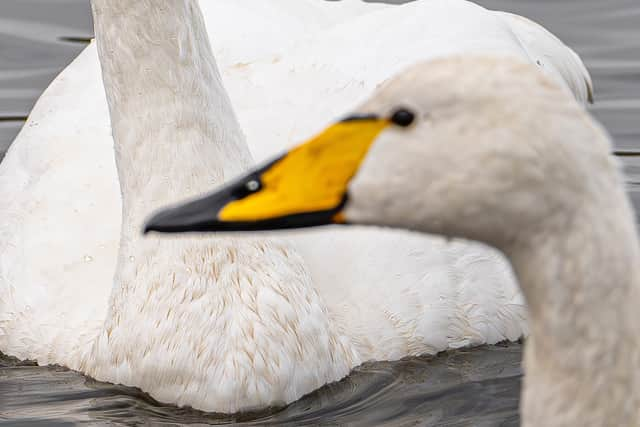
Whooper swans have been recorded migrating at altitudes up to 8,200m where the ambient temperature is -40C. Now that’s COLD!
The whooper swan is mainly a winter visitor to the UK from Iceland, although a couple of pairs nest in the north.
Most Iceland whooper swans spend the winter in Britain and Ireland, although a small proportion, of up to 1,300 individuals, remain in Iceland and this number may be related to weather conditions and food supply in Iceland at the time.
In winter we have three swans here in the UK.
Our resident mute swan, with the bright orange beak, is easy to identify.
In summertime there’s a 99.9999 per cent chance that the swan you see will be a mute.
The two that can cause some confusion, though, are the whooper and the Bewick.
The first cause of confusion is that both have black and yellow beaks.
The whooper can easily be told from the Bewick's by its larger size, longer neck and larger amount of yellow on the bill.
It is similar in size to our native mute but easily told apart by its bill colour and shape.
In silhouette, it has a straighter, less-bowed neck and holds its head more horizontally than the mute swan.
Bewick swans are becoming somewhat of a rarity with very few turning up in the North west these days. Saying that, a few usually turn up at Martin Mere most winters.
The North West European population of Bewick swans has declined dramatically since the mid 1990s and is therefore of great conservation concern.
The Wetland and Wildfowl Trust (WWT) are working with several international conservation organisations to determine the causes behind the decline by examining a combination of factors including weather and habitat changes, affecting the swans’ survival and breeding success.
They are also working to reduce the threats such as illegal shooting, lead poisoning and collisions with man-made structures.
WWT’s years of research has provided an understanding of the swans’ behaviour and ecology that is invaluable in conserving them.
Factoids
Musical utterances by whooper swans at the moment of death have been suggested as the origin of the swan song legend.
The whooper swan is the national bird of Finland and is featured on the Finnish 1 euro coin.