
Nature Notes with Graham Workman: the return of the little ringed plover
After a winter in Africa a diminutive bird is back in Wigan to breed.
The ittle ringed plover (Charadrius dubius) start arriving mid-March from their wintering grounds in Africa, reaching us in ‘tNorth by mid-April.
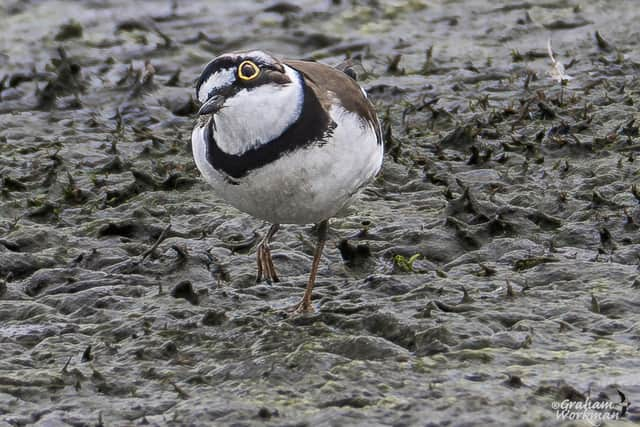

As its name suggests, it’s a small plover with a distinctive black and white head pattern, very similar to its larger cousin the ringed plover.
It has a black beak and pale (not orange) legs. Close views reveal its “dead give away ID feature”: a distinctive yellow eye-ring.
When in flight it shows a plain brown wing without the white wing stripe that its cousin the ringed plover has.
It’s pretty recent really when the first pair were recorded breeding in 1938, and since then ,thanks to man (and it’s about time our actions resulted in some plus for biodiversity), it now breeds in a large part of England and Wales during our summers.
This colonisation is basically due to us providing flooded gravel pits, reservoirs and quarries replicating their preferred gravelly habitats. It goes to prove that if we make the living conditions right, eventually lost species may return!
When I managed Pennington Flash we brough in cockleshells from a sand processing plant in Southport and made spits and bays to attract LRPs (as they’re known in Birding Speak) and it worked: we soon had them successfully nesting.
Then a problem began to manifest: Canada geese - a non-native goose that has established populations throughout the UK and has large broods. It’s quite usual for them to lay more than 12 eggs, most of which successfully hatch.
Then the trouble begins. The parent birds would lead the goslings to the spits and bays where soon there could be over 60 goslings wandering en mass in a crèche.
They easily disturbed the LRPs and many times actually crushed the unprotected eggs after which the plovers would move on to other sites away from Pennington.
We had to control these unregulated breeders in a humane way with no impact on the parent birds: just managing their nest sites and number of eggs laid.
So working with Natural England we developed measures to reduce the impact of the geese’s breeding – and this was done under licence from Natural England. Once we had implemented this the LRPs began to thrive again.
LRPs are fully migratory in much of their range. The European (including ours) and North African populations migrate across the Sahara Desert between late-July and early-September (leaving breeding grounds June to mid-July) to reach their wintering grounds in tropical Africa from late-August onwards. T
hey then do a full reverse and return to their breeding grounds from mid-March, where they breed April-June (Europe) or March-May (North Africa).
Their nest, and I use “nest” in its wider description, is usually a shallow scrape on loose sand, dry mud or on flat, bare rocks surrounded by mud or sand.
They will also nest among sparse vegetation in the vicinity of water, and often on small islands.
Another of man’s “habitats” they have been recorded nesting on are flat gravelled roofs!
Little ringed plovers are listed as a Schedule 1 species under The Wildlife and Countryside Act which gives them special protection.