
Wildlife columnist Graham Workman introduces us to a Wigan all-year resident: the great spotted woodpecker
Wildlife columnist Graham Workman waxes lyrical on some all-year-round feathered friends of a Wigan park
It seems to have been a good year for the great spotted woodpecker in our woodlands at Haigh this year.
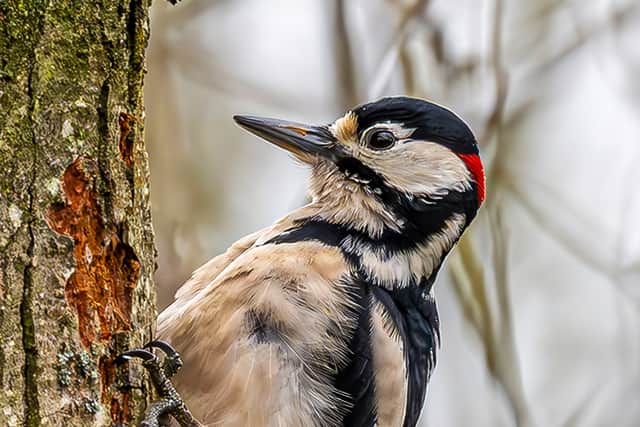

There are definitely more around than usual.
It's so important to leave “standing deadwood” as well as “fallen deadwood” for woodpeckers but a whole list of other wildlife benefits starting with the wood-boring invertebrates and then all the animals that feed on them.
They are also handy nesting and roosting opportunities for birds like woodpeckers and owls, plus bats, who'll happily move in to a disused woodpecker hole or a natural hole or crack.
The great spotted woodpecker is the most common woodpecker in Britain.
In parts of the country, here in Wigan included, they regularly attack wooden nest-boxes.
The eggs and, more commonly, the young of blue tits, great tits, coal tits and nuthatches have all become victims.
The woodpeckers usually gain access to the nest by enlarging the box entrance so many were fitted with metal “shields” to protect the front.
It shows how birds learn within their environment because nearly immediately nest boxes were being attacked from underneath by drilling through areas where there was no added protection!
The great spotted woodpecker is a really easy bird to recognise because of its distinctive drumming and call and also by its colours and “bouncing” flight.
The plumage is striking black and white with bright red under the tail. Males have a distinctive red patch on top of the head and young birds have a red crown.
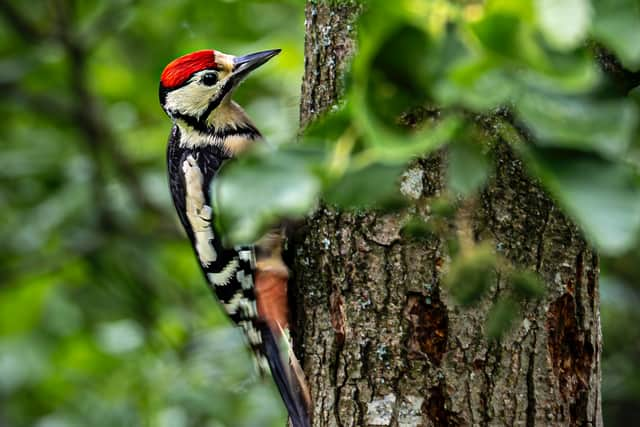
When searching for food, a great spotted woodpecker usually lands on a tree trunk then works upwards and often from side to side.
The great spotted has a varied diet changing with the seasons.
During spring and summer it feeds largely on insects, especially ants and the larvae of wood-boring beetles.
Holes may be chiselled up to four inches deep.
But in autumn and winter the birds switch to a variety of fruits, seeds and nuts.
Our new arrival, the nuthatch, does the complete opposite and works its way down the trunk, so it’s probably looking in cracks, splits and fissures that wouldn’t be looked at by the great spotted.
It was around the time that the nuthatch colonised Haigh that sadly we lost one of the three woodpeckers, and our largest - the green woodpecker that nested regularly around the cottage.
It was such a distinctive call that couldn't be mistaken for anything else.
The call is known as the yaffle. It's a loud, sort of laughing call and the bird is also known as a yaffle in many parts of the UK.
Compared to other woodpeckers, green woodpeckers have relatively weak bills.
When excavating their nest holes in trees, they usually only chisel into soft wood, and they rarely drum to communicate.
Instead, they are very vocal and use their yaffle.
Male and female green woodpeckers look similar, but adult males will have a lot of red in the moustachial stripe, while there is none in that of an adult female.
All ages and sexes have bright green plumage with yellow rumps and red caps, but in the young, the plumage is streaked with grey.