
Wildlife columnist Graham Workman introduces us to the sacred tree of the Druids
An introduction to a tree which is deadly poisonous but also lives for thousands of years and represents both mortality and eternity
Well, I finally managed a couple of hours away from my office and reports to get into the wood with my camera.
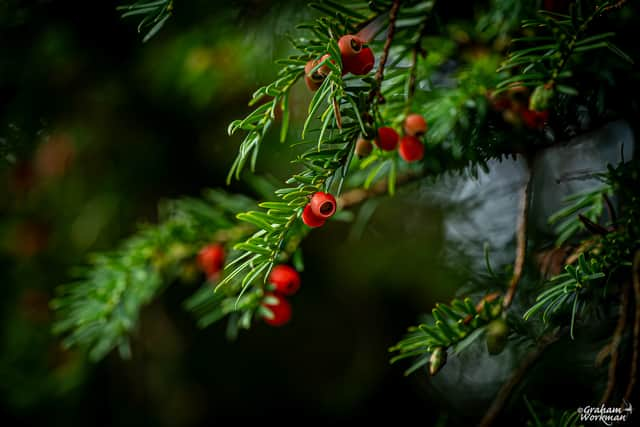

The autumn changeover is really under way now with many trees now colouring up and coming into fruit.
I’d put my macro lens on my Nikon Z6iii to give them a run before my upcoming adventure in Costa Rica.
I got the Z6iii as a back up to my Z9 (an absolute beast of a camera) which is always my go to one.
On a recent adventure someone dropped their Z8 camera and we were away from any place where she could buy a replacement so her expensive photography safari was a real heartbreaker for her.
So I decided there and then a back up camera was a necessity not a luxury. I went with the Z6iii as it’s allegedly superb for video and I need to start doing some and not relying on Marcus all the time.
Anyway, enough waffle – I headed where a grove of really old yew trees grow to see how the fleshy, flashy berries are developing.
The trees had real good crop of berries and a blackbird and mistle thrush were fully tucking in
Yew trees are definitely up there when it comes to my favourite trees: they have so much rich history, legend, mystery and tree lore associated with them going back to the mists of time and the first people of our island – whoever they were.
Its seeds, encased in a soft, sweet, bright red jacket, are deadly poisonous if eaten. Even the needles are poisonous.
But with it being an evergreen tree that lives for thousands of years, it also represents both mortality and eternity.
They have a unique ability to regenerate.
As the central trunk dies or hollows out, new branches can drop to the ground and root, or new trunks can sprout from the old root system, symbolizing natural resurrection.
This was probably one of the traits that attracted the Celts, Druids, and Norse and developed traditions that the tree yew served as a bridge between the living world and the spirit realm.
Ancient burial sites and old churchyards usually have a couple of yew trees at least.
There are two trains of thought regarding yew trees in church grounds.
One is that every village with a church had to plant yew trees for eventually being used for the famous and mighty English long bow.
The other is that the churches, when Christianly was in its infancy, were built on previous sacred spots (as a safe bet – and not to forget the Old Gods!)
The yews planted in churchyards were quickly adopted as emblems of everlasting life and the resurrection, with their red heartwood and white sap sometimes likened to the blood and body of Christ.
Yew trees are among the oldest living organisms in Europe, with some specimens estimated to be thousands of years old.
It’s easy to see why the Druids held them in such awe.
Here are a few uses the Druids had for yew:
• Kindling to build Beltane fires to mark the arrival of summer.
• They used yew staves or wands for protection, support, prophecy aids, and memorizing long poems or incantations.
• Lengths were carved with ancient Ogam alphabets for ritual and magical purposes
If you’re interested in the oldest yew tree in Britain, it’s in Fortingall Parish Churchyard, Perthshire, Scotland and is Between 2,000 and 5,000 years old (dating back to the Bronze Age).
One amazing fact is that to combat their reputation as deadly poisonous trees, yew trees are used to make the cancer chemotherapy drug paclitaxel.