
Another Encounter
This time just a few miles away not 6000!
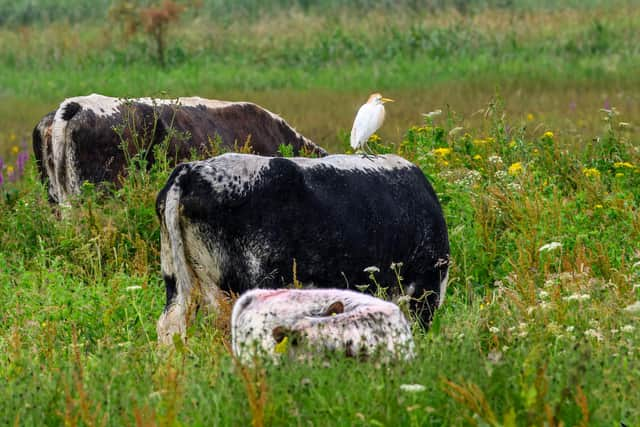
Talk about Déjà vu!!! A couple of years ago Marcus and I were watching Cattle Egrets on the backs of Cape Buffalo in the tall grass on the edge of the Kalahari Desert! This Sunday we were watching Cattle Egrets on the backs of English Long-horn Cattle. So, what’s the difference – our Kalahari encounter was around 6,000 miles from home in Botswana Southern Africa – the second about 15 miles from home in Lancashire!
Strictly speaking, the Cattle Egret Bubulcus ibis is not an egret, despite the similarities in plumage to the egrets of the genus Egretta. So not really an Egret more of a member of the Heron family and the single example of the monotypic genus Bubulcus. Some ornithologists regard two of its subspecies as potentially full species, the Western Cattle Egret and the Eastern Cattle Egret. Although similarly and mostly white, where there are hints of orange and yellow the eastern version is more strikingly colourful than the western.
Is their colonisation of the UK due to climate change?

The effects of climate change on our birds are becoming ever more obvious, with quite a few Mediterranean species moving northwards and becoming more regular and some actually breeding in Britain. The best evidence for this is through the heron family, with first Little Egret and now Western Cattle and Great Egrets establishing themselves as part of the British bird list. Following in their footsteps are a number of other, rarer, striking looking herons. In Britain, before 2007, Cattle Egrets would be best considered a rare vagrant. Between 1950 and 1980, the species occurred roughly once every four years, with occasional instance of multiple birds, such as in 1962 when four were recorded.
The Cattle Egret has become a more regular sight in the UK in recent years, following several large influxes. The first in 2007 saw over 200 arriving throughout Britain and Ireland and resulted in successful breeding in the Somerset Levels in 2008. Another influx in 2016 brought even larger numbers, with further successful breeding in Cheshire in 2017, during which two more colonies were discovered, giving rise to a total of 10 pairs.
Rapid population growth and range expansion is characteristic of Cattle Egret, which is now probably the most widespread species of bird on the planet, having colonised the UK, Europe, the Middle East, and North America from Africa, and Australia from Asia. So on Sunday we spent a few hours over at Martin Mere actually just watching the Cattle Egrets following a small herd of English Long Horns dashing about catching insects that were being ‘flushed’ by the moving cattle.
Another historically rare bird here in Britain, the Purple Heron has become much more common in recent years and is now classed as a scarce migrant, mainly in spring but also in autumn. After turning up for many years with some long stays in spring, it bred in Britain for the first time at Dungeness, Kent, in 2010. It is a shy and furtive species which favours large reedbeds. A couple of years ago one turned up, again at the wetland WWT Reserve Matin Mere and after a long search we eventually found the heron.