
Goshawk Adventure: Off over the border to Yorkshire
‘Dad and Lad’s Goshawk Adventure’
Its’s been an age since I last saw a Goshawk and Marcus had never seen one so that’s something we needed to rectify.
Some background on Goshawks.
Falconers have trained goshawks for more than 2,000 years; the birds were once called “cook's hawk” for their success at snaring meat for the pot.
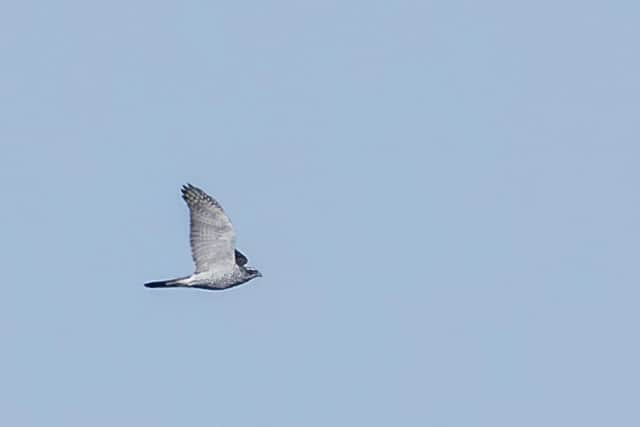

The name ‘Goshawk’ originates from the Old English ‘Goose Hawk’ due to the birds ability and that it favours ‘birds’ as its quarry. Females are usually considerably larger than the males which means taking down birds the size of a goose is no problem.
By the end of the 19th century Goshawks were all but extinct as a breeding bird in the UK. This was mainly due to loss of woodland habitat and persecution. Deliberate and accidental reintroductions have seen the population slowly recover, with an estimated 542 birds in 2017 an incredibly low population and on the edge of becoming extinct again.
Thanks to careful conservation, there are now more than 100 pairs north of the Border. And nowhere are they more at home than in some of our biggest and most productive Scottish forests.
The front of the goshawk's body is white and patterned with pale grey horizontal bars. Its head is primarily grey with a pale stripe across its distinctive, bright red eye.
Goshawks have broad wings which are grey on top and range from pale cream to white underneath. It has long yellow legs and sharp talons. They are large birds, roughly the same size as a buzzard. The female goshawk is larger than the male, and juveniles have brown feathers. In the photo look for a white shape in the larch trees – another name for the Goshawk is ‘Grey Ghost’ which again suits the bird with near supernatural powers of not being seen and if disturbed just vanishes silently into the forest.
So it was up at 0300hrs and set off at 0400hrs to North Yorkshire and the Wykeham Forest Area which covers a massive area of 2,760-acres (1,115-hectares) woodland and six miles into the North York Moors National Park.
The forest provides cracking habitat for Eurasian Goshawk year round, but especially in late winter when they're displaying. In summer a good spot for European Honey-buzzard. Common Buzzard, Peregrine Falcon and Red Kite also present. In the adjacent forest Common Crossbill, Eurasian Siskin and Eurasian Bullfinch can be seen, with very occasional Hawfinch in winter.
We’d chosen early March which with correct weather conditions we had a good chance of seeing the males and females in their display flights.
What a day we had! With five different Goshawks seen, displaying males and females, females calling and a spectacular female sat snug in a Larch Tree.
What a day we had and what an experience – watching Goshawks displaying, Buzzards soaring over the forest if display flights. I didn’t expect to get much with the camera and that was the case really.
We walked miles, me with all my camera gear and Marcus with the telescope and tripod but was it worth the effort OH YES DEFINITELY.