
Graham Workman column: success on our wild geese chase
Marcus and I headed for Martin Mere on Sunday
Sunday morning was absolutely pouring down and Marcus and I had organised a days birding – so weather fir for ducks it was ducks we went looking for! Well geese to be precise – for me Autumn should be heralded with the honking of geese as they fly in long skeins across the sky. We decided that a wetland visit would be the best idea and somewhere local to save on driving so Martin Mere Wetland Reserve was quickly chosen for our destination.
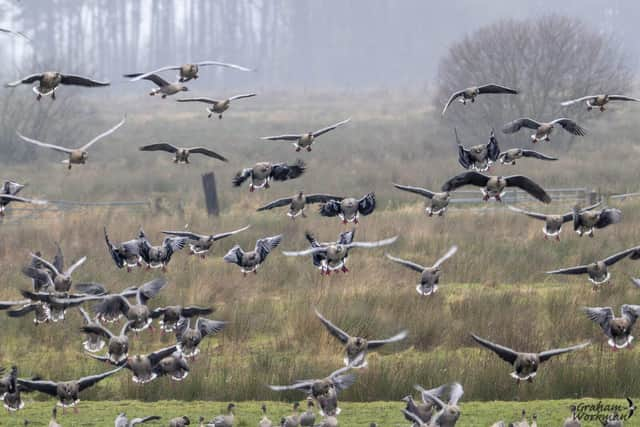
After a Cappuccino Grande each from the onsite café and we were ready for the off. So Autumn started pretty much immediately – the sky had the long lines of geese flying in and out of the wetlands – three species – Greylag, Canada and the wild goose just arriving from Iceland Pink Footed Geese. All the Pink Foots that overwinter at Martin Mere originate from Iceland then groups this time from Greenland and Spitsbergen in the High Arctic head for other areas of the UK where numbers are on the increase, particularly in Norfolk, probably due to better protection at winter roosts.
Pink footed Geese do not breed in Britain, they arrive September overwinter and the head back to their breeding grounds in Iceland, Greenland and Svalbard in Spitzbergen to breed and raise their goslings.

Well don’t breed until now!!!.......
Martin Mere WWT has had a pair of Pink-footed Geese breed for the first time in the reserve's history and they hatched two goslings!!.
The Lancashire reserve typically welcomes to 40,000 Pink-footed Geese each autumn as they migrate to avoid the harsh winters of their breeding grounds in Iceland Spitzbergen and Greenland. The first flocks usually arrive from the end of August and into September and build up to their maximum numbers mid-October to November.
Nearly all the geese make the journey back north in spring, six individuals stay at Martin Mere WWT. These birds remain at the reserve due to injuries that are not obvious but mean that they are unable to fly the long distances back to their traditional breeding grounds.
In May, a pair of these summering geese started nest-building near Martin Mere's Ron Barker Hide. The birds went on to successfully raise two goslings for the first time in the reserve's history. This is a rare event in the UK, with the world population almost exclusively breeding in Iceland, Greenland and Svalbard. (I’m off to Svalbard in Spring and hopefully I’ll see the geese on their breeding grounds before we head onto the pack ice in search of Polar Bears and Walrus)
It will be really interesting to see what these two goslings do come Spring. Will they stay with their injured parents and become the nucleus of a breeding population in the UK or will something in their race memory click and they’ll join the thousands flying north!
Then another brilliant successful breeding – Bittern have bred on the reserve as well this year with seven young ‘Bitterlings’ reared from two nests!!.