
Graham Workman column: When its Spring again...
I was really pleased when having a wander around the woodland to see swathes of little white heads nodding in the breeze.
I was really pleased when having a wander around the woodland to see swathes of little white heads nodding in the breeze. The Snowdrop Galanthus nivalis (The word Galanthus is of Greek origin, and roughly signifies 'milkflower', referring to the white coloration of the flowers. Nivalis means 'relating to or resembling snow') is not a native plant in Lancashire; indeed, current botanical opinion is that it is not native anywhere in Britain, for despite the apparently 'wild' appearance of some colonies, it was not recorded 'in the wild' until 1778. The first garden reference is way back in Gerard's Herbal of 1597.
It is thought that monks may have brought snowdrops to Britain from Italy in the 15th Century, as the flowers are frequently found in the gardens of old monasteries. Nevertheless, a large drift of Snowdrops on a freezing cold winter’s day on a roadside verge, deep in woodland or in a churchyard is a fantastic sight. Snowdrops are said to be the first flower of spring, symbolising purity and the cleansing of the earth after winter.
Snowdrops can also be a clue for the budding archaeologist, for a large patch of Snowdrops in a wood often marks the site of a forgotten tumble-down cottage. The snowdrop's origins in this country are as interesting as its cultivation. This emblematic flower's native home is the mountains of central and southern Europe - its delicate display of hardy beauty ensured its appeal and transport to our shores several hundred years ago. Although it may not be native to England, it has long been naturalised in moist woods, road verges, parks and churchyards.
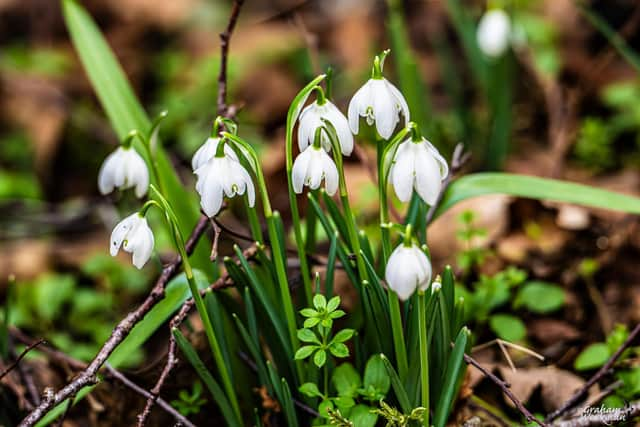

Its frequent occurrence on religious sites may well be associated with the coincidence of its flowering period with Candlemas, on 2 February. The delicate, faintly honey-scented flowers have white outer petals and a shorter inner ring with a green mark. It is a bulb plant in the lily family, with tough, grey-green leaves that extend after flowering. These have a tough sheath protecting the growing tip from damage as it chisels its way up through cold-hardened ground. 'Snow piercer' is one of many common names.
According to legend snowdrops first appeared when Adam and Eve were driven out of the Garden of Eden, to a land where it was winter: cold, snowy, dark and barren. An angel consoled them by promising that, even here, spring would follow winter. As a token, he blew upon some falling snowflakes which, as they touched the ground, were transformed into snowdrops. In this way, Hope was born.
Ever since then, snowdrops have appeared during the bleakest winter weeks as a sign of the better times to come. Because of their presence in churchyards, snowdrops folklore foretells ill-luck if brought into the house. In some parts of the country single flowers are viewed as death-tokens. Many superstitious people will not take snowdrops indoors, and the sight of a single snowdrop blooming in the garden is taken as a sign of an impending disaster!!