
Graham Workman: Little Auks
How frustrating can getting a photo be!!!
Well I’ll share one last shot and one of the most annoying and frustrating photo capture from my recent Arctic expedition. This was trying to get a decent shot of a Little Auk. All of the areas where little Auks nest are protected and landings are not allowed which is a really good conservation measure.
So any and all shots had to be taken from the Zodiac, and here’s where the first challenge began. To get near to the colonies we had to be pretty close to the cliff which meant a really choppy sea. Sat in the bottom on my bottom of a bouncing rubber boat without being thrown around is a major challenge in itself.
The next ‘limitation’ is the Little Auk’s diminutive size – we are talking Starling or small Song Thrush with jet black upperparts and brilliant white body. Then their preference for nesting in or on cliffs where they can squeeze in or under boulders doesn’t help in the slightest – a small black and white bird pressed up against a light-coloured rock background makes manual focusing impossible. Next include being tossed about sat on the floor of the Zodiac and that’s about the size of it.
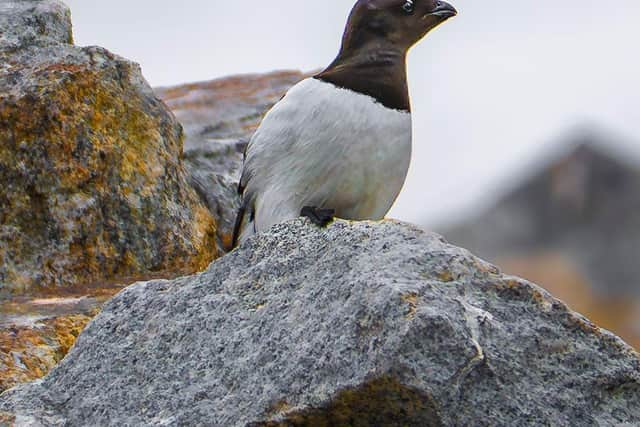

Out of 900+ shots took visiting three different colonies during the expedition just a handful are ‘usable’. Which is so frustrating with Little Auks being such a good-looking birds.
The name Litte Auk perfectly describes the bird as it’s a little auk (other larger members of auks are Puffin, Razorbill, and Guillemots.
It has a black stubby bill, and a short neck and tail. It flies with lightning-fast whirring wingbeats, usually very low over the sea. We get them in small numbers here in the UK during the winter. It breeds up here in the Arctic in massive nesting colonies. Svalbard holds around 90% of the world's breeding Little Auks. Most of the population breeds in colonies in the southwestern and northwestern parts of Spitsbergen, especially in Hornsund, Bellsund and the area around Magdalenafjorden. A total of more than 200 colonies/breeding areas are known within Svalbard. Estimates for the world breeding population are difficult to assess but the European estimate of around 80 million individuals gives some insight into the numbers involved. Little auks breed in unvegetated screes (areas of loose rocks) and also in rock crevices. The largest colonies on Spitsbergen are typically of the scree type. In the major breeding areas, the slopes of the mountains are covered by screes formed through frost erosion; they are often found from 50 to 300 meters above sea level. The breeding density in the screes seems to vary with the size of the stones, with coarse screes having the highest densities of nests. Breeding in rock crevices is common over most of Svalbard, and is likely related both to a lack of suitable scree habitat and to earlier snow melt on cliff faces.
I did manage a few decent shots of Little Auk in the end but getting them was no easy task!!!