
Graham Workman: The Arctic
I headed north a couple of weeks ago on an expedition to photograph the wildlife of the High Arctic
Just got home after a couple of weeks in the High Arctic on an expedition photographing the special wildlife that lives in this frozen land where the Polar Bear is King. Firstly I flew to Oslo for an overnight in the Radisson Blu then an early flight to Svalbard where I would meet the ship that would take me north up past the 80degrees north. We had perfect weather and very good sea conditions we meant we were able to sail north of the 80 degree latitude. Knowing that I was only 10° away from the North Pole is was something I’d had on my bucket list for years
We saw lots of Walrus and being a pretty social animal, they were mainly in large groups either on the shore line, on floating ice sheets and small icebergs and on the edge of the pack ice – all these ‘haulouts’ had instant access to the water. They may be graceful once in the water but they are somewhat ‘lumps’ when it comes to moving on land – especially when they try to move ‘quickly’. I have come to the conclusion that my spirit animal must be a Walrus!!
There are two main sub species of walrus, the Atlantic and Pacific – which both occupy different areas of the Arctic. The Atlantic walrus which is the one we encountered around the coast of Svalbard, lives in the seasonally ice-covered northern waters of Canada, Greenland, Norway and Russia.
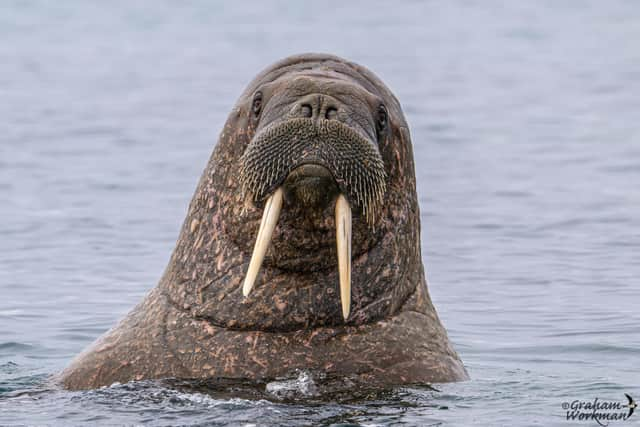

The Pacific walrus has a wide range between Russia and the US (Alaska), from the Bering to the Chukchi Seas, as well as the Laptev Sea. There's thought to be around 25,000 Atlantic walrus and a significantly larger population of around 200,000 Pacific walrus in the wild.
Both male and female walrus have tusk’s which have a number of uses – like a natural Swiss Army knife – they use them to haul themselves out of the water and onto the sea ice, for keeping breathing holes open in the ice, fighting with other walruses, and for defence against predators. I would not like a prod with one of these toothy weapons!
They are mostly found in shallow water where they feed entirely on clams, molluscs, worms, snails, soft shell crabs, shrimp and sea cucumbers – mmmmmm tasty!!
Walrus absolutely stink!!!
We could smell them well before we got anywhere near them and one of the main threats to Walrus is disturbance so we kept well away and quietly moved ourselves up wind of the group. They are not exactly neat and clean animals. They belch and fart constantly. Which is probably the results of a diet of clams, mussels and crabs does to their digestive organs.
I wouldn’t say Walrus’s (or is it Walli?) rate highly in my Top Ten Favourite Arctic species but I do admire the fact that they are perfectly adapted to their life in the cold! They’re fairly long lived on average around 40 years.
Sadly Atlantic walruses are still hunted primarily by Indigenous communities for subsistence purposes, not commercially. While commercial hunting is outlawed throughout their range, Indigenous groups like the Inuit are permitted to hunt them for food, traditional tools, and crafts. However, illegal hunting for tusks ("head-hunting") remains a problem in some areas.
Next Week the mighty Polar Bear.