
Meet Julia Sixsmith, owner of Hindley's only hedgehog hospital
Julia Sixsmith lives the typical life of any 68-year-old British woman, to a certain degree. She wakes up early, at the side of her husband Cyril, before getting dressed and sticking the kettle on for her ritualistic cup of early-morning coffee.
She takes her mug, and heads westward; the settee sits just inches from her kitchen doorway, edging closer and closer, and closer, and –
Brr-ring! Brr-ring!
The phone goes off, a belated alarm clock; Julia’s day has finally begun, in a similar way to how it has for the past 3 years: a local hedgehog needs her help, and the idyllic early-morning coffee will have to wait again.

To many her age, this might seem a tumultuous and distressing morning routine; for Julia – a counsellor-turned heroic hedgehog carer-campaigner, rooted firmly in the cosy suburban, hog-cobbled backstreets of Hindley – it’s just another day.
“I’m a doer, I need to be kept busy - I can’t just watch Loose Women,” she started; she clearly isn’t a Ruth Langsford fan. “I can’t think of anything worse.
“You’ve got to have a sense of purpose – a reason to get up in a morning.
“I certainly have.”
Julia’s working life has been nothing short of intensive. She started out as a youthful, fresh-faced NHS nurse 50 years ago, before dropping the pale blue scrubs after 26 years to plunder into the complicated world of psychotherapy and counselling. A student at heart, she never truly could settle into retirement when it fell at her feet in 2021 - she needed something to devote herself to.
And then, overnight, her world changed; a brief discussion with her neighbour John about 3 little hedgehogs, plodding along at the bottom of her garden, had her hooked. A bag of hedgehog food and a feeding station later, that was it – utter, unflinching devotion.
“It has taken over my life; I’m busier now than when I was working, and it’s costing me my NHS pension – but it’s the best job I’ve ever had.” she told me.
In 2021, Julia met Irene Thomson of Lowton Hedgehog Rescue; she doesn’t hesitate to lay on the praise, to a woman she says knows all there is to know. It becomes abundantly clear that one of Julia’s biggest star qualities is her eagerness to learn from those around her – but truthfully, as I sit here in her cosy, hedgehog-adorned living room, listening to her speak so eloquently about the things she loves and loathes, I begin to wonder how much more one could possibly know than Julia.
“She is my guiding light,” Julia tells me. “She’s been doing it for 15 years.
“I still do my shift there every Wednesday.”
She describes one of her very first patients – a hedgehog named Alistair, the very first hedgehog she’d hand-reared, who had fallen ill with age.
“I was meant to give him injections – he’d been a little hedgehog that just walked straight onto my hand from being a baby, and I had to inject him.
“That hurt me as much as him. I had to hand him to Irene,” she uttered, with a slight reflective pause. Julia is well-grounded, a resolute ex-nurse who has seen it all again and again and again – but she’s also a staunch defender of animal welfare, a vegetarian of 55 years, and a woman who is deeply in touch with her humanity. Emotions are only human, and Julia has so much humanity about her. After a moment, she goes on:
“If you're in this job, it's because you're a kind, caring person,”
“But there's a price to pay for that – it’s so sad when they don't make it.
Julia’s at-home hospital functions as a satellite for Irene’s rescue; they’re intrinsically intertwined, mutually dependent upon each other. When one is full, unable to house any more patients, another steps in. Between them is a relationship strengthened by their passion; a relationship for the benefit of a population devastated by another: hedgehogs, and humans.
“If you look at the word ‘hedgehog’, they’re from hedges. You won’t find a hedgehog in the middle of a field. So, if we open up the fields and get rid of the hedges, they’ve nowhere to go.” Julia tells me.
Hedgehog Street’s 2022 State of Britain’s Hedgehogs Report describes Britain as ‘one of the most nature-depleted nations in the world’, with a third of the UK’s rural hedgehogs lost in the past two decades.
It states: “The continuing loss of a generalist species such as hedgehogs is the ‘canary in the coal mine’ – we need to recognise our dependence on the tapestry of natural habitats and species. That tapestry is becoming threadbare.” It’s a call to arms, a profound signal of how far we’ve let our nature fall.
Julia offers to show me the upstairs clinic - of course, I oblige. Quickly, she hurries herself up from the couch, and enthusiastically scurries through the doorway to my right; I’m barely to my feet, and she’s halfway up the stairs, shouting down to me as I lag behind.
“This is my examination room,” she tells me, as I just about catch up behind her.
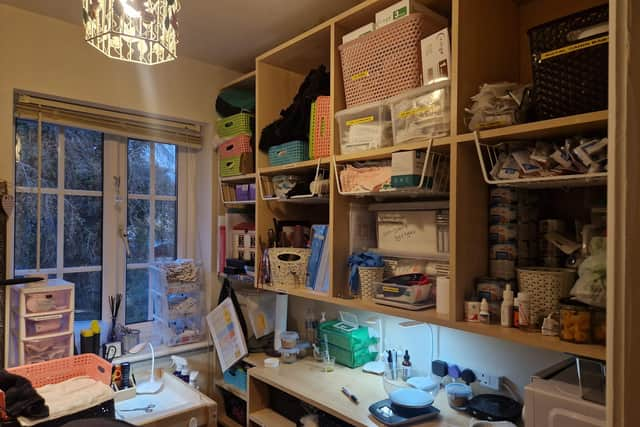
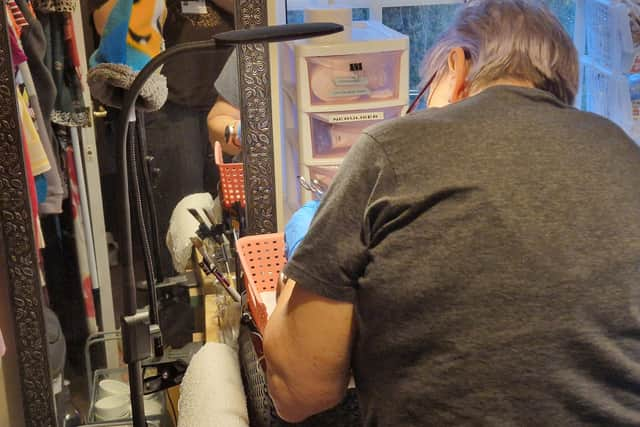
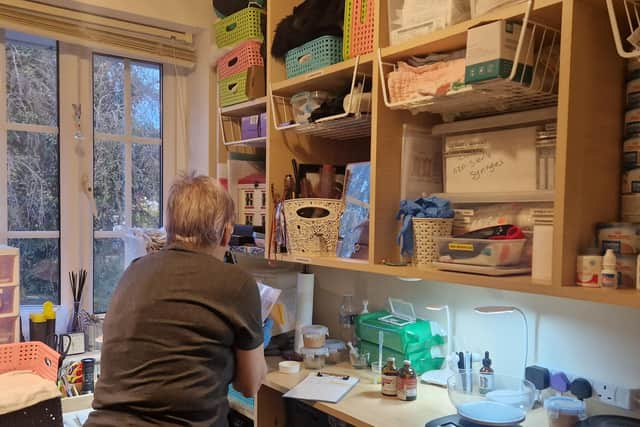
I almost fall back down the stairs at the sight of it. Gazing through the doorway, my eyes dash and dart between this and that; the room is brimming, from the deck to the ceiling, with everything a hedgehog rescue could ever need – syringes, scales, lamps, saline solution, flystrike and maggots remedy, nebuliser, sterile gloves, heating pads; the works. Julia stands in the middle of the room, grinning back at me. “I can’t do things by halves,” she tells me – though she needn’t have bothered.
She takes me through a day in the office: the hedgehogs are examined and treated as they come in. They are noted onto the registry, and allotted a set of treatment timeslots based on their condition. It’s a procedure curated carefully with a blend of total precision and abundant adoration, at the hands of a woman who would do anything to see her hedgehogs on the mend.
As we speak, she darts from room to room – to the left of the examination room is the hedgehog’s ward, where a ram-jam plethora of spines and prickles cocoon themselves in the comforting warmth of woollen blankets and heated mats, enveloped by full bellies and the lasting effects of compassion. Julia runs me through the lot of them, addressing each of her patients by name and telling me a little bit about them as she does. I can’t remember all of their names – they’ll have to forgive me, next time – but one in particular stuck with me: Billy.
“I was wondering: what shall I call him?
“And then I remembered you were coming on Thursday and thought ‘Billy it is!’,” she chuckled, wearing a familiar warmth across her face.
Billy was admitted to the hospital on Wednesday, with a bout of internal parasites. He was found by a local woman in the street, and was collected from Golborne Vets the following day.
“It’s okay sweetheart,” she softly reassures, as she gently helps him from his bed. Billy is due an injection, to set him on his road to rehabilitation – not before a quick photo opportunity, mind.
“Isn’t he beautiful?” she beams, holding him mightily with a sort of maternalistic pride. Into the examination room, and he’s set upon the scales. He’s up 20 grams since the morning.
Julia prepares his syringe carefully, whilst gently placing little Billy in situ. She covers his face, and prepares his injection site; before he knows it, it’s done.
Billy is set on the road to recovery, and Julia may sleep a little easier in the knowledge.