
Wigan hospital trust says jelly drops will improve the borough's dementia care
Wigan health chiefs are hoping they will enjoy sweet success with a dementia care improvement plan.
For Wrightington, Wigan and Leigh Teaching Hospitals NHS Foundation Trust (WWL) is introducing jelly drops as a way of enhancing the quality of care for those suffering with dementia as a way of helping them to stay hydrated when they are struggling to drink.
Mark Oakley, Lead Admiral Nurse pitched the idea to WWL’s Patient Experience Group, and, after a successful presentation, was provided with the funding to roll it out for a three-month pilot.
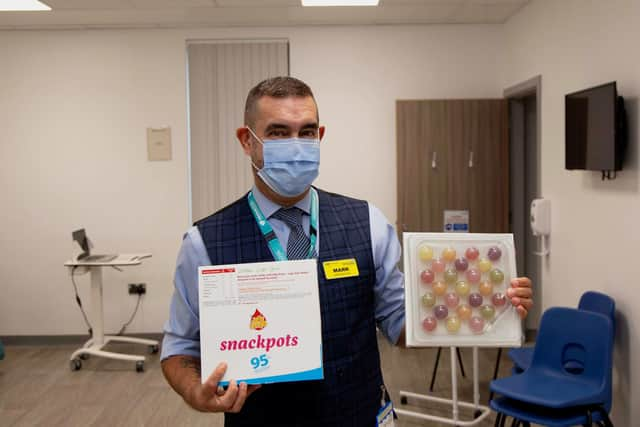

Mark specialises in providing care for patients and helps carers gain the skills they need to assist with dementia care.
Mark said: “As an Admiral Nurse my role is to advocate for the patients living with dementia who may not have a voice or forget they need something.
"When it comes to our patients and their experience, I want to ensure all our patients get the best possible care.
“We need to think of innovative ways of caring for patients with a dementia diagnosis as this group of patients are not always able to tell us why they do not want to do things, or do not like certain things.
“So far the feedback from the wards has been very positive about the project and we’re going to be working together on this pilot to do all we can to make a difference.”
Rabina Tindale, Chief Nurse at WWL commented on the forthcoming pilot saying: “Here at WWL we are committed to finding new and innovative ways to provide quality care to all our patients.
“The jelly drops pilot is another example of this, and we hope that this will help us build on the excellent care we look to provide for our patients living with dementia.”
Each of the drops, this recipe of which was invented by the grandson of a lady suffering from Alzheimer’s disease as a way of encouraging her to increase her fluid intake, is made up of 95 per cent water.
As well as helping those patients who are reluctant to drink or show signs of dehydration, they can also help improve oral hygiene and reduce the risk of malnutrition.
The pilot will be trialled at the Wigan Infirmary site at Standish, Aspull, Winstanley and Bryn wards.
Should it prove to be a success, Mark will look to carry on using jelly drops to help those living with dementia.
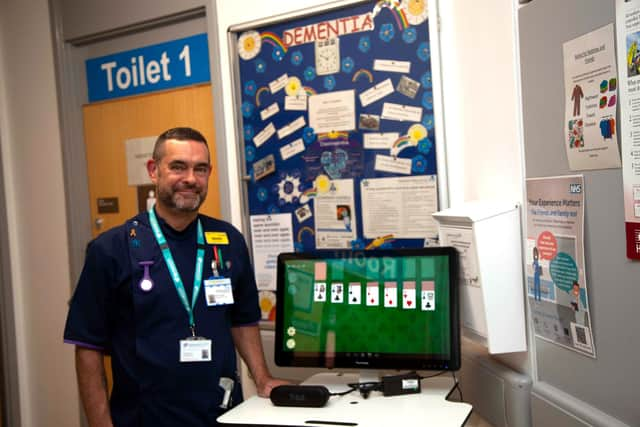
He also led the way in bringing in a Reminiscence Interactive Therapy Activity (RITA) system, which was introduced to WWL wards in March, and gives patients access to a wide variety of interactive content.
It is a relatively new tool in the fields of nursing and healthcare and utilises user-friendly interactive screens and tablets to blend entertainment with therapy.
Each screen allows patients to enjoy relaxing music, watch archived BBC news footage and view old photographs to help spark memories and spark conversations on the wards.
Since RITA’s inception, films and music have proved to be popular, with two patients, who were previously very quiet, starting to interact whilst watching a “Carry On” film.
This has resulted in some patients feeling less isolated, but it has also encouraged another patient to listen to music and, as a result, ask for something to drink when previously colleagues were struggling to get them to drink.
Mark said: “Quite early on in my role I realised that there were limited activities that we were able to offer staff and patients with dementia to actively interact and engage.
"With my knowledge about the RITA system, I felt I should champion this for our patients and actively sought funding to purchase and provide this.”