
Human remains dating back 4,000 years are being uncovered in a Wigan village
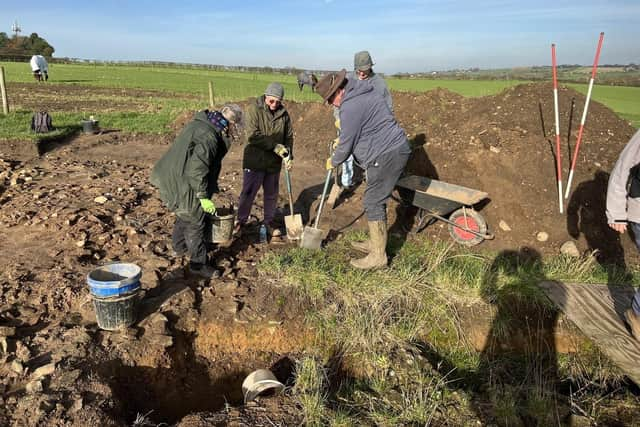
A 4,000-year-old Bronze Age cemetery full of ancient human remains is being excavated in a Wigan township.
And the team of enthusiastic archaeologists believe the origins of the site in Aspull could stretch further back to the Neolithic or Stone Age.
The members of Wigan Archaeological Society have been digging on the farmland for four years and have uncovered numerous human bones which are the remnants of funeral pyres – the Bronze Age form of cremation.
Unlike modern-day cremations, funeral pyres left bones intact, which can be clearly identified as human.

A scientific process known as radiocarbon dating has enabled samples from the site to be validated as belonging to the early part of the Bronze Age, which last 1,000 years until about 1,000BC.
The society’s secretary and editor of its online website Bill Aldridge believes the oval shape of the site which is surrounded by an ancient ditch gives a clue to the site’s possible pre-Bronze Age history as a ‘Henge’ dating further back to the Stone Age, 12,000 years ago.
Bill said: “Radiocarbon dating is carried out at various universities, like Oxford, Queen’s in Belfast and Edinburgh.
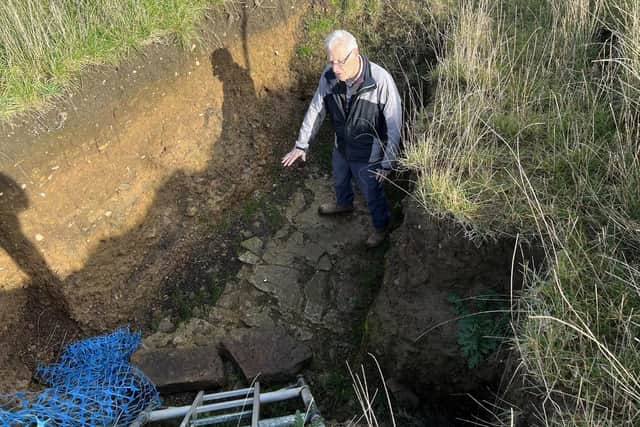
“It enables samples from the site to be dated to within an accuracy of 200 years.”
And volunteers digging at the site yesterday unearthed an intact cremation urn from the Bronze Age, which still contained fragments of human bones.
The archaeologists have asked the Local Democracy Reporting Service not to reveal the precise location of the site to prevent it from being plundered or vandalised.
Bill added: “Everyone we know in the archaeological world has been amazed at what we’ve found because it was so unexpected.

“When we first found evidence of human bones, we had to call in the police and the coroner to ensure that the remains were not recent or evidence of a crime.
“It took some time for it to be established that the remains were thousands of years old, so we could carry on with what we are doing.”
“Wigan has a rich history, particularly in relation to the town centre. In 2005, the remains of a vast Roman bathhouse were discovered during construction work on the Grand Arcade.
“And in 2008, the remains of an Apostle Fort were discovered in the town centre.”
Wigan is widely believed to have been a significant Roman settlement, then known as Coccium, situated in the key strategic location between Manchester and Ribchester.
According to Bill, archaeologists have yet to find the Roman road from Wigan to Ribchester, although the road from the town to Manchester has been found.
Last year Wigan Today reported that Wigan Archaeological Society members had been unearthing ancient treasures and revealing a previously unknown monument thought to date back to 1650 BC on open land at Aspull.
The enigmatic site first came to their attention in 2019, when a near-circular cropmark was spotted in overhead images seen online.
Further ancient relics in the area are currently on the move. The remains of a Roman hypocaust, which has stood next to the Grand Arcade for many years, is now being transferred piece by piece just a few dozen yards to a grassy area across Millgate as work on the Stack entertainment and hospitality hub at Debenham’s former home continues.