
I lived in Wigan during the Second World War: remembering a 1940s childhood

As he nears his 90th birthday, south London resident David Talbot recalls his childhood in Wigan during the Second World War: from terraced slum dwellings and schooldays to pantomimes, rationing and everyday life in the town.
I was born in April 1936, and we were in the process of moving to Birmingham with my father in 1939, as his newspaper job had relocated.
He was in his 30s, not called up when war broke out, but the BBC did ask him to be a radio broadcaster based in London first, before being sent out to report the war in Egypt in early 1942.
By that time, my mother and I had already moved to be with her parents in Wigan, where Grandaddy was the Borough Electrical Engineer based in a huge Bradford House with a large garden that was next to the Works.
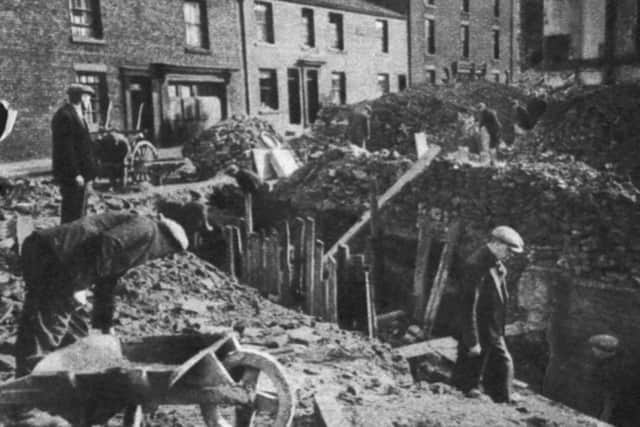
By then, I was of school age and attended a private school called Woodfield, up Wigan Lane on the other side of the town - quite a journey each day, there and back, through both the terraced slum dwellings and the town centre.
The slums bordered one side of the house our family occupied, separated from our large garden by a large brick wall.
There was absolutely no contact between them and us.
My mother would sometimes comment on some of the shocking things she could see from our upstairs window, though I was, of course, far too young to understand what she might have been talking about.
Bradford House, with slums on one side and the Electricity Works on the other, was large enough to accommodate quite a household.
Living there were my gran and grandfather, me and my mother, my aunt Dilys and her husband David (who had their own quarters accessed by a separate staircase), my father when he was on leave, and the youngest brother in the family, Derek, when he was home from the RAF.
Another brother, Stanley (just a year younger than my mother) stayed elsewhere in the town when on leave from the RAF.
He lived with his wife Phyl in a semi‑detached house on the other side of town, along with their two small daughters, Valeria and Pamela, who were one and three years younger than me.
Other people present at Bradford House included Jack the gardener, Wally the chauffeur of the official car, and a maid servant who helped with cleaning and cooking, though my Gran was an expert in the kitchen, and her Yorkshire puddings, served first as a separate course, were really super.
Much of our fruit and vegetables, the latter especially, were home‑grown in the garden, despite an atmosphere not short of smoke from nearby factory chimneys.
The garden also had a tennis court, plus a huge lawn.
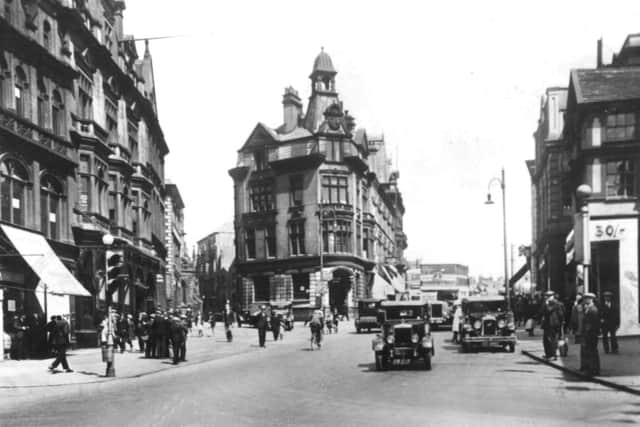
It is difficult to know where to start when describing the town of Wigan.
I have mentioned the slums, which were usually back-to-back terraced housing, but the north side of the town was a bit more middle-class with semi-detached properties as well as terraces.
A new road, Mesnes Road, had been built as an alternative route north from the town centre, and it joined the main road very near my school, Woodfield.
There were two railway stations: the main line ran south to north through the town and on towards Carlisle and Scotland, while a smaller station on the opposite side of the road had trains to Southport and Liverpool.
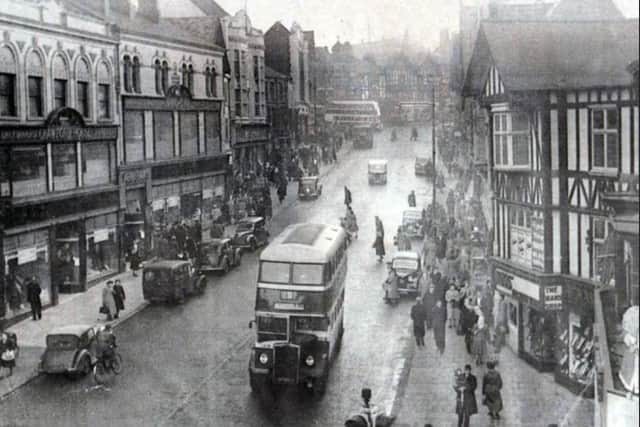
Brown‑coloured double‑decker buses served the town and surrounding areas; they had an upstairs with a recessed corridor on the right‑hand side, and the seats were arranged along the side in rows.
A word now about shops. There were two department stores in the town centre, Lowe’s and Pendlebury’s, and three bookshops with lending libraries.
The best grocer was Peterkin’s, where cash was transported from the counters to a little enclosed box of a dwelling which could then buzz back the receipts on an overhead wiring system.
It all seemed a very sensible idea to me in those days.
There was rationing then, not only of foodstuffs, with milk still delivered by horse and cart, but of clothes and shoes as well.
Allstead were the leading men’s tailors, and their son Alan attended my school.
Places for recreation included a rather well laid-out Mesnes Park, one music hall theatre and several cinemas.
The theatre at the end of King Street was known for its pantomimes.
On my first visit there as a small boy, the family sat in a box at the side of the stalls, which pointed almost as much towards the audience as towards the stage.
The pantomime was Cinderella, and I had been briefed on the plot, including the two Ugly Sisters.
Not being entirely sure which was the stage and which was the stalls, it is said that I spotted two well‑dressed ladies in the audience, both wearing hats as was customary in those days, and called out in a loud voice before the performance had even begun: “Mummy, are those the Two Ugly Sisters?”
I was quickly hushed to the back of the box, though I don’t suppose that they heard!
There were many cinemas, both in the town centre and its suburbs.
At the better end of King Street were the Court and the County, quite respectable places to attend, but this could not be said of another cinema at the bottom end of Library Street, which had double seats for couples at the back of the stalls and was widely referred to as a “flea pit”.
Needless to say, I was never allowed to go there.
The biggest cinema was fairly central but on the other side of the town’s main square, and I think it might have been used as a theatre.
I have no real memory of this, and I believe that when I went to the Court and the County, it would have been with family.
If there were children’s Saturday morning films, I was certainly not told about them.
Readers of this memoir may be surprised that there is no mention of a library.
Indeed, there was one, presumably still is, at the bottom of Library Street, but our family were not allowed to go there because, I was told, “one might catch something”, presumably from other borrowers who were not likely to be of our type of class!
Sheer snobbery, of course, but my family were pretty ignorant of the people whose main breadwinning came from the open coal mines and cotton mills that were still open back then.
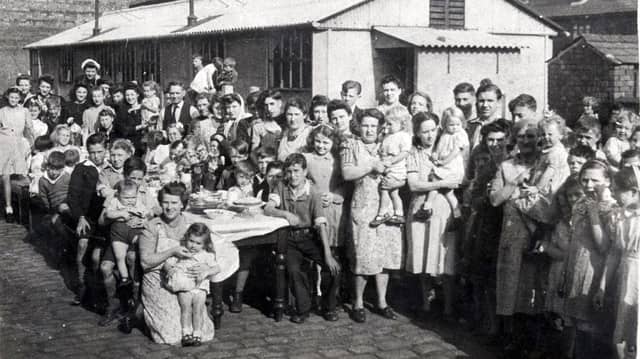
One only has to look at the picture of the children attending either my seventh or eighth birthday party to realise that they could all have been from “respectable” families in the area.
Just to digress, my best girl friend, or so I thought, is not in the picture.
Her name was Helen, and I later heard that she became Head Girl at Wigan Girls’ High School.
I would not remember these birthdays at all, if it were not for a snapshot of us all standing in a row, with two girl twins, just to be different, facing the wrong way from the rest of us!
Those twins lived on Wigan Lane, just uphill from our school, and in winter their back garden opened onto the hill’s open ground where, in those much snowier days, there was plenty of tobogganing.
Another inhabitant of Wigan Lane, a little further along, was my music teacher, though any skill imparted to me was soon lost when we moved down south after the war.
Getting me to help with my new baby brother Richard was thought, quite correctly, to be a much more important job for nine-year-old me!
Did I miss Wigan when we moved away? Well, yes, I suppose so, but having been dispatched at age nine to a Spartan boarding school in Anglesey, it did not leave much time for regret. But that’s another story.
Did I miss any of my Woodfield classmates? Well, not for long, because our family lived in relative isolation from the other families, and there was little availability for socialising outside normal class and timetabled occasions.
But I do wonder if any are still around and what had happened to them.
The only one I am still in contact with is the big sister of a little fellow, now no longer with us, who was in my class.