
The final resting place of a Wigan First World War hero has finally been identified - 108 years after he died
A ceremony in a Belgian cemetery this week will rededicate a war grave after its occupant was finally identified as a 25-year-old Wigan soldier who died on the battlefield more than a century ago.
For 108 years, a First World War casualty buried at Strand Military Cemetery in Belgium has rested beneath a headstone reading simply "An Officer of the Wiltshire Regiment.”
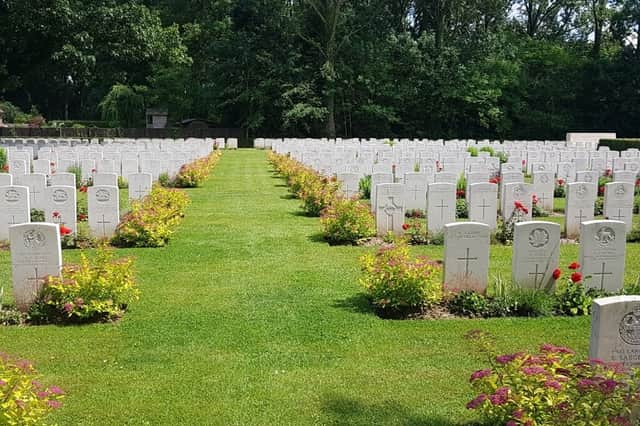

But thanks to painstaking work by a Belgian researcher and the Ministry of Defence's "War Detectives,” that soldier has now been formally identified as a Wigan ma,
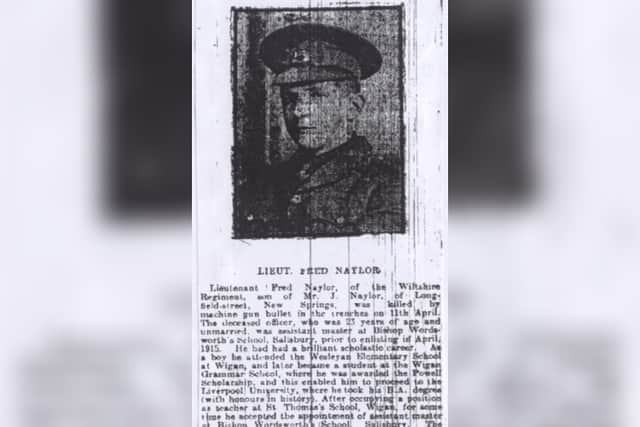
Lt Fred Naylor was a miner’s son from Aspull, and a former Wigan Grammar School scholar and local teacher.
He was killed in action aged 25 in April 1918 while leading his men during the German Spring Offensive at Ploegsteert Wood.
Although his surviving relatives (including a twice-great-niece in the US) are unable to travel to Belgium this Wednesday, his military family—represented by The Rifles—will gather to rededicate formally his headstone and restore his name.
It was Michiel Vanmarcke, a young researcher in Belgium, who decided to try and identify the “unknown officer,” having solved similar cases before and now works for the Commonwealth War Graves Commission (CWGC).
The Ministry of Defence Joint Casualty and Compassionate Centre collaborated with him.
By cross-referencing uniform insignia, recovery locations, and war diaries, they eliminated all other possibilities to prove definitively that this grave belongs to Lt Naylor.
He was killed by a machine-gun bullet while leading his men during a chaotic withdrawal during a four-day battle.
Historical records differ slightly on the exact day he fell, but regardless of the exact date, his leadership and sacrifice remain inextricably linked to the stand of the 1st Wiltshires at Ploegsteert Wood—a costly defensive action that slowed the German advance, and helped stabilise the front line in Flanders during the spring of 1918.
The successful allied counter-offensive in the summer followed, which ultimately led to victory.
The Chaplain in a letter to Fred’s father wrote: “He behaved with remarkable coolness and gallantry, and is mourned by the whole battalion with whom he was popular.
“I can only commend you to the grace of God to help you to bear the blow with courage and patience.”
David Stebbings is a CWGC volunteer and is responsible for the churcyard of St David’s, Haigh, among others.
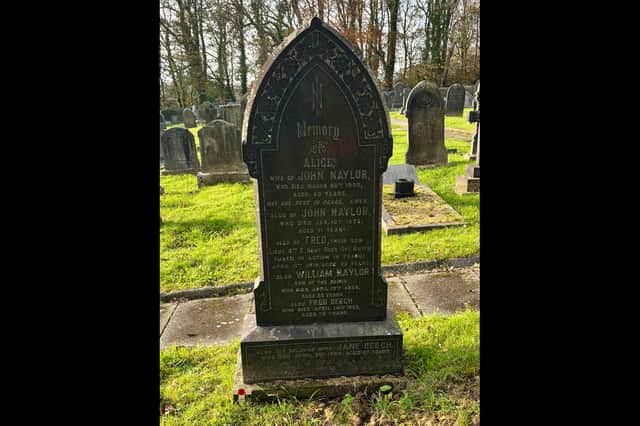
There lies the Naylor family plot. While this memorial is not one of the headstones for which he is formally responsible, he still keeps an eye on it.
Only last week David and his 12-year-old son Teddy placed a remembrance poppy cross on the Naylor grave.
He said: “This is a truly remarkable story and very gratifying that closure has been found for Fred’s surviving relatives.
“I was hoping to attend the service in Belgium to represent the local community, but logistics are proving difficult.”
Fred was born in 1892 and lived with his family at 6 Longfield Street, New Springs.
He was one of nine children born to miner John Naylor and Alice Naylor nee Seddon (who died in 1909 aged 49).
Fred was extremely academic, attending the Wesleyan Elementary School and later Wigan Grammar School where he was awarded the Powell Scholarship, enabling him to go to Liverpool University.
He graduated with a BA with honours in history, then taught at St Thomas’s School, Wigan, before taking a post as an assistant master at Bishop Wordsworth’s School in Salisbury, Wiltshire.
This is why he enlisted for the Wiltshire regiment in 1915 and, after months of training, embarked for France in September 1916 to serve on the Somme before advancing north into Flanders.