
Graham Workman's Nature Notes column: Jackdaws
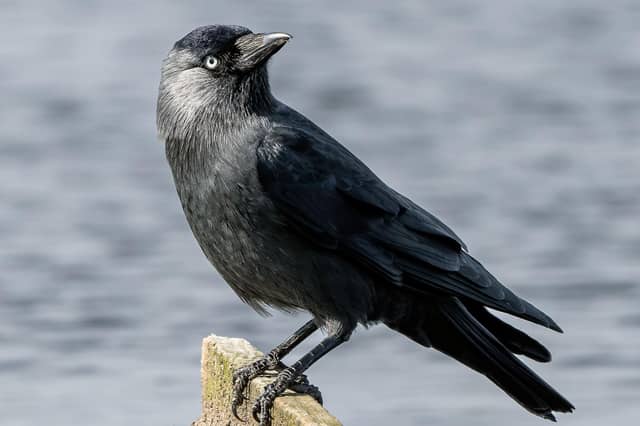

Jackdaws are one of the smaller members of the crow family but what they lack in size they make up for in personality!
Just after dawn this morning I noticed quite a few small groups of jackdaws heading west. They were being very noisy too and seemed to be enjoying the windy conditions that the tail end of storm Amy was still giving us. I counted 44 altogether in groups of between three and seven.
So how did I know the black birds were jackdaws? It’s quite easy and, despite most people's perception, you don't have to be an expert to tell crows, rooks and jackdaws apart.
Crows, rooks and jackdaws all belong to the same family, the Corvidae, which also includes magpies, jays, choughs and ravens. Here are some tips on telling them apart...
Rooks are the same size as crows and their plumage is also black. However, they have a patch of greyish bare skin near the base of their bill and their feathers hang more loosely on their underside, giving them a "baggy" appearance.
Rooks also have a more peaked head than crows. They are very social birds and nest in large colonies called rookeries. There is a large, active one at Worthington Lakes.
Crows appear to have a jet-black plumage with a bluey purple or blue gloss, the gloss greener on the wings and tail. The bill, legs and claws are all black and their eyes are a dark brown.
They are more solitary than rooks, but may roost in groups, so at dawn and dusk you might see large groups of either species.
British crows do not migrate. They are not so adversely affected by the winter cold since they can feed upon the bodies of those who have succumbed to the low temperatures.
They do prefer country where trees are plentiful and will nest in denser woods than the rook. The crow doesn’t favour bare mountainous land or treeless desert the way the raven does but is an adaptable creature and will nest on the ground if necessary, notably in the Shetlands. They will also nest in electricity pylons in country where there are no suitable trees.
Jackdaws are much smaller than crows and rooks - 33cm from head to tail - and have a more slender bill. From a distance their plumage looks dark, but, at close range, it is dark grey, with a lighter grey neck. Jackdaws also have grey-white eyes, while those of crows and rooks are black.
They mate for life and live colonially, being particularly fond of nesting in chimneys and derelict buildings. Their call is more of a "tchack" sound than the hoarse, croaking calls of crows and rooks.
Jackdaws are surface feeders and do not dig for worms in the way that rooks do. They like grassland insects, grain and wild plant seeds and larvae, although their eating habits are very adaptable to what is available, taking animal feed stuffs, carrion and other birds’ eggs also, and will also take ticks from sheep and cattle.
They are happy scavengers and enjoy hawking for flying ants. They are less inclined to store food than are other crows.