
Graham Workman column: Ghost Owl
Good news for a change!
Just finishing a survey the other evening I saw a ghostly white figure fly past the two barns and carry on over the fields and into the trees where I lost it completely. Thankfully, it wasn’t a ghost it was something more exciting it was a barn owl heading out to hunt the fields for small rodents. It really did appear quite ghostly with its white wings reflecting what little light was left in the evening sky. Thankfully barn owls seem to be making a comeback in the borough and from just hanging on we now have a small breeding population establishing.
The Barn Owl Report in May 2024, even though a year of unpredictable weather in 2023 saw increases of breeding Barn owls across the UK. Nesting occupancy increased by an impressive 22% on average, indicating a healthy resurgence for Barn Owls. While this increase wasn’t quite as dramatic as the 37% jump seen in 2022, it still points to a hopeful future for Barn owls.
Unfortunately, half of all barn owl deaths occur on roads – especially recently fledged owls. Farmers are being encouraged to provide owl 'windows' in new barns in an effort to encourage nesting by barn owls.
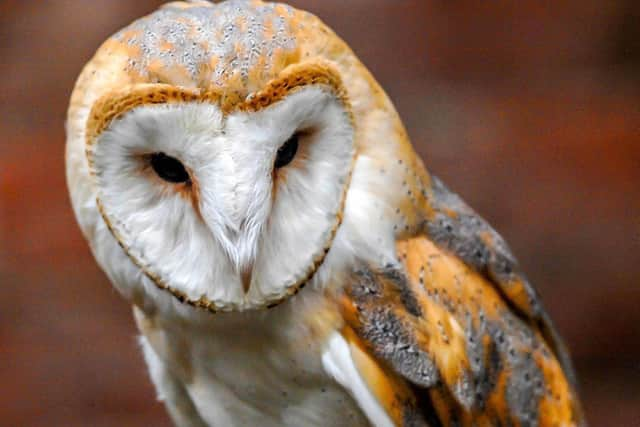

Often referred to as the “White Owl” or Ghost Owl, the barn owl’s plumage is white to the breast and a sort of golden buff flecked with grey and black to the its head and back.
The undersides of the wings are also mainly white with the males showing various amounts of black speckles. The barn owl’s distinct heart shaped face is also a distinguishing feature its eyes appear somewhat small and dark. The barn owl stands just over 30cm tall when perched and has a relatively large wingspan of about 3 feet. In flight it appears like a white ghost.
Barn owls, like all owls, have special feathers which allows it to fly silently. When out hunting, the typical method is to quarter the ground, flying back and forth at a height of about 3m. It will use available perches, such as fence posts, when hunting and can rotate its head through 180 degrees to give all round vision. It has very sensitive hearing and uses this to help locate prey.
Particularly, but not exclusively, during the breeding season, from late April to September, the owl screeches both to mark it territory and during courtship. It does not hoot. Barn owls are largely nocturnal except perhaps during the breeding season when, having dependent chicks they may extend their hunting into the early morning or afternoon.
The owl diet is predominantly small rodents such as voles, shrews and mice and therefore ideal habitat should be rough grassland or young open woodland. It has been calculated that suitable barn owl territories need to contain at least 48 ha of permanent pasture and rough grassland. Hedge and ditch margins and rough field corners also form valuable hunting grounds.
Unfortunately half of all barn owl deaths occur on roads – especially recently fledged owls. Farmers are being encouraged to provide owl 'windows' in new barns in an effort to encourage nesting by barn owls.