
Graham Workman column: Snow Bunting
He's back...........again!
Snow Bunting (Plectrophenax Nivalis)
I think this is the same Snow Bunting that takes up residence every winter along the strand line on the coast over at Southport. We managed to find him last year (winter 23/24) and he’s returned to the exact same spot this winter. The winter plumage makes both male and female look like the breeding female with inky black feathers turning a duller shade of greyish ginger brown. The bill also turns a yellowish orange. Yet even with the similarities, the male still exhibits a whiter wing. Throughout the winter, the dull plumage gradually wears away, revealing again the beautiful black and white feathers of a male snow bunting ready to mate. Globally, they breed around the arctic from Scandinavia to Alaska, Canada and Greenland and migrate south in winter.
I’m hoping this summer to get more photographs of the male in breeding plumage and if I’m lucky and there’s no chance whatsoever of disturbing the birds some photos of the nest. – Watch this space – later!
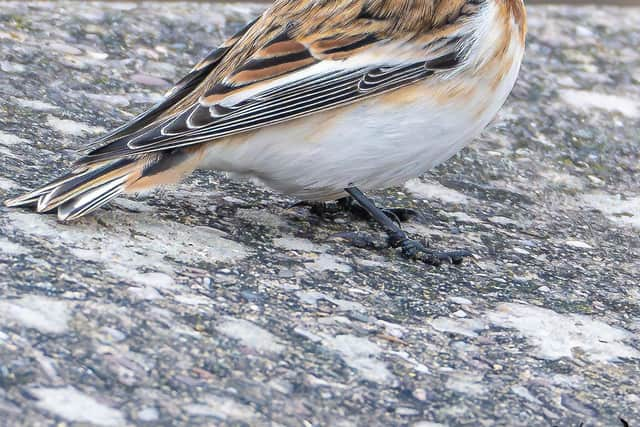

Snow buntings are generally considered to be monogamous. While this is true, there is absolutely crazy competition between the males. The older, more experienced males will return to the summer breeding grounds round about a month to six weeks before the females arrive. This is when they become very territorial and will aggressively defend It is during this time that they claim their territory and aggressively defend it. It is also it their ‘home’ against other less experienced males. It is thought that the males when they arrive back are more than likely return to the same territory year after year. Then when the females do eventually arrive, the male snow buntings attract them with their warbled song that many describe as finch-like. When a female approaches, the male dives and pursues her. The chase ends with mating.
The incubation period for snow buntings ranges from four to ten days and during this time the males keep the female who becomes ‘nestbound’ well fed until the eggs hatch. In the extreme cold, of the far north the eggs would not hatch if they did not have the mother's constant warmth. The nestling period of snow buntings usually lasts ten to fifteen days. During this time the parents feed their nestlings almost exclusively on insects. Since snow buntings are pretty social birds and travel in flocks it is assumed that the young birds join the parental flock after fledging.
They are a really rare breeding species in the UK, in Scotland, making them an Amber List species. They are more widespread in winter in the north and east when residents are joined by continental birds. They are listed under Schedule 1 of the Wildlife & Countryside Act, making it illegal to disturb them.
We did manage to see some in breeding plumage several years ago, high up in the Cairngorms just flitting about around the Cairngorm Café by the Ski lifts. We had gone up looking for Ptarmigan which we eventually found.