
Graham Workman: It's an Albatross!
Well it's nearly one - its a close relative.
Fulmar look just like a gull but it’s actually a close relative of albatrosses and it’s in a family called Tubenoses. It’s a ‘pelagic’ seabird only visiting land when it’s time to breed. This means it could be quite a while for its visit to dry land as it first breeds when it is between 6-12 years old and usually it returns to the nesting site where it first hatched. So obviously they have good memories!
The origin of their name is fabulous….it’s from the old Norse for foul gull (full = “foul” and mar = ”gull”), in reference to their resemblance to gulls and their habit of spitting a really stinky stomach oil at any predators. This oil has two purposes; when spat at predatory birds it will coat their feathers and inhibit their ability to fly (which can be fatal in seabirds), but it is also an energy rich food source that they can use on long flights or to feed to their young
I like to think of Fulmar’s as the Nomads of the northern oceans where they wander around gliding on the ocean winds. Their flight patterns are a real give away even from a good way off. They have bursts of stiff wing strokes with their wings being held straight as wooden planks and then into long glides which they have mastered so well. They dip into the troughs of waves when there are storms out at sea to suddenly pop up over the very crest of the wave still gliding beautifully!
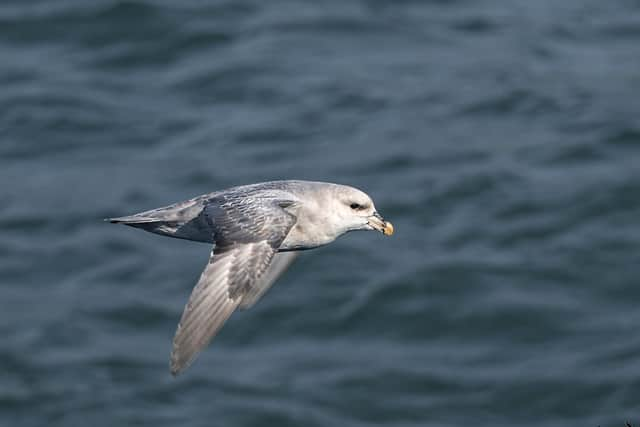

The fulmar’s head is pretty large and they have short, thick necks. The masterpiece of desalination is the bill which is relatively short with a colour palette of lead-grey and yellowish. When seen up close and personal the ‘tubes’ that give it the Tubenose its ‘family name can be seen to be quite a complicated appendage. The ‘tubes’ are actually naricorns and are a characteristic of a group of birds often called ‘tubenose seabirds’ which includes petrels and shearwaters. Part of this ‘bill’ is a salt gland that sits just above the nasal passage and this cleverly removes all the salt from their bodies. They ‘swallow’ a good amount of sea water when diving to depths of over 4 metres. This gland excretes a high saline solution from their nose. When they are expelling this it looks like the birds are having a wet sneeze!
Throughout the 1700 and 1800s they were hunted for food and for their stomach oil that was used as both medicine and fuel. On the remote St Kilda fulmars were the main food source and it was estimated that during the 1950s tover 12000 were caught and consumed each year – that’s over 100 birds per person for the island’s population Urghhh no thank you!. Since the 1800s when they only nested on a few Scottish islands, fulmars have gradually expanded their range and are now found all around the coast of the UK wherever there are suitable cliffs to provide nesting sites. There are now estimated to be around 500,000 nesting pairs all around the UK and 1.6-1.8 million fulmars spend winter in British coastal waters.
These photos I took on my recent Arctic Adventure, they are a different colour phase to the fulmar we get around the UK – these are called Blue Fulmar due to their darker plumage colours.