
Graham Workman: Little ringed Plover
What they lack in size they def make up with attitude!
The Little Ringed Plover Charadrius dubius.
Out birding at our Martin Mere WWT local wetland on Sunday we managed to find a couple of really interesting waders – a Little Ringed Plover and a Temmink’s Stint, both birds are pretty small. The little Ringed Plover is an attractive little bird and a relatively recent addition to our British Birds list. The first confirmed nesting was in 1938 and was in some gravel workings in central England – which became their preferred habitat and only slowly moved into other parts of the country, especially where river gravel or stoney ground is present with areas of wet mud which provides their invertebrate diet.
It's a summer visitor but usually an early migrant sometimes arriving in mid March. The immediate confirmation of it being a Little Ringed as opposed to its cousin the Ringed Plover is the very obvious yellow eye ring which really stands out even from a distance using binoculars or telescope.
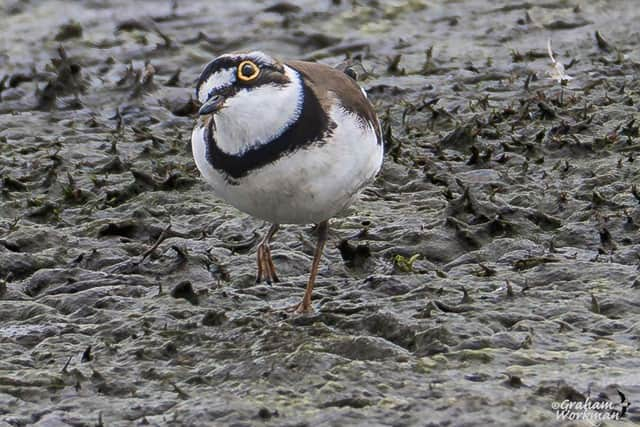

The Little Ringed Plover also much prefers inland sites with fresh water as opposed to the Ringed Plover which prefers coastal sites.
When I saw the small wader on the far side of the wetland, I had an idea it was a LRP (little ringed plover - birders abbreviation) and Marcus using the scope soon confirmed my suspicion’s. We watched it get chased around the wetland by a couple of Jackdaws and soon realised why. It was a female bird that had a nest with eggs. She did the broken wing display to the Jackdaws where she pretended to have a problem with her wing and unable to fly – it worked and the Jackdaws excitedly followed her thinking an easy meal was on the menu! It wasn’t and as soon as she’d lured them away she quickly flew leaving them bewildered as where their lunch had gone!
When it was all clear she returned and immediately sat on the scrape which was her nest and started incubating the eggs. Fingers crossed she manages to hatch the eggs but then the problems get worse with newly hatched chicks being present on the open aspect of the nesting site. Hopefully she’ll lead them away to areas of tall vegetation and relative safety!
The other tiny wader that Marcus managed to ID using the scope was a Temmink’s Stint, a pretty scarce passage migrant that had dropped into the wetland on its journey to the wet moorlands and Tundra of Eastern Siberia in Russia and Scandinavia. I was impressed that Marcus had found it and confidentially ID’d it straight away. To be honest they are an unobtrusive pretty drab looking very small birds somewhat due to the fact they are usually not in their full breeding finery when they appear early to mid May.
Birding on your doorstep can be just as exciting as dashing many miles north, east, west or south to look at some rare warbler and is much more ‘green’ and definitely less tiring!