
Wigan grandad's chance cancer diagnosis sparks charity crusade
A former Wigan soldier is planning to take on Africa’s highest peak for charity after a shock discovery about his health.
Grandad Billy Haggerty took a prostate cancer test after an ex-army colleague discovered he had the condition and advised his peers to get a precautionary screening.
The 64-year-old biscuit factory worker from Ashton, who had never had any serious health scares, took the advice but, instead of learning he was in the clear, he was sent for further tests which eventually concluded that he had stage two cancer.

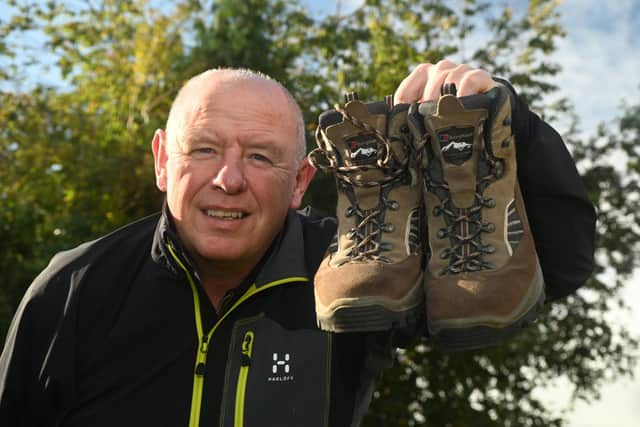

In gratitude for his good fortune that the growth had been discovered far earlier than it might have been – for Billy had no symptoms – he is now planning to raise money for Macmillan Cancer Care by scaling Mount Kilimanjaro in Tanzania.
A JustGiving page has been set up to which people can donate as he aims to raise £4,650, the total then being topped up with his own money.
It was only in August that Billy’s world was turned on its head.
The Scots-born father of three and grandfather of one, who has lived in Wigan with wife Pauline since 1987, said: “I had always thought I was pretty healthy and had never had any real scares.

"Then I was contacted by an old army friend from the 1980s who said he had gone for a routine prostate cancer test and discovered that he had got it. He was advising me and other ex-colleagues of a similar vintage all to be better safe than sorry.
"I had no symptoms either but I took him at his word and went to get what they call a PSA test from my GP. They said the results would be back within a week, but after only two days someone got in touch to say that they had found an anomaly and would I go for an MRI scan. That took place on the Sunday, only five days after I had the PSA. That too showed anomalies and it was suggested that there be a biopsy.
"That happened and a couple of weeks later I went to hospital, still expecting to be given the all-clear. But they told me that three out of 22 cells were cancerous and I had stage two prostate cancer.
"They were completely professional about it but, as you might expect, it came as a complete shock to me and I went home in a daze. One of the first things I did was message my friend thanking him for his advice.
"I can only imagine how much more advanced the cancer might have been before I exhibited symptoms.
"As it is they are going to keep the cancer under ‘active surveillance.’ Apparently you can have stage two and it never gets any worse, so there’s no need to treat it. As I had only just been diagnosed, there was no way of knowing how long I have had it. If it has grown by the next examination then we reassess our options. If it hasn’t, they keep monitoring it.”
In the meantime Billy will focus on his charity hike, even though it is a way off yet.
He said: “I planned to do it in a year’s time but then discovered October is the wettest time of the year over there so now it’s going to be in January 2026. It gives me more time to prepare physically and raise money and awareness though.
"I have done long walks – such as the Yorkshire Three Peaks – before, including some for charity, but this is something a lot bigger.
"I want to raise as much money as possible but also raise awareness of this illness.
"I have been very lucky because my friend advised me to go for a check-up when I didn’t think there was anything wrong with me. It just goes to show that if you take the initiative then you could spare yourself a whole lot of trouble.
"If I’d left this all for 18 months or more, there's a possibility that I might have needed quite invasive treatments such as surgery or radiotherapy.
"That could still happen, of course, but it’s good to know that it has been discovered early and that there are options.
“I would definitely be advising men in their 50s and 60s to be getting themselves checked out too. I am so glad I did.”
Billy, who is retiring next year, is planning to take on the walk on his own, although he will be with a group of other walkers from around the world who will be led up and down the volcano by expert guides.
One of the biggest dangers comes in doing the ascent too quickly because the human body can struggle to acclimatise to the lack of oxygen at high altitudes.
As far as his diagnosis is concerned, Billy says that he has been been “overwhelmed by the kind words of support and the very generous donations from everyone already. It's been very humbling.”
The prostate is a small, walnut-size gland under the bladder and behind the penis. It produces a thick fluid that mixes with sperm to make semen.
A PSA test checks the level of prostate specific antigen (PSA) in a patient’s blood. High levels may be a sign of a prostate condition, although not necessarily cancer.
Testing may be recommended if a man has symptoms that could indicate prostate cancer, such as:
Urinating more than usual, having a sudden urge to go to the toilet or getting up often in the night to pass water;
Blood in a man’s urine; or
Problems getting or keeping an erection.
But, as Billy and his friend both discovered, prostate cancer can develop without symptoms.
Routine PSA testing is not available on the NHS but men aged 50 and over can ask their GP for one, even if they don’t have symptoms.