
Wigan train stations to form part of Bee Network expansion plan
Train stations in Wigan will be part of a step-by-step plan to bring rail into the Bee Network by 2028.
Under the plan, the first two lines - connecting Manchester to Glossop and Stalybridge - will join by December 2026.
These will include Appley Bridge, Gathurst, Hag Fold, Hindley, Ince, Wigan North Western and Wigan Wallgate.
A further 32 stations and all lines within Greater Manchester would join by 2030, which will include Bryn, Orrell and Pemberton.
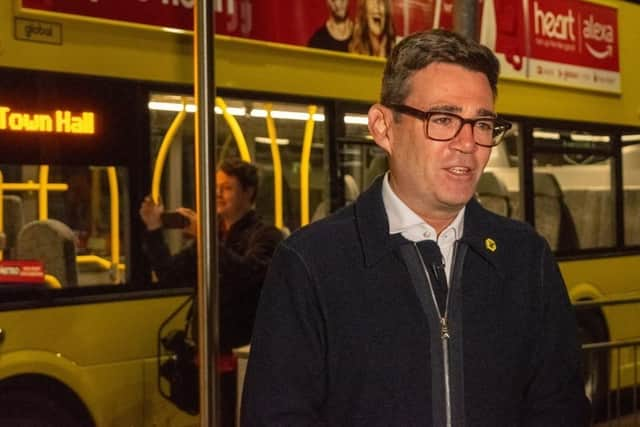

It is the next stage of mayor Andy Burnham’s vision for a joined-up ‘London-style’ public transport system in Greater Manchester.
Developed in partnership with the rail industry, it is aimed at not only improving transport and boosting passenger numbers but unlocking major regeneration and housing opportunities on land around the city-region’s stations.
Greater Manchester’s proposition is for eight commuter rail lines, covering 64 stations, to be brought into the Bee Network in three phases, delivering major improvements to the city-region’s train stations, services and passenger experience – including integrated capped fares across bus, tram and train.
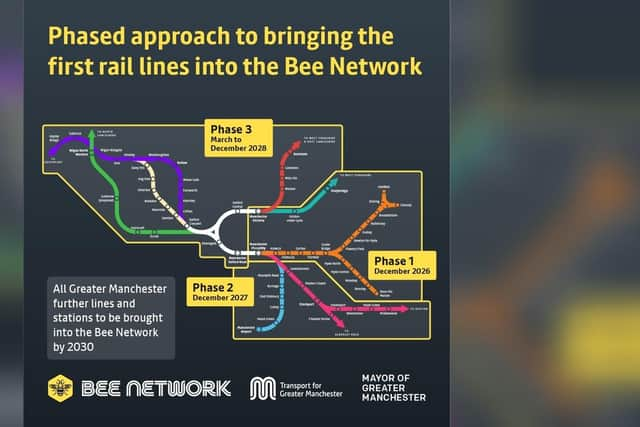
It is planned for Greater Manchester leaders to work closely with the Department for Transport, Network Rail, Shadow Great British Railways and Train Operating Companies to further develop and implement the three-phase plan as follows:
- Phase 1 [By December 2026]: Contactless tap in tap out ticketing across 17 stations on the first two lines between Manchester Victoria and Stalybridge, and Manchester Piccadilly and Glossop. Passengers will also see a trial of Bee Network branded trains, stations brought up to Bee Network standards, and flagship stations at Manchester Piccadilly and Stalybridge showcasing the integrated approach in action.
- Phase 2 [By December 2027]: Rollout of tap in tap out ticketing on a further two lines, including services connecting Manchester Piccadilly to Manchester Airport, Alderley Edge and Buxton via Stockport. The stations on these corridors will join the Bee Network, with a flagship station at Manchester Airport, creating an international travel hub as the gateway to the city-region.
- Phase 3 [By December 2028]: Services on the Rochdale, Wigan via Atherton (onward to Southport), Wigan via Bolton (onward to Southport) and Wigan via Golborne lines enter the Bee Network, with these stations being upgraded to the new standard.
The same approach will then be applied to the remaining Greater Manchester stations by 2030.
The approach is expected to boost the number of trips by train by 1.3 million each year, with more people choosing public transport and more services running later and at the weekend.
Doing so will foster more sustainable economic growth, ensuring residents in new homes have rail connections right on the doorstep, connecting them to even more opportunities.
By 2028, the plan for Bee Network rail integration is scheduled to deliver:
- Tap in, tap out ticketing: First, contactless tap in tap out ticketing will, working with government, be rolled out across commuter rail lines. Passengers will also get a more joined-up experience, with the ability to buy rail tickets through the Bee Network app and travel shops at stations becoming one-stop-shops for all tickets and information across bus, tram and train.
- Simpler fares across bus, tram and train: Greater Manchester’s aim is then to simplify the complex rail fare structure that can put people off travelling. This would be done by expanding the daily and weekly fare caps (already being introduced on Bee Network buses and trams this March) to include train travel. An example of this simplification is that those travelling from Glossop could tap in on the train and then use all buses or trams in Greater Manchester. Rather than worrying about having the right ticket - or buying individual tickets - the best fare would be calculated for them by TfGM. This would have a daily and a weekly cap, give passengers more flexibility and would be cheaper than buying separate tickets. Delivery of such fare capping across bus, tram and train will be subject to agreement with Government on the approach to national fare reform.
- Bee Network stations and trains: All 64 stations on the initial eight lines will be brought up to an exemplar Greater Manchester standard – including Bee Network branding, new safety and accessibility features, upgraded toilet and waiting facilities, and improved passenger information. A trial of Bee Network branded trains will also run in the first of three phases. A further 32 stations will be incorporated by 2030.
- New homes and regeneration around stations: The programme will put the city-region’s rail stations at the heart of connected communities, with underused land around stations identified for employment and regeneration opportunities. This will include a delivery plan to unlock an initial 750 new homes close to rail stations by 2028.
- Service improvements: Greater Manchester leaders will work with the Government and the rail industry to improve reliability and implement service changes to drive growth. Opportunities to optimise both freight and passenger journeys will also be explored - using opportunities such as Old Trafford – with the aim of moving more freight journeys outside the city centre.
- A step-change in making stations accessible for all passengers: Transport for Greater Manchester (TfGM) will work with the rail industry to accelerate delivery of accessibility improvements, with over 60% of stations on the eight lines to have step-free access by 2028, compared to 43% at the end of 2024. Work at Irlam and Daisy Hill stations is set to complete this year, with the Greater Manchester Combined Authority (GMCA) set to consider funding allocations for further priority stations at a meeting next week.
- New rail stations: Plans for a new train station in Golborne have also taken a major step forward, with Government approving the outline business case. The £32 million station will reconnect Golborne to the railway for the first time in more than 60 years. With the Department for Transport green light, TfGM, GMCA and Wigan Council can now develop a full business case and detailed design this year. Subject to approvals, work is expected begin in 2026 with the first trains hoped to stop there in 2027.
Mayor of Greater Manchester, Andy Burnham, said: “Our rail system today is acting as a brake on growth and, as the UK’s fastest growing city-region, Greater Manchester deserves better.
"We need a railway that is reliable and fully integrated with the rest of the Bee Network to drive growth and deliver new homes with public transport connections on the doorstep.
“Building on the success of bringing our buses back under local control, we’re planning a phased approach to bringing eight commuter lines and their stations into the Bee Network.
"It will start with lines between the city centre and Glossop and Stalybridge and then expand each year between now and 2028.
“Our plan puts passengers first by delivering a simplified, joined-up public transport network, with better services, stations and overall experience.
"Only by making travel by train more reliable, simpler, flexible and accessible to everyone, will we convince more people to leave the car at home and make the switch to the Bee Network.
“Delivering change on the railways is notoriously complex, but our phased plan has been drawn up with and has the backing of the rail industry.
"We’ll continue to work with government - as Great British Rail is established – to support them on the national reform of the railways, enacting the rail powers outlined in the English Devolution White Paper and supporting the Government’s agenda.”
The Mayor has committed to approaching the expansion of the Bee Network with the same rigour and pace applied to bus franchising, which made history when completed on time and on budget earlier this month.
Getting more people onto public transport will not only make rail services more financially sustainable – reducing the need for Government subsidies – but will play a major role in reaching net zero targets.
Integrating the eight rail lines alone is expected to take over 7 million cars off the road, saving around 700 tonnes of carbon.