
Why does it take so long to get spare parts for your car, and what can you do about it?

You ordered a car part three weeks ago, but it hasn't arrived yet? You're not alone. Two-thirds of people in the UK who receive parcels say they have had problems with their deliveries. The most common complaint is about delays.
But here's something most people don't realise: when you order car parts on the internet, your package might cross three countries, go through lots of warehouses and pass through customs checks after Brexit before it reaches you. And that's when everything goes right.
The truth is, delays in auto parts delivery aren't about one company being slow. This is just how the European auto parts market works.
But, unlike ordering a book from a UK warehouse, your brake pads or oil filter often start their journey in Germany, France, or Poland, travelling through a complex logistics network that's become even more complicated since Brexit.
If you understand why delays happen and what causes them, you can avoid getting frustrated and plan better when your car needs fixing.
Where your parts actually come from
When you buy an auto part from a website, you might think it will come from one place in the UK. The reality is more complicated.
Many of Europe's biggest online shops have warehouses in different places across France, Germany, Poland and Spain. Big companies like AUTODOC have their own warehouses in these important European places so that they can offer the biggest possible choice.
Why this matters: there is no warehouse that can stock every single part for every car model ever made.
For example, your 2015 Ford Focus might need a sensor that's in a warehouse in Poland, while the brake discs are in Germany. One order can involve getting things from lots of different places all over the world, and each part takes time to arrive.
How the bigger picture affects your delivery
Brexit has changed everything. Customs inspections and new trade documentation requirements mean delivery times are now longer. In the past, delivery times were simple, but now they can take days or even weeks.
A part that used to move freely between France and the UK now stops at customs, where paperwork gets checked and occasionally questioned. This causes delays in the delivery of car parts that are difficult for retailers and couriers to control.
Demand for these products changes with the seasons, making these problems worse. In the winter months, there are a lot more orders for batteries, wipers, and parts for maintaining your car in cold weather. Holidays put pressure on courier networks that are already busy. The same delivery route that takes four days in summer might take ten days in December.
There is currently a shortage of HGV drivers in the UK, so fewer vehicles are moving goods around the country. The speed of regional courier deliveries varies considerably. Some parts of London might get their deliveries quickly, but rural areas in Scotland or Wales might have to wait longer.
These problems are affecting all online deliveries in the UK.
According to industry reports, about two-thirds of UK parcel recipients have experienced delivery problems, with delays affecting about 27% of shipments. Auto parts delays simply reflect his wider issue in logistics.
The biggest problem nobody talks about
The truth is a bit uncomfortable: the biggest reason for delivery delays is not customs or couriers – it's ordering the wrong part in the first place.
When customers return items or order more, this can create problems that add weeks to the process.
Galina Stepanova, Head of Customer Feedback at AUTODOC, recently wrote about this problem on LinkedIn. She mentioned a report by Roland Berger that shows how often there are problems with business-to-business transactions (15-20%) and direct consumer sales (5-7%).
These numbers are not small. They show that hundreds of thousands of packages are going the wrong way.
Recent surveys of customers show this is true:
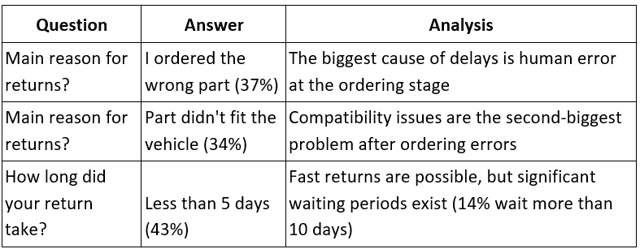
The most common reasons for returns and how long it takes to process them (Source: AUTODOC customer survey)
The numbers show the story: 37% of customers said they ordered the wrong part by mistake. Another 34% found the part didn't fit their vehicle.
These customer-side errors are the reason for more than 70% of all returns. Only 16% of people said they received the wrong item because of mistakes in the warehouse.
The real cost in time: the return process itself adds a lot of time. While 43% of customers report that returns take less than five days, 14% wait more than ten days.
Think about the whole process: you order a part, wait for it to be delivered, find out it's the wrong one, start the return process, wait for it to be processed, then order the right part and wait all over again. A process that should take one week can take three or four weeks.
What the industry is doing: the main focus of efforts to reduce these errors is on improving search accuracy and checking for compatibility. Better catalogues help customers find the right part for their vehicle.
Features like HSN/TSN code verification (vehicle identification numbers used in Europe) help customers check compatibility before purchasing. These improvements are the best things that the industry is doing to cut return rates.
What happens inside the warehouse
Even when customers order correctly, there are still delays because of internal logistics.
Problems in the supply chain: there are not enough raw materials, especially microchips for electronic components. This slows down production. If a factory stops making something or if there are faulty products, the promised stock doesn't arrive at warehouses when it should.
There was an error at the warehouse: workers pick, pack and ship thousands of items every day. Mistakes happen. The fact that 16% of returns are caused by customers receiving the wrong item is a warehouse error, not a customer ordering mistake.
The complexity factor: some of the delays are because of how complicated the car parts market is. If you need a rare part for an older vehicle, you might have to order it from the manufacturer, which could take weeks.
In some cases, parts that are no longer being made can be really hard to find. There are times when people have had to wait a year for a part, or even had to give up their vehicle because they couldn't find a certain mirror for an electric car.
Industry data suggests that around 45% of car manufacturers are worried about not having enough information about the parts that they are getting from their suppliers. This lack of visibility means that unexpected delays can happen in the system without anyone noticing.
What you can actually do about it
Understand the trade-off: different retailers use different logistics models. Amazon's business model involves huge warehouses in the UK with local stock, which means they can deliver quickly, but they have fewer products available.
Specialist companies like AUTODOC and Mister-Auto have much bigger catalogues. This is because they get their products from centres all over Europe. This means they may take longer to deliver, but you can always get the parts you need. Both models have their flaws. You just need to decide whether you need speed or selection.
Track actively: most shops give tracking numbers when they send items out. Check these regularly, especially for international deliveries, where packages are often held by customs. Different courier services have different performance records. Note which ones consistently perform well for your address.
The most important point: knowing about these industry realities won't make your parts arrive faster, but it does explain why delays happen. Post-Brexit customs procedures, seasonal demand, driver shortages and, most importantly, a high rate of ordering errors are all issues affecting every auto parts retailer in the UK.
Because of all this, major shops often offer incentives to make up for possible delays. For example, if you shop at autodoc.co.uk, you can get a 5% discount on orders over £100 if you use the code wiganATD. This offer is valid from 11 November 2025 to 15 January 2026.
If your order takes longer than expected, remember that you're not dealing with the incompetence of just one company. You're experiencing the reality of a global supply chain that has had to change to deal with life after Brexit. In this new situation, getting the right part to the right place is still very difficult.